
Let’s be honest: facing a sewer line replacement is stressful, and the last thing you need is a financial shock on top of it all. So, what should you expect to pay? Most homeowners will see a sewer line replacement cost somewhere between $3,000 and $7,500, with the national average sitting around $5,000.
Of course, that’s a pretty wide range. The final price tag really depends on the replacement method, the length of the pipe, and how easy (or difficult) it is for a crew to get to the line.
What Should You Expect to Pay for Sewer Line Replacement
Knowing the potential investment is the first step toward fixing your plumbing without any nasty surprises. It’s a lot like getting a car repair estimate—the final bill looks very different if you just need a simple part swapped out versus a complete engine overhaul. The same idea applies to your sewer line.
A simple, straightforward replacement in an open yard will always cost less than one where contractors have to dig through a concrete driveway or carefully work around your prize-winning rose bushes. The total length and depth of the pipe are also huge factors that drive the cost up or down.
Setting a Realistic Financial Baseline
To get a handle on a realistic budget, it helps to see how the costs usually break down. Industry data shows that the average cost for a sewer line replacement is around $3,319, with most projects falling somewhere in the $1,388 to $5,323 range. These numbers can fluctuate quite a bit based on things like whether a ton of digging or demolition is needed just to access the pipe.
A sewer line replacement isn’t just a repair; it’s a long-term investment in your property’s core infrastructure. Getting it right prevents future emergencies and protects your home’s value.
The table below gives you a clear idea of what you might pay, helping you frame your budget before you get too deep into the project details. Catching the problem early can also make a big difference, which is why we put together a guide on how to identify common sewer or water pipeline issues before they turn into full-blown emergencies.
Typical Sewer Line Replacement Cost Estimates
This table provides a summary of typical costs associated with sewer line replacement, showing low-end, average, and high-end estimates to help homeowners budget.
| Cost Tier | Estimated Price Range | Common Project Scope |
|---|---|---|
| Low End | $1,500 – $4,000 | A short, accessible pipe replacement (e.g., under a lawn) using modern PVC materials with minimal digging. |
| Average | $4,000 – $7,500 | A standard replacement of a 40-70 foot line, potentially involving trenchless methods or minor obstacle navigation. |
| High End | $7,500 – $20,000+ | A complex project involving a long pipe, deep burial, difficult access (under driveways/patios), or extensive restoration. |
Seeing these numbers can help you prepare for conversations with contractors and ensure you’re getting a fair estimate for the work required.
Key Variables That Drive Your Final Cost
When you see a price range for sewer line replacement that spans from a few thousand dollars to well over $15,000, it’s easy to get sticker shock. But there’s a good reason for that wide gap. The final cost all comes down to the unique details of your property and the specific challenges of your project.
Think of it this way: no two homes are identical, so no two sewer line jobs are the same. Understanding the factors that move the needle on price is the first step toward getting an accurate and fair quote from a contractor.
The Pipe’s Physical Characteristics
Let’s start with the basics—the pipe itself. The most straightforward cost drivers are its length and depth. A 100-foot replacement will naturally require more materials and labor hours than a 30-foot one. It’s simple math.
Depth is another major player. A shallow line buried just a few feet deep is relatively easy to get to. But a pipe that’s ten feet or more underground? That requires much more significant, careful, and time-consuming excavation.
Your project’s final cost is a direct reflection of its unique challenges. A straightforward replacement under a lawn is a molehill; one under a concrete patio with mature oak trees is a mountain.
The type of pipe material also affects the bottom line. Modern PVC is a durable and cost-effective standard, but other options exist. For instance, high-density polyethylene (HDPE) might be recommended for its flexibility in earthquake-prone areas, and it comes at a different price point. If your home is older, you’re likely replacing materials like cast iron or clay, which are heavier and more difficult to handle.
Site Access and Obstacles
Here’s where costs can really start to climb: accessibility. A sewer line running under a wide-open, grassy yard is the best-case scenario. It’s a straight shot for the crew and their equipment.
The game changes entirely when the line is buried under major obstacles. These add a ton of labor and restoration costs to the project.
- Concrete and Asphalt: A line under your driveway, a sidewalk, or a patio means that hardscaping must be demolished and then repaved once the new pipe is in.
- Landscaping: We have to work around (or through) mature trees, established garden beds, and sprinkler systems. This requires careful work to minimize damage and will involve restoration.
- Structures: Sometimes, decks, sheds, or retaining walls have been built right over the sewer line. These structures have to be deconstructed and then rebuilt.
Permits and Unforeseen Issues
Every city and county has its own rules for underground utility work, and that includes permits. These administrative fees are a necessary part of the job to ensure everything is done to code, and they’ll be factored into your total. For homeowners wanting to know more about local rules, a contractor specializing in pipe repair and replacement in Monterey can walk you through the specifics.
Finally, you have to account for the unknown. Once digging starts, crews might uncover issues that weren’t visible from the surface. They could find contaminated soil that requires special disposal, or discover other utility lines are tangled in the path. These kinds of surprises can complicate the job and add to the final sewer line replacement costs.
Comparing Trench and Trenchless Replacement Methods
When your sewer line gives up the ghost, you’re faced with a big decision. It’s not just about who you hire, but how they’ll tackle the job. The method you choose—whether it’s old-school digging or modern trenchless tech—will have a massive impact on your final bill and the state of your yard.
Think of it this way: traditional trenching is basically “open-heart surgery” for your property. A contractor shows up with an excavator and carves a long, deep trench all the way from your house to the street, laying the entire pipe bare. It gets the job done, but it’s incredibly invasive. Your lawn, garden beds, and driveway instantly become a full-blown construction zone.
The Modern Alternative: Trenchless Technology
Now, contrast that with trenchless methods like pipe bursting or Cured-in-Place Pipe (CIPP) lining. These are more like “laparoscopic surgery.” Instead of a huge, disruptive trench, your contractor just needs one or two small access pits at either end of the broken pipe. This minimal-impact approach is a lifesaver for your landscaping, patio, and other features you’d rather not destroy.
With pipe bursting, a brand-new pipe is pulled right through the old one. As it moves, it fractures the old, damaged pipe outward, laying the new line in its place. It’s a really effective way to get a completely new pipe into the ground without turning your property into a disaster zone. Getting a handle on these methods is important, and learning how to avoid costly mistakes in the trenching process really drives home why less invasive options have become so popular.
Breaking Down the True Cost
So, what’s cheaper? The answer isn’t as simple as you’d think.
On paper, trenchless methods can look more expensive. The specialized equipment and skilled technicians needed for something like pipe bursting mean the initial quote might be 10-30% higher than what you’d see for traditional digging.
But that first quote for trenching is just the tip of the iceberg. The real expense kicks in with the restoration costs—everything you have to pay for to put your property back together after the pipe is in the ground.
These “hidden” costs can easily pile on thousands to your final bill. You’re suddenly on the hook for:
- Re-sodding your entire lawn
- Replacing torn-up flower beds and shrubs
- Repairing or completely re-pouring a concrete driveway or walkway
- Rebuilding a deck or patio that had to be dismantled
Take a look at this breakdown. It shows how the total project costs stack up once you factor everything in.
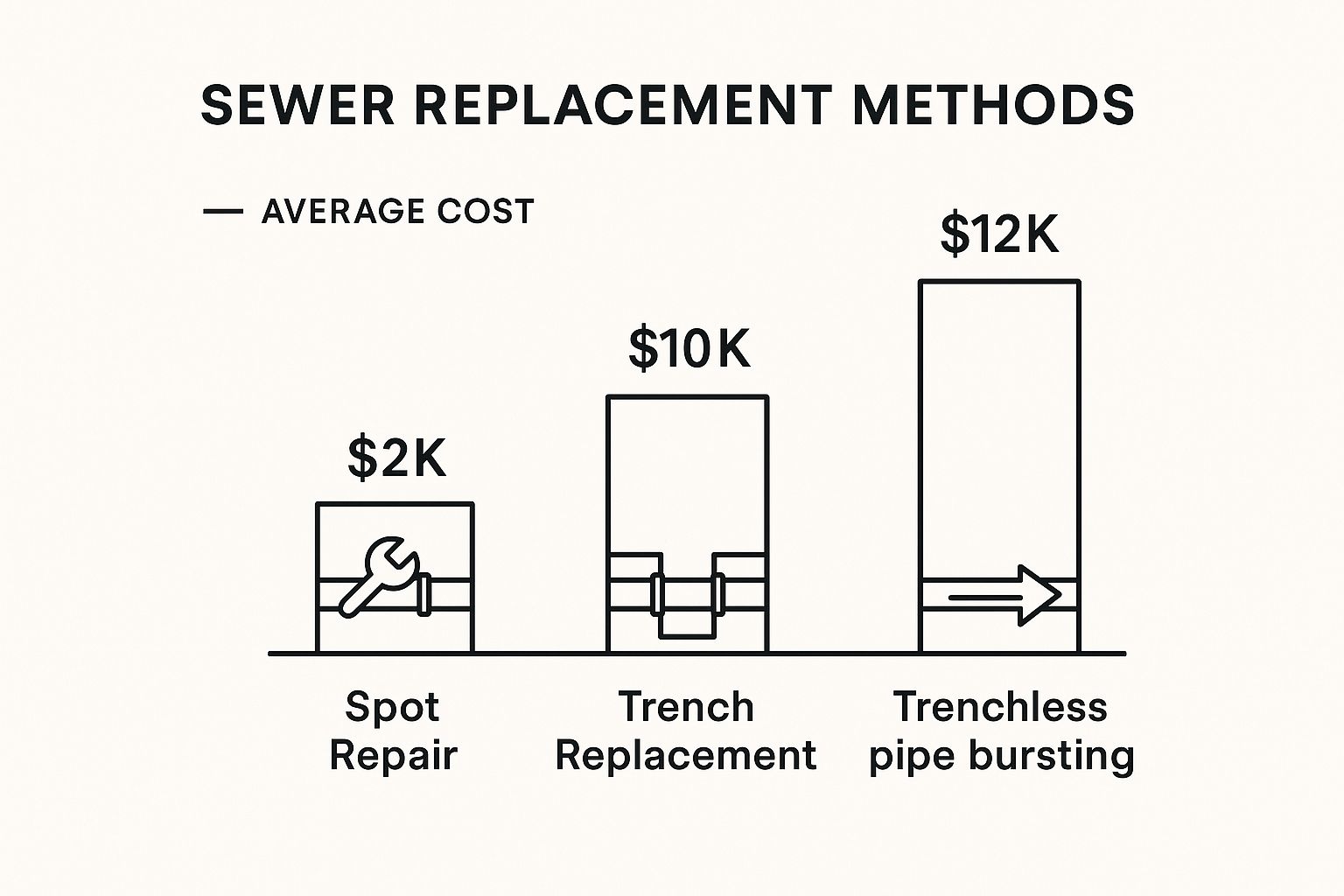
As you can see, that “pricier” trenchless option often ends up being the more economical choice in the long run. When you add up the thousands you’d spend on landscape and hardscape repairs after a traditional dig, trenchless technology frequently delivers better overall value—not to mention a much faster, cleaner, and less stressful experience.
Trench vs Trenchless Methods: A Head-to-Head Comparison
To make the decision clearer, let’s put the two main sewer replacement methods side-by-side. This table breaks down the key differences in cost, disruption, and when each method makes the most sense.
| Feature | Traditional Trenching (Open-Cut) | Trenchless Methods (Pipe Bursting/Lining) |
|---|---|---|
| Initial Cost | Lower upfront cost per foot for the pipe replacement itself. | Higher upfront cost per foot due to specialized equipment and labor. |
| Total Project Cost | High, once you add thousands in landscape and hardscape restoration. | Often lower overall, as restoration costs are minimal or non-existent. |
| Property Disruption | Extremely high. Destroys lawns, driveways, patios, and gardens. | Very low. Only requires one or two small access pits. |
| Project Timeline | Longer. Can take several days to a week due to excavation and restoration. | Much faster. Often completed in a single day. |
| Ideal Use Case | Open areas with no obstacles, or when the pipe has completely collapsed. | Preserving established landscaping, driveways, or working under structures. |
| Durability | Excellent. You get a brand-new, modern pipe. | Excellent. Results in a brand-new, seamless, and durable pipe. |
Ultimately, while traditional trenching has its place, the minimal disruption and predictable total cost of trenchless methods make them the superior choice for most homeowners. You save your yard, you save your sanity, and often, you even save money.
Why Proactive Maintenance Is More Important Than Ever
If you’re dealing with a sewer line problem, you’re not alone. Far from it. Across the country, pipes installed decades ago are quietly hitting their expiration dates, turning what was once out-of-sight-out-of-mind into a major headache for homeowners. This aging infrastructure is a big reason why sewer line replacement has become such a hot topic.
This isn’t just a feeling; the numbers back it up. The market for sewer line repairs was valued at $3.5 billion and is expected to swell to $5.2 billion by 2033. This growth shows just how common this issue has become. You can dig deeper into what this expanding market means for homeowners over on Verified Market Reports.
Shifting from Reaction to Prevention
Knowing this helps put your project in perspective. Instead of a sudden, surprise expense, think of it as a crucial investment in your home’s health and future value. A failed sewer line can cause a world of damage, but you have the power to get ahead of it.
Proactive maintenance is your best defense against a worst-case scenario. It’s like changing the oil in your car—a small, regular task to prevent the entire engine from seizing up. A sewer line camera inspection does the same thing, giving you a crystal-clear look at your pipe’s condition before a total failure.
A proactive camera inspection is your best defense against a middle-of-the-night emergency. It empowers you to address small issues before they escalate into a full system failure, saving you immense stress and expense.
How Market Trends Can Affect Your Project Price
The quote you get for a sewer line replacement isn’t just about the work on your property; it’s also a reflection of bigger economic forces. Think of it like trying to book a flight during a holiday weekend. When everyone wants to fly, the limited number of seats drives prices up. The same thing happens in the construction world.
When the housing market is booming and big infrastructure projects are kicking off, the demand for skilled plumbers and specialized equipment goes through the roof. Suddenly, qualified crews are in short supply. This means you might see higher prices for sewer line work and find yourself waiting longer to get on a contractor’s schedule.
Supply and Demand in Action
The materials for your new sewer line, like PVC or HDPE pipe, are commodities, too. Their prices can change based on things like manufacturing output, the availability of raw materials, and even global shipping costs. If there’s a construction boom, the high demand for these pipes can push their prices up, and that cost naturally gets passed on to you, the homeowner.
This isn’t a small-scale trend. The entire market for water and sewer line construction is seeing steady growth. Industry projections show the market is expected to jump from $219.93 billion to $225.86 billion in a single year, and it’s not slowing down. You can dig into more of this data over at The Business Research Company blog.
Understanding these market dynamics helps explain the ‘why’ behind the prices you see. Your project is part of a larger economic ecosystem, and being aware of these trends allows for better financial planning.
This is why planning ahead, when you can, is so important. Of course, you can’t schedule an emergency. But if you know a replacement is on the horizon, booking the job during a contractor’s slower season could lead to more competitive pricing. A local expert in trenching and backfilling services in Monterey County can give you a much better sense of the current market conditions and what their schedule looks like.
Actionable Tips to Manage and Reduce Your Costs
Knowing what drives the cost of a sewer line replacement is half the battle. The other half is taking control of the process to make sure you get quality work at a fair price. You wouldn’t buy the first car you see without doing a little homework, and the same thinking applies here.
With a few smart moves, you can avoid overpaying and feel confident in your choice.
Be Proactive and Get Multiple Bids
The single most powerful step you can take is to get at least three detailed quotes from licensed, insured, and reputable plumbing contractors. This isn’t just about comparing the final number; it’s about seeing how each company plans to tackle the job, what materials they’ll use, and how long it will take.
Be wary of any bid that seems way too low. It could be a red flag for cutting corners, using subpar materials, or hitting you with hidden fees later on.
A pre-work camera inspection isn’t an upsell; it’s your best tool for an accurate diagnosis. It ensures contractors are quoting for the real problem, preventing expensive surprises once digging begins.
A video camera inspection is key here. It gives every contractor the exact same diagnostic info, so you’re comparing apples to apples. This way, you avoid one plumber quoting a small spot repair while another quotes a full replacement, which makes your decision-making clear and simple.
Strategic Scheduling and Insurance Checks
If your sewer line problem isn’t a full-blown emergency, timing can work in your favor. Scheduling the job during a plumber’s slow season—often late fall or winter—can sometimes get you more competitive pricing when demand is lower.
And don’t overlook a huge potential source of savings: your homeowner’s insurance policy. It’s definitely worth pulling out your documents and making a call.
- Standard Policies: Most basic plans won’t cover damage from gradual wear and tear, like a slow-growing tree root that finally breaks a pipe.
- Sudden Damage: But if the damage was sudden and accidental—say, from unexpected ground shifting—you might have a strong case for a claim.
- Service Line Coverage: The magic words to ask your agent about are “service line coverage” or a “service line endorsement.” This is an inexpensive add-on that many people have. It’s designed specifically to cover repairs to utility lines running to your house and could literally save you thousands of dollars.
Still Have Questions About Sewer Line Replacement?
Even after breaking down the costs and methods, it’s natural to have a few more questions rattling around. Let’s tackle some of the most common ones we hear from homeowners so you can move forward with confidence.
Does Homeowners Insurance Cover Sewer Line Replacement?
This is a big one, and the answer isn’t always straightforward. Typically, your standard homeowner’s policy will not cover damage that happens over time—think gradual wear and tear, neglect, or the slow, inevitable crawl of tree roots.
However, there’s a key exception. If the damage was sudden and accidental, like if a construction crew accidentally strikes the line, you might have a claim. Your best bet is to check your policy for a “service line endorsement.” This is a relatively inexpensive add-on designed specifically to cover utility lines, and it could literally save you thousands of dollars. Before any work starts, a quick call to your agent to confirm your exact coverage is always a smart move.
What Are the Warning Signs of a Failing Sewer Line?
Your home has its own way of telling you that trouble is brewing underground. Catching these signals early can prevent a small headache from turning into a full-blown, expensive disaster.
Keep an eye out for these red flags:
- Multiple Slow Drains: If it’s not just one sink but your toilet, shower, and kitchen sink all draining slowly, the clog is likely in your main sewer line.
- Gurgling Toilets: Hearing strange gurgling sounds from the toilet, especially when you run the washing machine or shower? That’s often a sign of trapped air in a blocked line.
- Sewage Odors: This one is hard to miss. Unpleasant sewage smells inside or outside your home are a clear sign that waste isn’t flowing where it should be.
- Lush Patches of Grass: A patch of lawn over your sewer line that’s suddenly greener and more vibrant than the rest is a classic sign of a leak. Your broken pipe is fertilizing the grass.
If you spot any of these signs, don’t wait. A professional camera inspection is the only way to know for sure what’s happening and how serious the problem is.
How Long Will My New Sewer Line Last?
The lifespan of your new sewer line really comes down to the materials used. Think of this as a long-term investment in your home’s health, and thankfully, modern materials are built to last.
Modern PVC pipes, which are now the industry standard, can have a service life of over 100 years. They don’t rust and are incredibly resistant to root intrusion, making them a fantastic, worry-free solution.
Compare that to older materials. Clay pipes generally last 50-60 years, while cast iron pipes give you about 50-75 years before they start to rust and crack. By choosing a modern material, you’re installing a new line that will likely outlive your time in the home.
When you need a contractor who understands every part of underground utility work—from camera inspections to full-scale replacement and site restoration—turn to the experts. The team at Coastal Pipeline Inc. delivers professional, compliant, and transparent service for residential and municipal projects. Visit us at https://coastalpipelineinc.com to schedule your consultation.