
The real heart of the asphalt vs pavers debate comes down to a single question: Are you looking for immediate cost savings, or are you making a long-term investment in your property’s value and appearance?
Asphalt gets you a new surface quickly and for a lower upfront cost. Pavers, on the other hand, deliver unmatched durability, endless design possibilities, and incredible long-term value. Your choice really depends on what matters most to you right now versus years down the road.
Choosing Your Driveway Surface
When you’re planning a new driveway, walkway, or patio, the material you pick does more than just provide a surface. It defines your home’s curb appeal and sets the stage for future maintenance. While asphalt and interlocking pavers are the top two choices for homeowners, they cater to very different needs and priorities.
Getting a clear understanding of their unique trade-offs is the key to making a decision you’ll be happy with for decades. This guide moves beyond the basics to give you a side-by-side analysis, so you can choose with confidence.
Key Factors for Your Decision
Before we get into the details, think about which of these factors are most important for your project:
- Initial Budget: What’s your comfort level for the upfront installation cost?
- Long-Term Costs: Are you willing to pay more now to avoid frequent maintenance and repair bills later?
- Aesthetic Goals: Do you want a unique, high-end look, or is a clean, functional surface good enough?
- Durability and Climate: How will your new surface hold up to local weather, like heavy rain, freeze-thaw cycles, or intense sun?
It’s no surprise that asphalt is everywhere—it covers about 94% of paved roads globally, largely because it’s cheap to install and goes down fast. But here’s the trade-off: pavers can easily last 50 years or more with very little upkeep, while an asphalt driveway often needs to be resealed every few years to stay in good shape. You can find more details in this asphalt market report from polarismarketresearch.com.
For those of us here on California’s Central Coast, knowing how local conditions affect these materials is critical. You can learn more about what it takes to install and maintain a quality surface with professional asphalt paving and sealcoating in Monterey. With that context in mind, let’s break down the major differences.
Quick Look Asphalt vs Pavers at a Glance
For a high-level overview, this table cuts straight to the most important differences between asphalt and pavers. It’s a great starting point to see which material aligns better with your immediate needs and long-term goals.
| Attribute | Asphalt | Pavers |
|---|---|---|
| Upfront Cost | Lower ($3-$7 per sq. ft.) | Higher ($10-$25 per sq. ft.) |
| Lifespan | 15-20 years | 30-50+ years |
| Maintenance | Regular sealcoating (every 3-5 years) | Occasional cleaning, re-sanding |
| Repairs | Patching, can be noticeable | Easy to replace individual stones |
| Curb Appeal | Basic, uniform black surface | High-end, fully customizable |
As you can see, the choice isn’t just about cost. It’s about weighing immediate practicalities against a lifetime of performance and curb appeal.
The True Cost of Your Driveway: Upfront vs. Lifetime
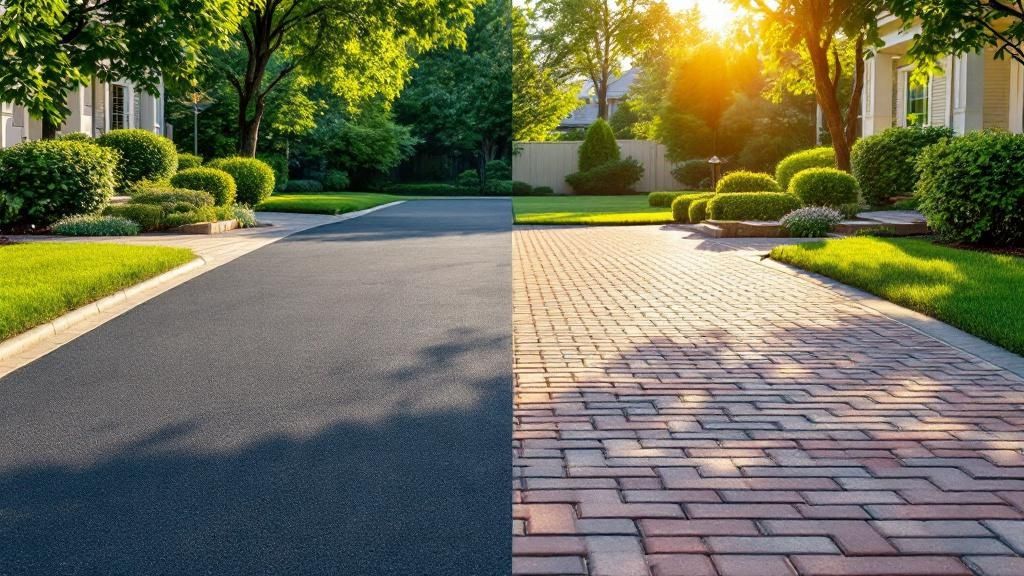
When you’re weighing the pros and cons of an asphalt vs. pavers driveway, it’s easy to get fixated on the initial price tag. But that’s a rookie mistake. While asphalt definitely wins on day one with a lower installation cost, the full financial story doesn’t unfold until you factor in years of maintenance, inevitable repairs, and eventual replacement. A genuine cost analysis means looking at the big picture over decades.
Asphalt’s main draw is its affordability. With installation costs typically running between $3 to $7 per square foot, it’s a very attractive option for homeowners on a tight budget or those who just need a functional surface without a long wait.
But that lower upfront cost comes with homework. To keep it from cracking, fading under UV rays, or suffering water damage, an asphalt driveway needs to be professionally sealcoated every three to five years. This isn’t optional—it’s essential maintenance if you want to get anywhere near its expected 15 to 20-year lifespan.
Long-Term Financial Planning
Pavers tell a completely different financial story. Right out of the gate, the installation is a bigger investment, often costing between $10 and $25 per square foot. That higher price covers the intensive labor required for proper site preparation, base compaction, and the meticulous work of laying each stone to create that perfect interlocking pattern.
Here’s the tradeoff, though: despite the higher initial spend, the long-term cost of owning pavers is surprisingly low. There’s no sealcoating needed. Maintenance is usually as simple as sweeping, an occasional power wash, and maybe topping off the joint sand every few years. And if a single paver cracks or gets stained by an oil leak? You just pop it out and replace it for a few bucks, keeping the entire surface looking pristine.
The most critical financial insight comes when you zoom out and look at the total cost over 25-30 years. The money you saved upfront on an asphalt driveway is often completely eaten up by repeated sealcoating and repair bills. Over that time, a paver driveway, with its minimal upkeep, frequently becomes the more economical choice.
The Breakeven Point Analysis
So, let’s crunch the numbers and see where these two paths really diverge. The “breakeven point” is that moment when the total amount you’ve spent on a paver driveway equals—and then becomes less than—the total you’ve poured into an asphalt one.
- Asphalt Driveway (25-Year Projection): This includes the initial installation, plus 5-8 rounds of sealcoating and likely crack-filling and patching. As the driveway ages, those repair costs can creep up unexpectedly.
- Paver Driveway (25-Year Projection): This is almost entirely the upfront installation cost. Your only other expenses will be minor, like cleaning supplies or a bag of joint sand every now and then.
This breakdown makes it clear. Asphalt gets you a win on the initial quote, but pavers almost always come out ahead over the long haul. Your decision really boils down to your financial priorities: do you want to save money now, or invest in a higher-value, lower-maintenance asset that will serve your property for years to come?
Comparing Durability in Your Climate
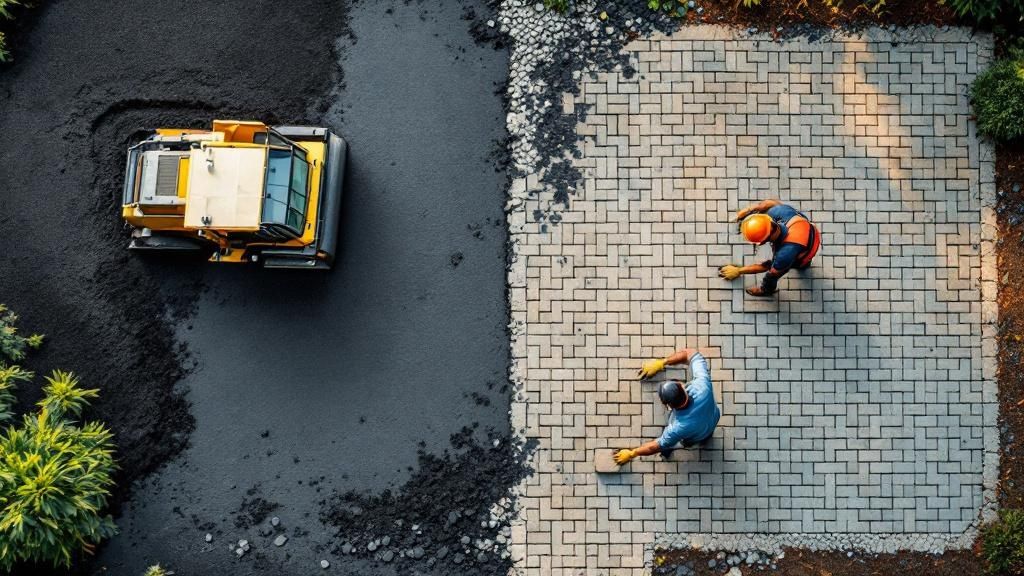
A driveway’s durability isn’t a simple, one-size-fits-all metric. It’s a direct response to your local climate. When you’re weighing asphalt vs pavers, you have to understand how each material stands up to environmental stress—things like intense sun, heavy rain, and ground movement. That’s the key to choosing a surface that will truly last for decades.
Asphalt’s defining trait is its flexibility. As a solid, continuous surface, it expands and contracts with temperature shifts, which sounds like an advantage. But this same quality also makes it vulnerable.
Performance in Hot and Cold Weather
In areas with intense summer heat, like many parts of California, asphalt can soften. This makes it susceptible to rutting, indentations from parked vehicles, and ugly tire scuffs. Over time, constant UV exposure also breaks down the binders in the asphalt, leaving you with a brittle, faded surface that’s far more likely to crack.
On the other hand, in regions with harsh freeze-thaw cycles, asphalt faces a different enemy. Water seeps into tiny cracks, freezes, expands, and forces the crack wider. This punishing cycle is what creates the spiderweb-like “alligator cracking” that eventually leads to potholes. You’ll find yourself dealing with frequent, and often noticeable, repairs.
Pavers, being individual interlocking units, handle weather in a completely different way. Their real strength is in their jointed design.
In the face of ground settlement or freeze-thaw heaving, a paver system can flex without cracking. The sand-filled joints between each paver absorb movement, preventing the widespread damage that plagues a rigid asphalt surface. This is why pavers are often a superior choice for long-term structural integrity.
Handling Water and Wear
While pavers are great at resisting cracks, they aren’t invincible. If the joints aren’t properly maintained, they can become a perfect spot for weeds to grow. Over time and under heavy traffic, individual pavers can also shift or sink, especially if the underlying base wasn’t perfectly prepared from the start. You can see how a professional installation process avoids these headaches by learning more about specialized https://coastalpipelineinc.com/asphalt-driveway-paving-services/.
It’s also interesting to see how material choices are driven by large-scale needs. The global demand for asphalt is huge, fueled by massive infrastructure projects, especially in the Asia-Pacific region. Rapid road development in countries like China—which adds thousands of kilometers of expressways every year—requires enormous investments in asphalt paving just to keep up with economic growth. You can discover more insights on the global asphalt market from maximizemarketresearch.com.
Ultimately, when you evaluate asphalt vs pavers for durability, think about the most common challenges in your specific area. Asphalt’s uniform surface is prone to cracking and potholes from weather extremes. Pavers, in contrast, offer a resilient, flexible system where any damage is usually isolated and much easier to fix.
The Installation Process From Start To Finish
When you’re weighing asphalt vs pavers, the installation process is a huge factor. It’s not just about how long it takes; it’s about the labor, the machinery, and the level of disruption to your property. Both materials demand a professional touch to get lasting results, but the journey from bare ground to a finished driveway couldn’t be more different.
Asphalt installation is all about speed and heavy machinery. The whole process is usually wrapped up in just a couple of days, weather permitting. This quick turnaround is a major selling point for anyone who needs their driveway back in action fast.
On the other hand, installing pavers is a true craft. It’s a methodical, hands-on job where precision is everything. The longer timeline is a direct result of the detailed work needed to create a strong, interlocking surface that’s built to last for decades.
Asphalt Installation: A Quick Rundown
The asphalt paving process moves fast, which is why it’s a go-to choice for people on a tight schedule. Here’s a look at what happens:
- Excavation and Grading: First, the crew clears out old material and soil to the right depth. Then, they grade the area to make sure water drains away properly.
- Sub-Base Preparation: A solid foundation is key. A layer of gravel aggregate is laid down and compacted with heavy rollers.
- Binder and Surface Layers: A coarse binder layer of asphalt goes down first for strength, followed by a smoother topcoat for a clean finish.
- Compaction: Heavy rollers press the hot asphalt mix, compacting it into a dense, non-porous surface.
- Curing: The final step is waiting. The new asphalt needs 24-72 hours to cure before you can walk on it, and usually a bit longer before it’s ready for vehicles.
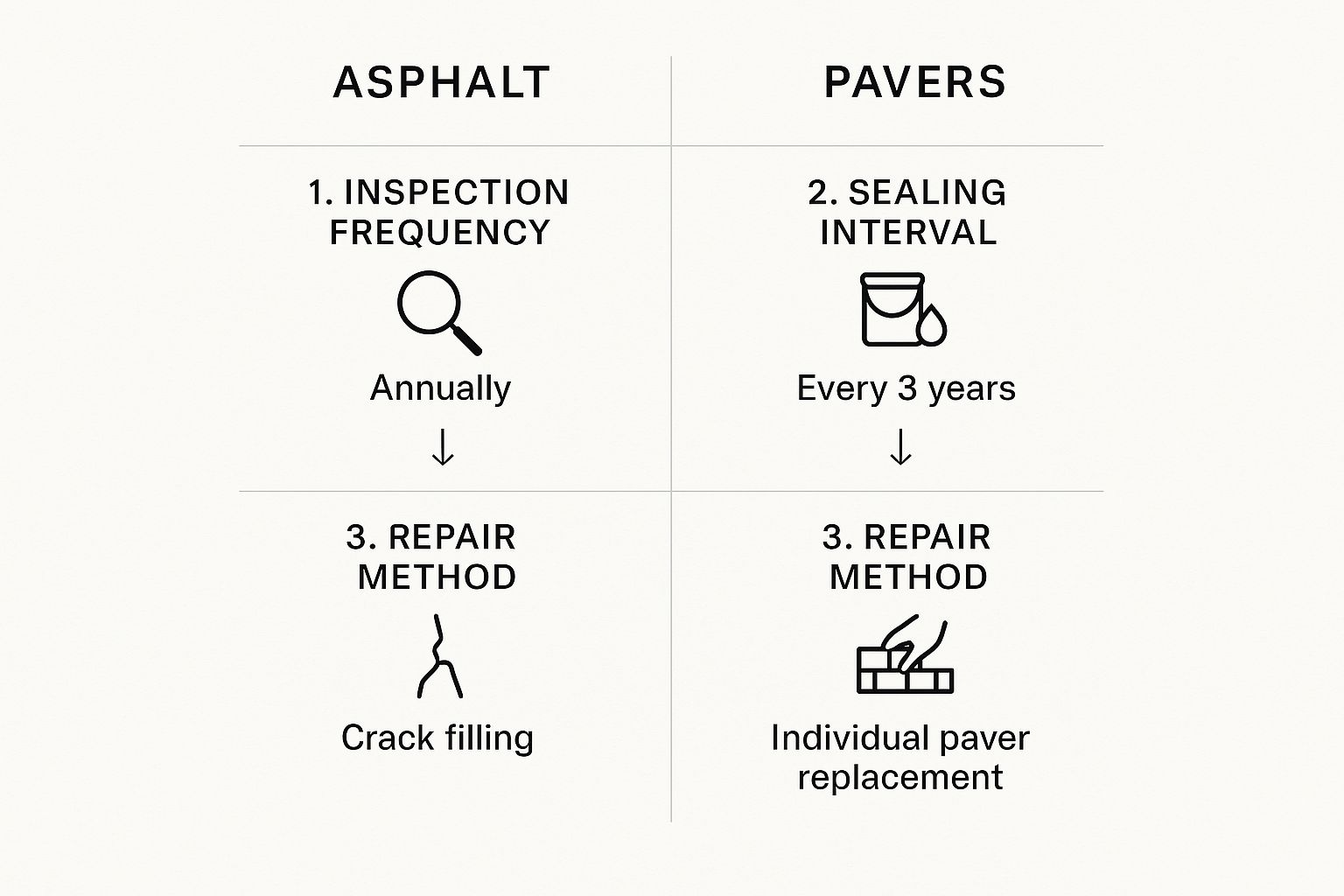
As you can see, the long-term commitment differs quite a bit. Asphalt requires more routine maintenance like sealing, whereas pavers allow you to fix specific problem spots without redoing the whole surface.
Paver Installation: A Methodical Approach
A paver project is a much more hands-on affair, requiring meticulous work from start to finish.
- Deep Excavation: The crew has to dig deeper to make room for a more complex, multi-layered base.
- Base and Sand Layers: A compacted aggregate base is installed first, followed by a layer of bedding sand that must be perfectly leveled.
- Paver Laying: This is where the artistry comes in. Each paver is carefully placed by hand to create the desired pattern.
- Joint Sanding and Compaction: Polymeric sand is swept into the joints and then activated with water, which hardens and locks all the pavers tightly together.
The real difference lies in the skill set. Asphalt paving relies heavily on experienced heavy equipment operators. Paver installation, however, demands skilled masons who can guarantee every stone is perfectly aligned and interlocked for maximum durability.
The table below breaks down what a typical project timeline looks like for both materials, giving you a clearer picture of the installation commitment.
Typical Project Timeline: Asphalt vs Pavers
| Installation Phase | Asphalt Timeline | Paver Timeline |
|---|---|---|
| Excavation & Base Prep | 1 day | 1-2 days |
| Material Installation | <1 day | 2-4 days |
| Compaction & Finishing | <1 day | <1 day |
| Curing / Ready for Use | 1-3 days | Immediately |
| Total Project Duration | 2-4 days | 4-7 days |
Ultimately, asphalt gets you a usable surface much faster, while pavers require more patience upfront for a hand-laid finish.
No matter which material you choose, it’s vital to know if your existing surface just needs a touch-up or a full overhaul. Our guide on driveway paving or crack repair can help you figure out the best path forward before you commit to a brand-new installation.
Your Guide to Maintenance and Repairs
How you care for your driveway is going to have a direct say in its lifespan and curb appeal. The long-term maintenance needs of asphalt and pavers are worlds apart, which will influence both your budget and your free time for years to come. This is a massive piece of the asphalt vs pavers puzzle.
Keeping Asphalt in Top Shape
Asphalt demands a proactive, cyclical approach to maintenance to keep its surface protected. The single most important task is sealcoating, something you’ll need to do every three to five years. This process puts down a protective liquid layer that acts as a shield against UV rays, water damage, and oil spills—all things that break down the asphalt binder and cause it to crack prematurely.
If you skip the sealcoat, small cracks are bound to show up. You have to fill these quickly to stop water from getting into the sub-base, where it can freeze, expand, and create potholes. For larger damaged spots, the work gets more intensive. You can get a better idea of what’s involved by looking into professional asphalt patching and repair in Monterey and Santa Cruz County.
The Simplicity of Paver Upkeep
On the other hand, pavers offer a much simpler, less demanding maintenance routine. For the most part, you’re just looking at routine sweeping and an occasional pressure wash to get rid of dirt and grime.
The most common real “task” is re-sanding the joints every few years. The sand between pavers can wash out over time, so topping it off with polymeric sand helps lock everything back together and keeps weeds from growing through.
The real game-changer in maintenance is how each material handles repairs. Asphalt repairs almost always leave visible patches that don’t quite match the original surface. Paver repairs? They’re practically invisible. If a paver cracks, sinks, or gets stained, you just lift it out and pop in a new one. The driveway looks good as new.
This incredible ease of repair is a huge long-term advantage. It makes paver surfaces forgiving and ensures they can be kept in pristine condition for decades with very little fuss. While the machinery and materials for asphalt are in high demand—the global market for asphalt pavers hit $2.42 billion in 2024 with a 3.8% growth rate—the sheer simplicity of paver repair often wins out for residential projects. You can discover more insights about this growing market on futuremarketinsights.com.
Making the Final Call: Asphalt or Pavers?
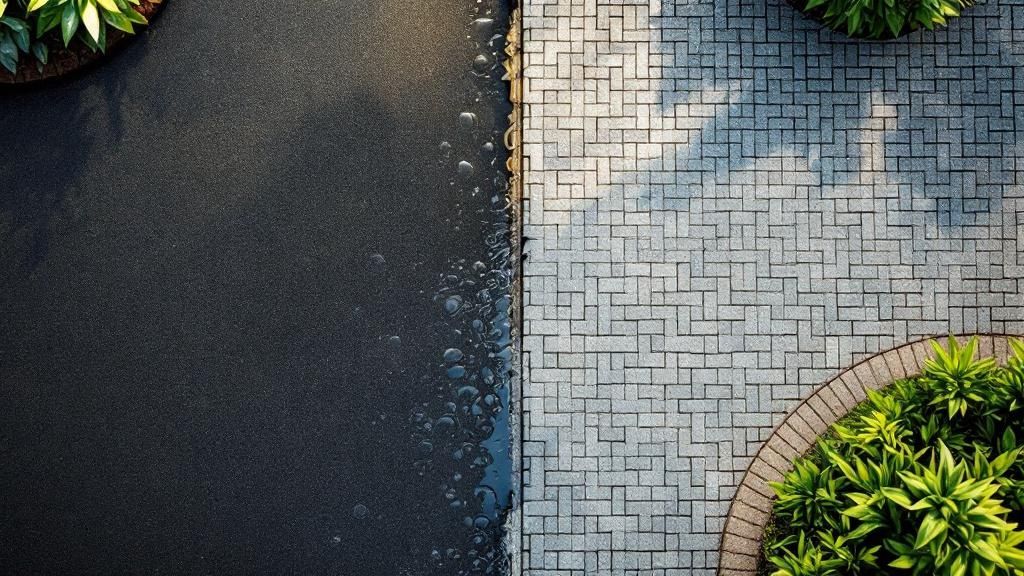
When it comes down to it, the choice between asphalt and pavers isn’t about which one is flat-out “better.” It’s about which one is right for you. The final decision in the asphalt vs pavers debate really hinges on what you value most—your budget, your aesthetic goals, and how much time you’re willing to spend on upkeep down the road.
Let’s walk through a few common scenarios. By seeing which one you identify with, you can make a choice you’ll be happy with for years to come.
For the Budget-Conscious Homeowner
If your number one priority is getting a new driveway installed quickly without a hefty upfront investment, asphalt is the clear choice. With installation costs typically running between $3 and $7 per square foot, it’s a far more accessible option than pavers. This makes it perfect for homeowners who need a solid, functional surface right now and understand it will require some regular care.
Choosing asphalt does mean committing to a maintenance plan. To get the most out of your investment, you’ll need to stay on top of upkeep. Learning about professional asphalt sealcoating in Monterey and Santa Cruz County is a smart first step, as it will protect your new surface and extend its life.
For the Curb Appeal Maximizer
For homeowners who view their driveway as a key part of their home’s overall design, pavers are the undeniable winner. The design potential is nearly endless. You have a massive selection of colors, shapes, and patterns to create a truly custom look that perfectly complements your home’s architecture and style.
Pavers elevate a property’s look in a way that plain black asphalt just can’t compete with. This investment in curb appeal often translates directly into higher resale value, making it an excellent move if you’re focused on boosting your home’s visual impact and marketability.
For the Long-Term Value Investor
If your main goal is to install a surface that will last for decades with minimal fuss and future costs, pavers offer superior long-term value. Yes, the initial cost is higher, but their incredible durability of 30-50+ years and low maintenance needs often make them the more economical choice over the long haul.
The real advantage is in the repairs. If a paver gets damaged, you can simply lift it out and replace it—a simple, seamless fix. This avoids the cycle of patching, crack-filling, and eventual resurfacing that comes with asphalt. For anyone who wants to “set it and forget it,” pavers deliver true peace of mind and a surface built to stand the test of time.
Frequently Asked Questions
When you’re weighing the pros and cons of asphalt versus pavers, a few specific questions always seem to pop up. Getting these details ironed out is often the final step before you can feel confident in your choice.
Can You Install Pavers Over an Old Asphalt Driveway?
It’s a common question, and while the technical answer is yes, it comes with a major catch. You can only lay pavers over an existing asphalt surface if that base is in excellent condition—no major “alligator” cracks, no heaving, and perfectly stable.
Honestly, though, most experienced professionals will tell you to avoid it. The best practice is to remove the old asphalt entirely and build a fresh, properly compacted base. Trying to install pavers over a failing surface is like building a house on a shaky foundation. It’s only a matter of time before they start shifting and sinking, which will wipe out any money you thought you saved upfront.
How Do Pavers and Asphalt Affect My Home’s Resale Value?
When it comes to boosting your home’s resale value, pavers are the clear winner. Their high-end appearance, limitless design flexibility, and association with custom landscaping dramatically improve curb appeal.
A thoughtfully designed paver driveway isn’t just a functional surface—potential buyers see it as a permanent, valuable upgrade.
A new asphalt driveway is certainly better than a cracked, old one, but it just doesn’t deliver that same “wow” factor or add the perceived value that interlocking pavers do.
Which Surface Is Safer in Wet or Icy Conditions?
Safety is a huge factor, and pavers generally provide better traction than asphalt.
The joints between pavers and their naturally textured surfaces create more grip, which helps reduce the risk of slips and falls in wet or icy weather. Asphalt is a smooth, non-porous surface that can get incredibly slick when it’s wet or has a thin layer of ice. While asphalt’s dark color might help melt snow a little faster in the sun, the superior texture of pavers gives them a more reliable safety advantage in slippery conditions.
At Coastal Pipeline Inc., we specialize in the expert installation and site preparation required for durable, high-performance paving projects. Whether you’re considering asphalt or pavers, our team ensures the job is done right from the ground up. Find out more about our professional paving services.