When people hear “construction technology,” they often think of office software, like scheduling tools or client updates. While those are helpful, the real changes in underground utility work are not happening on a computer screen. They are happening out in the field.
The technology that truly makes projects faster, safer, and more exact is the kind you can see on the job site.
How Field Technology Is Redefining Utility Work
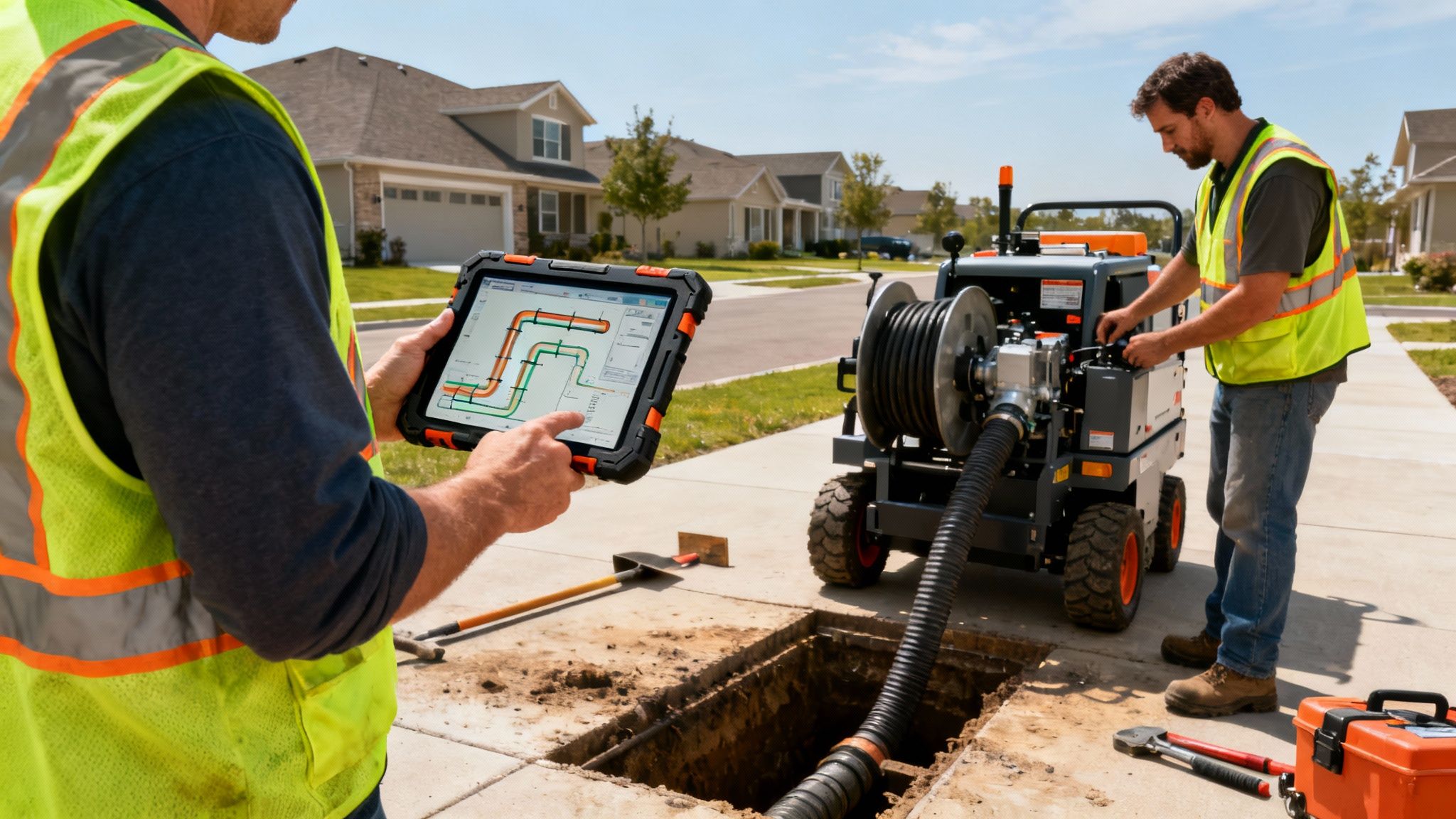
The biggest shift in our industry is happening on the ground. Digital tools for client updates are a good start. But today’s clients want to know how technology is being used to make infrastructure work better. They want to know how we are making projects faster, safer, and more precise. This is the part most contractors overlook.
Today’s clients are smart. They want to know how we use modern tools to build better infrastructure. They care about accuracy, safety, and causing as little disruption as possible to their property and community. That’s why the conversation should be about the equipment that does the actual work, not just office software.
The Real-World Impact of On-Site Tools
It’s easy for competitors to talk about their scheduling software. But they are missing the bigger picture. They leave out the tools that are changing the quality of the work itself. These tools impact timelines, accuracy, and costs in ways that customers should understand.
Here’s a look at the technologies that matter on-site:
- Trenchless Replacement Equipment: This is a big deal. It lets us replace underground pipes without digging long, messy trenches. This is great for saving lawns, gardens, and expensive pavement.
- Video Sewer Inspections: We use high-definition cameras to go inside pipes and find problems with perfect accuracy. This means we find the exact issue without guessing or needless digging.
- GPS-Grade Control Systems: Imagine guiding a digging machine with precision down to the centimeter. That’s what these systems do. They prevent expensive mistakes and lower the risk of hitting existing utility lines.
- GIS-Based Utility Mapping: Before we dig, our crews use digital maps of all known underground pipes and cables. It’s like having x-ray vision to see what’s buried below.
These tools are not just for show; they help us work smarter. A Q4 2025 report found that 42% of contractors now use AI or tech tools to streamline work. Coastal Pipeline isn’t just following that trend. We’re applying it where it delivers the most value: in trench safety, sewer diagnostics, and utility tie-ins. That’s what modern infrastructure clients care about.
Field tech leads to faster jobs, fewer mistakes, and safer sites. Technology like video diagnostics and drone-assisted planning allows for better decision-making before a trench is dug, reducing permitting delays and protecting existing infrastructure.
Comparing Field Tech vs Office Tech in Utility Projects
To make it clear, here’s a quick look at how on-site technology offers direct benefits compared to office software.
| Technology Type | Primary Function | Direct Impact on Your Project |
|---|---|---|
| Field Technology | Hands-on work, diagnostics, precision digging | Reduces digging, prevents utility strikes, improves accuracy, shortens timelines |
| Office Technology | Project management, communication, scheduling | Organizes office tasks, provides client updates, makes billing easier |
While both are useful, the tools used on the ground have a much bigger and more immediate effect on the quality and speed of the final work.
Where Technology Delivers Real Value
The main goal is to prevent problems before they start. When we use video diagnostics or advanced mapping, we can create a much more detailed and accurate plan. This planning greatly reduces the chances of running into surprise conflicts with existing utilities—a common cause of delays and extra costs.
For our team at Coastal Pipeline, this isn’t just an idea; it’s how we work every day. We integrate NASSCO-certified inspection tech, modern pipe bursting systems, and GPS-enabled trenching to prevent strikes, delays, and rework. Our PG&E OQ-certified crews use these systems to meet exact project details, deliver cleaner tie-ins, and minimize surface disruption. This is critical for our city, business, and residential clients.
This commitment to using and mastering field technology is what makes a good contractor great. From GIS mapping to trenchless repair, having the right tools—and the certified experts to use them—makes all the difference.
If you’re a property owner or developer in Monterey, Santa Cruz, or San Benito County, choosing a contractor who invests in this kind of technology is the best way to make sure your project is done right the first time.
Seeing Beneath the Surface with Modern Mapping Tools
Before we start digging for an underground utility project, the most important work has already begun: finding out exactly what’s down there. Not long ago, this meant looking at old paper maps and making a lot of guesses. Today, we have tools that give us a clear, data-backed picture of what is underground. This has completely changed how we plan and carry out projects.
This early work is where we first see how technology is transforming underground utility projects—long before any digging starts. These advanced tools don’t just help us see; they replace risky guesses with solid facts. This creates a foundation for a project that is safe, on time, and on budget by avoiding nasty surprises.
Creating a Digital X-Ray of the Job Site
One of the most powerful tools we use is Ground-Penetrating Radar (GPR). Think of GPR like an ultrasound for the earth. The system sends harmless radio waves into the ground. By reading the signals that bounce back, our technicians can build very detailed 3D maps of pipes, cables, and other buried objects.
It’s a process that doesn’t disturb the ground at all and is key to preventing utility strikes. Instead of digging and hoping not to hit a water main or a major fiber optic line, crews know the exact location and depth of everything around them. This first mapping step has become so important that in North America, over 80% of major construction projects now use underground mapping during the planning stage. It’s simply the right way to do things.
Inspecting Pipes from the Inside Out
Once we know where the existing lines are, we need to know their condition. For that, we use video sewer inspection cameras. These are tough, high-definition, remote-controlled cameras made to travel deep into sewer lines and storm drains.
It’s like a doctor using a tiny camera to see inside a patient without surgery. That’s what this tech does for our underground pipes. It lets our NASSCO-certified technicians find problems with clear proof, such as:
- Cracks and fractures that could cause leaks or pollute the soil.
- Root intrusions that are blocking flow and causing backups.
- Pipe collapses or shifts that are emergencies waiting to happen.
This video footage gives us a clear record of a pipe’s health. It saves us from a lot of disruptive digging and lets us fix problems with surgical precision. To get a better handle on all the pieces that make up these hidden networks, you can dive deeper into our guide explaining underground utilities.
By combining GPR mapping with video diagnostics, we create a complete, three-dimensional understanding of the job site. This digital model replaces guesswork with real-world data, allowing for smarter planning, more accurate bids, and far fewer unexpected problems during construction.
The Power of GIS in Modern Utility Work
All of this valuable data—the GPR scans, the video footage, the property records—is brought together into a Geographic Information System (GIS). At its heart, GIS is a smart mapping tool that lets us layer all these different types of information onto a single, interactive map.
The result is a complete digital blueprint of the entire project area. With this, project managers can map out the safest, most efficient route for new utility lines, easily coordinate with other agencies, and make sure we’re following all the rules. This careful planning sets the stage for a smooth, fast, and precise project, saving our clients time, money, and a lot of headaches.
Minimizing Disruption with Trenchless Technology
The days of digging long, messy trenches across lawns, driveways, and parking lots are ending. A big change is happening in underground utility work, thanks to methods we call trenchless technology. This isn’t just a small improvement; it’s a completely different way of thinking about working underground.
Instead of causing a huge mess, trenchless methods let contractors repair or replace underground pipes with very little digging. For anyone who owns property—whether it’s a busy shopping center, a quiet neighborhood, or an area with sensitive nature—this is a real game-changer. It totally changes the impact of a utility project.
What Is Trenchless Technology
At its core, trenchless technology is about working underground without having to dig up the entire length of a pipe.
Let’s say you need to replace a 100-foot sewer line that runs under a beautiful garden and a new driveway. The old way? A long, deep trench that destroys everything in its path. Trenchless methods, on the other hand, usually only need two small access holes—one where the pipe starts and one where it ends.
This approach saves landscaping, pavement, and other valuable surface features, which saves a lot of time and money on repairs. It turns a major construction project into a much smaller, surgical procedure.
Of course, this kind of precision requires careful planning. It relies on accurately mapping what’s already underground before any work begins, as you can see in the flow below.
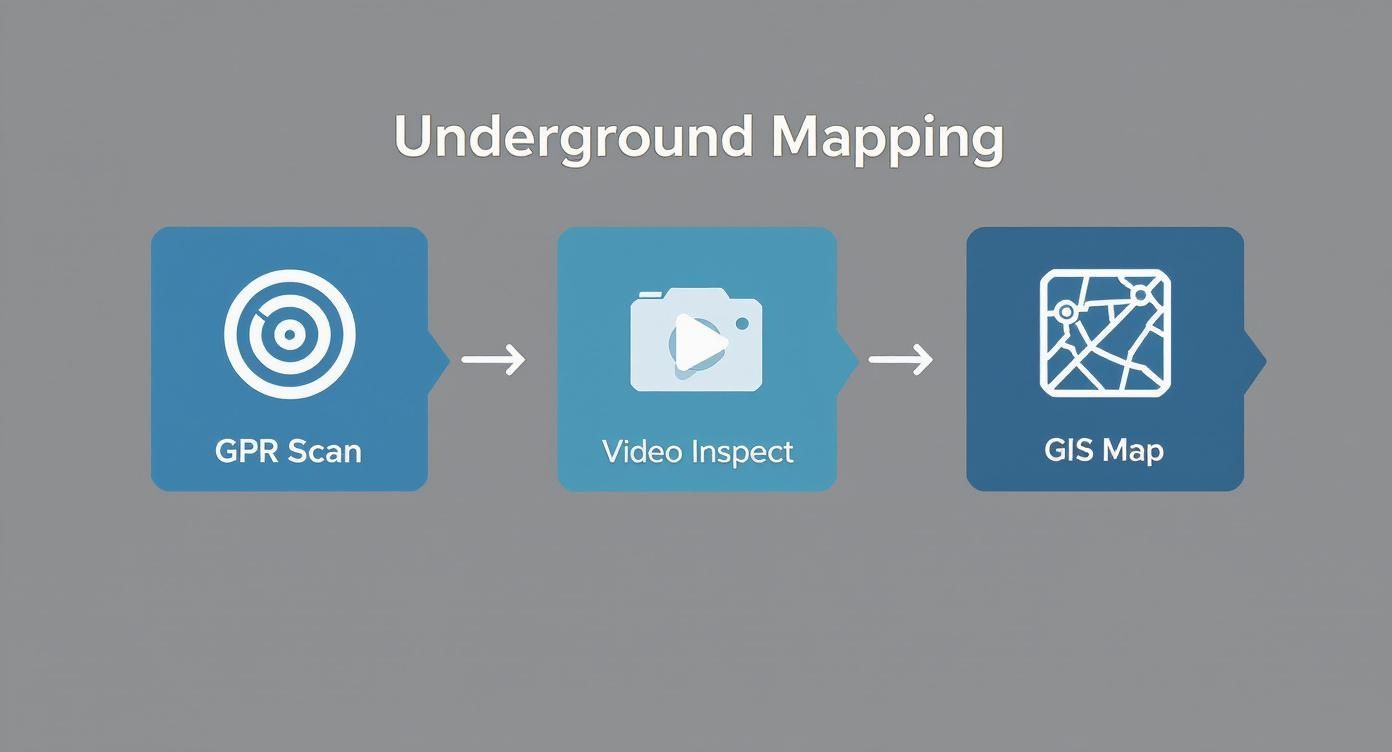
This step-by-step approach of scanning, inspecting, and mapping is what allows trenchless work to be done with perfect accuracy, avoiding costly damage to other buried utilities.
Key Trenchless Methods Explained
While there are several techniques, two of the most common and effective are pipe bursting and horizontal directional drilling. They each do something different but have the same goal: to keep surface disruption as small as possible.
Pipe Bursting
This method is perfect for replacing an old, failing pipe with a new one of the same or even larger size. Think of it like pulling a new pipe through the old one, breaking the old one from the inside.
Here’s how it works:
- Access Points: Crews dig small pits at both ends of the old pipe.
- Bursting Head: A cone-shaped “bursting head” is attached to the new pipe and put into one end of the old line.
- Replacement: A powerful system pulls the bursting head and the new pipe through the existing line. The old pipe breaks and is pushed aside into the soil as the new, seamless pipe takes its place.
The result is a brand-new, stronger pipe installed without digging up the entire line. It’s a great technique for sewer and water line replacements in developed areas. To see the financial benefits, it’s worth comparing the trenchless sewer line repair cost with old methods, which always come with big restoration bills.
Horizontal Directional Drilling (HDD)
HDD is used to install new pipes where none existed before, especially when you need to go under things like roads, rivers, or buildings.
Instead of digging down, HDD drills sideways. A small pilot hole is drilled along a carefully planned underground path, guided by advanced tracking systems. Once the drill head reaches the other side, the new pipe is attached and pulled back through the new tunnel.
This technique is essential for adding new utility lines in busy cities without tearing up streets or damaging existing buildings.
The Clear Advantages for Property Owners
For any client—city, business, or homeowner—the benefits of going trenchless are clear and immediate. By making the project’s physical footprint smaller, these techniques deliver value that goes beyond just the pipe itself.
The biggest wins include:
- Lower Restoration Costs: Less digging means less money spent fixing lawns, sidewalks, driveways, and parking lots. It’s that simple.
- Faster Project Completion: When you skip most of the digging and refilling, jobs get done much faster.
- Minimal Disruption to Daily Life: Businesses can stay open. Neighborhoods can continue as normal without the constant noise, dust, and traffic problems.
- Increased Safety: Fewer open trenches mean a safer work site for crews and the public.
In the end, trenchless technology gets important infrastructure work done quickly and cleanly, while protecting the value and use of the property above ground.
How GPS Brings Unprecedented Precision and Safety to the Job Site
When you’re working underground, a few inches can be the difference between a perfect installation and a costly disaster. Guesswork is no longer good enough. That’s why GPS-grade control systems are not a luxury—they’re a key part of modern digging, turning what was once a manual skill into a science based on data.
This isn’t the same GPS that’s in your car. We’re talking about advanced systems that use satellite signals and on-site base stations to achieve centimeter-level accuracy. This technology guides heavy machinery with a level of precision that was once impossible.
What Does GPS Grade Control Look Like in Action?
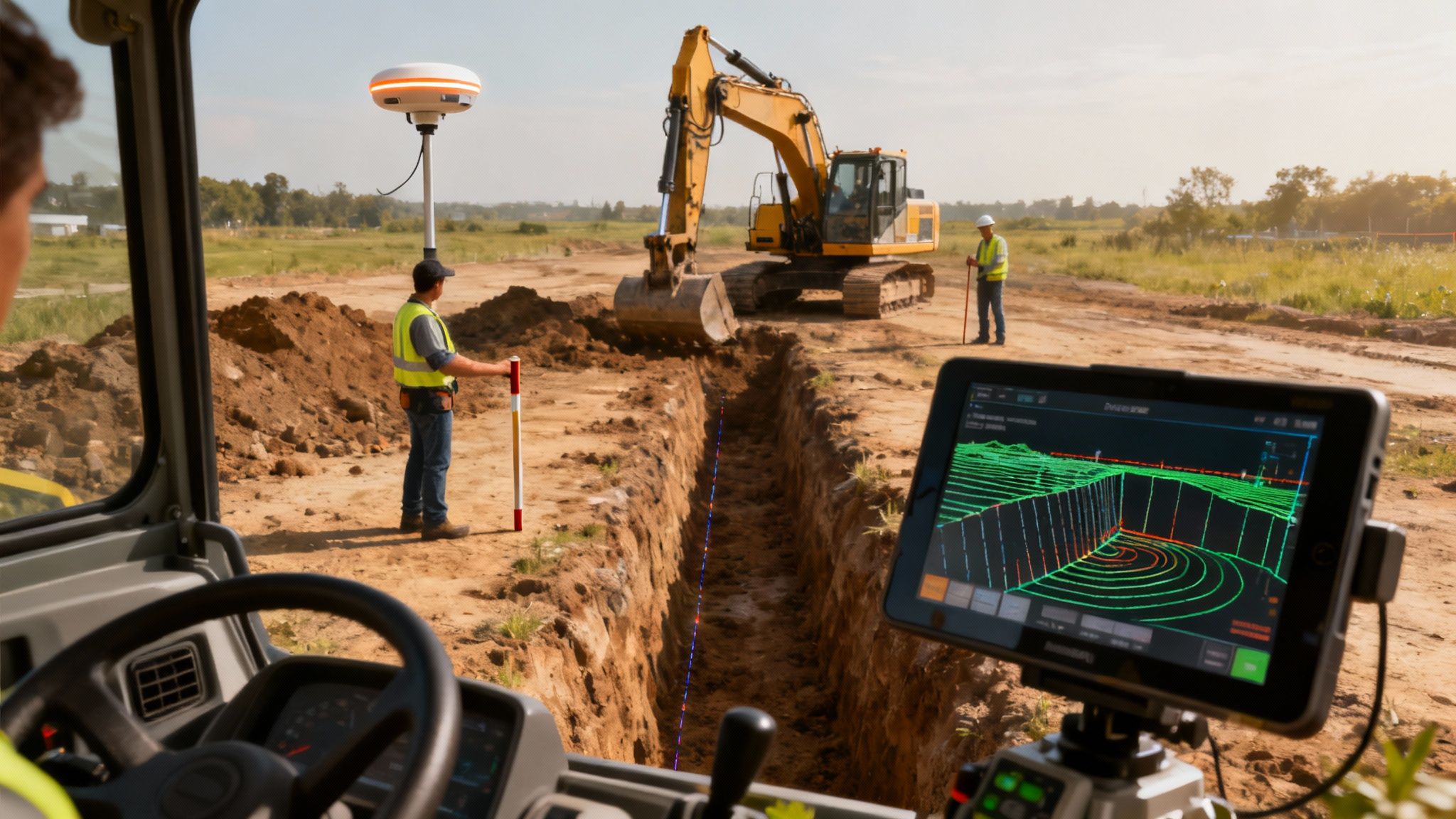
Imagine an excavator operator who knows the exact position of their bucket’s teeth at all times. That’s what grade control does. The project’s engineering plans, with the exact depth, slope, and location for a new pipe, are loaded right into the machine’s computer.
Inside the cab, the operator sees a live 3D model of the site on a screen. It shows them exactly how much deeper they need to go to get the perfect slope. This digital feedback gets rid of the human error that leads to digging too deep or not deep enough, saving a lot of time and material.
No more stopping the machine every few minutes for a crew member to check the depth with a measuring stick. The operator can now work without stopping and with total confidence, knowing the finished trench will perfectly match the plans.
A Quantum Leap in Job Site Safety
While the speed is impressive, the most important benefit of GPS-guided equipment is the huge improvement in safety. A big part of how technology is transforming underground utility projects is its power to prevent the most dangerous accidents before they happen.
When existing utility maps are loaded into the system, the operator sees a digital “fence” around known gas lines, fiber optic cables, and water mains. The system can even flash alerts if the bucket gets too close to a marked utility, providing a critical last line of defense against an accidental strike.
Digging with such accuracy also means crews avoid disturbing nearby pipes and cables. This isn’t just about preventing service outages; it’s about protecting workers and the public from the terrible results of hitting a high-pressure gas line. For a deeper look into this important topic, check out our guide on essential construction site safety tips.
The Big Picture: Field technology is all about creating faster jobs, fewer mistakes, and safer sites. Tools like GPS-grade control enable smarter decisions on the ground, helping to reduce permitting delays, avoid utility conflicts, and minimize unnecessary digging—which saves everyone time and money.
The Real-World Impact on Budgets and Quality
This precision directly affects the project’s bottom line and the long-term quality of the new infrastructure. It adds value in several real ways:
- No More Rework: If you dig a trench to the wrong depth, you have to fix it. That means wasted fuel, wasted labor, and wasted time. GPS gets it right the first time, every time.
- Lower Material Costs: Digging too deep means you’re buying more backfill material—like sand or gravel—than you needed. GPS ensures you use only what the plan calls for.
- Guaranteed Performance: For systems like sewer lines that rely on gravity, the pipe’s slope is everything. A tiny error can lead to big flow problems years later. GPS-guided installation guarantees the system will work exactly as designed.
At the end of the day, using GPS-grade control is about taking full responsibility for every inch of the project. It shows a commitment not just to getting the job done, but to getting it done to the highest standards of accuracy, safety, and quality.
Using Data and AI to Prevent Problems
Modern field technology does more than just guide equipment—it also gathers a huge amount of data. The best contractors know this information is a goldmine for working smarter. By looking at data from video inspections, GPS mapping, and other tools right on the job site, crews can spot potential trouble long before it becomes an expensive problem that stops the project.
This move toward using data is what’s really changing the game in underground utility work. We’re moving from reacting to problems to preventing them. Instead of just fixing problems as they happen, we can now get ahead of them. This ability to predict issues makes our work smoother, helps us follow complex rules, and leads to a much more reliable final product.
Turning Raw Data Into Actionable Insights
Think about hours of video from a sewer inspection. A person can easily see big cracks and blockages, but what about the small signs of wear that could lead to a failure in the future? This is where Artificial Intelligence (AI) can really help.
AI programs can be trained to scan this video, finding the early stages of pipe decay, rust, or joint problems that a person might miss. This lets us make small fixes before they turn into a major emergency, like a big leak. By catching these issues early, our team can help you with our expert leak detection and repair services.
The Growing Role of Smart Tools in Construction
This shift toward data-driven work isn’t just a small trend; it’s quickly becoming the new industry standard. The entire construction world is using digital tools to work more efficiently and make job sites safer.
For a client, this means your project is managed not just with experience, but with the forward-thinking that modern data provides. You get better results and infrastructure that’s built to last.
Recent industry reports show that 42% of contractors now use AI or tech tools to manage their work more effectively. At Coastal Pipeline, we’re not just following the trend—we’re putting these tools to work where they matter most: in trench safety, sewer diagnostics, and critical utility tie-ins.
This data-first approach brings real benefits that directly impact your project’s bottom line.
How On-Site Technology Delivers Real Value
The table below shows the real benefits different field technologies bring to your underground utility project.
| Technology | Primary Benefit | How It Saves You Time and Money |
|---|---|---|
| GPS & GIS Mapping | Pinpoint Accuracy | Eliminates guesswork and costly rework by ensuring every dig is in the right place. |
| Drone Surveys | Rapid Site Assessment | Provides a complete site overview in hours, not days, speeding up planning. |
| AI Video Analysis | Predictive Maintenance | Catches tiny defects before they become major breaks, avoiding emergency repair costs. |
| IoT Sensors | Real-Time Monitoring | Alerts crews to soil shifts or pressure changes, preventing accidents and downtime. |
Ultimately, it’s about using every piece of information to build smarter, safer, and more durable infrastructure from the ground up.
Finding a Contractor Who Uses the Right Technology
It’s one thing to know how new tools are changing underground utility work, but it’s another thing to find a contractor who actually uses them. When you hear a company talk about “tech,” they often just mean scheduling software or a client website—things that help run the office, not the job site.
The real difference-maker is a contractor who invests in the equipment that makes the work faster, safer, and more precise. You have to ask the right questions. Does their team use trenchless methods like pipe bursting to keep surface disruption small? Are their crews NASSCO-certified for modern inspection techniques? Do they use GPS-grade control for digging? These aren’t just buzzwords; they show a real commitment to quality and safety.
Beyond the Basics: What to Look For
A truly modern contractor doesn’t just own the latest tools; they’ve built their entire work process around them. When a company invests in field technology, it’s a clear sign they’re serious about preventing expensive mistakes, meeting exact project details, and delivering clean, long-lasting results. This is especially important for city, business, and home projects where there’s no room for error or delays.
When you’re checking out a potential contractor, look for these things:
- Certification and Training: Look for credentials like PG&E OQ certification or technicians who are NASSCO PACP-certified. This is proof that their team isn’t just using the tools, but has been professionally trained to use them correctly.
- A Focus on Field Solutions: Their website and past projects should be full of examples of on-the-ground tech—think video inspection, GIS mapping, and trenchless systems, not just office software.
- Integrated Services: A contractor who can handle everything from precise digging to the final paving has a much deeper understanding of the entire project. This complete approach is almost always backed by better technology and coordination.
Choosing the right partner goes beyond just comparing prices. For a deeper look at the selection process, check out our guide on how to hire subcontractors who will meet your project’s standards.
Choosing a partner like Coastal Pipeline, whose investment in field technology shows a commitment to quality, ensures your project benefits from the latest advancements. It guarantees a smarter, safer, and more durable result from the start.
At the end of the day, the goal is simple: get the work done right the first time. The best way to protect your investment and make sure your infrastructure is built to last is to choose a contractor who has already adopted modern, field-level technology.
Want a smarter, safer underground utility contractor? From GIS mapping to trenchless repair, Coastal Pipeline brings the right tools and certified expertise to every job. If you’re in Monterey, Santa Cruz, or San Benito County, contact us to see how modern infrastructure work is done right.
Frequently Asked Questions
Is This New Technology Going to Drive Up My Project Costs?
That’s a fair question. When you hear about things like GPS-guided excavators or advanced trenchless systems, it’s easy to think they will be more expensive. But here’s what we see all the time: while the equipment might be a bigger investment for the contractor, it almost always brings the total project cost down for the client.
Think about it. These tools reduce labor hours, cut down on wasted materials, and nearly eliminate expensive redos. For example, preventing a single accidental utility strike can save tens of thousands of dollars in emergency repairs and fines. That one incident alone more than pays for the cost of the tech used to avoid it.
How Can I Tell if a Contractor Actually Uses Modern Tech?
When you’re checking a contractor, don’t just ask if they “use technology.” That’s too general. You need to ask more specific questions about how they use it in the field where it really counts.
Here are a few sharp questions to ask:
- Do you use trenchless methods like pipe bursting to avoid tearing up my property?
- Are your crews who inspect pipes NASSCO-certified to accurately diagnose issues on video?
- Do you rely on GPS-grade control to make sure every trench is dug precisely and safely?
Their answers will tell you everything you need to know. You’ll quickly find out if they’re just using software in the office or if they have the modern tools on site to deliver higher quality work.
The bottom line is this: the right technology in the field means faster jobs, fewer mistakes, and safer work sites. It cuts through permitting delays and stops unnecessary digging, which saves everyone time and money while keeping our infrastructure intact.
Are Trenchless Methods Really Better for Homes?
For homeowners, trenchless technology is almost always the best choice. The old way—digging a long, open trench—can completely destroy a yard, driveway, or sidewalk. This leaves you with a huge and expensive repair bill.
Methods like pipe bursting, on the other hand, let crews replace an entire sewer or water line using just a couple of small holes. Your property is left almost completely untouched. It’s simply a faster, cleaner, and more budget-friendly approach in the long run.
Looking for an underground utility contractor who works smarter and safer? From GIS mapping to trenchless repair, Coastal Pipeline Inc. brings the right tools and certified expertise to every job. If you’re in Monterey, Santa Cruz, or San Benito County, get in touch with our team to see how modern infrastructure work gets done right—the first time.