
Direct Answer: No. Trenchless pipe bursting is the right call in many situations, but failed pipe condition, burial depth, and access limitations can make open trench the more reliable — and less expensive — choice.
Trenchless sewer replacement gets a lot of attention — and for good reason. In the right conditions, pipe bursting can replace a failing sewer lateral with minimal surface disruption, no torn-up landscaping, and a faster return to service. But “trenchless” has become a bit of a marketing word, and that’s where property owners and contractors run into trouble.
In Monterey County, soil conditions, buried utility conflicts, and the age of existing pipe infrastructure mean the method that sounds best on paper doesn’t always perform best in the ground. The October 15 grading restriction deadline also creates real scheduling pressure that affects which approach is even feasible on a given timeline.
The honest answer is that trenchless and open-trench methods each win in different scenarios. Understanding which one fits your project — before you’re standing over an open excavation — saves time, money, and a lot of second-guessing.
What Pipe Bursting Actually Does — and Where It Works
Pipe bursting is a trenchless replacement method where a cone-shaped bursting head is pulled through the existing pipe. It fractures the old pipe outward into the surrounding soil while simultaneously pulling a new HDPE pipe into place behind it.
You still need two excavated access pits — one at each end of the run — but the trench itself stays closed. That’s the real advantage on projects where surface restoration is expensive or disruptive.
Pipe bursting works well when all of the following are true:
- The existing pipe has a consistent diameter with no major diameter changes along the run
- Soil conditions are stable enough to accept the displaced material from the burst pipe
- There are no conflicting utilities within close proximity to the pipe path
- The pipe is relatively straight — significant bends require additional access pits or may rule out bursting entirely
- The host pipe is structurally degraded enough to burst, but hasn’t collapsed to the point that the bursting head can’t travel through it
For a typical residential sewer lateral in Seaside or Pacific Grove — a 4-inch or 6-inch clay or cast iron line running roughly 50 to 100 feet from the house to the mainline connection — pipe bursting is often a clean, cost-effective choice. But that profile doesn’t describe every job.
If you want a deeper look at how these two methods compare side by side, this breakdown of open trench vs. pipe bursting covers the decision factors in more detail.
The Three Scenarios Where Open Trench Is the Right Call
There’s a tendency to assume open trench is the “old” method and trenchless is the upgrade. That framing isn’t accurate. Open trench excavation gives a crew direct visual access to the pipe, the surrounding soil, and every connection point along the run. Sometimes that visibility is exactly what the job requires.
Severely collapsed or offset pipe is the most common reason trenchless methods fail. If a NASSCO-certified video inspection shows the pipe has buckled, bellied significantly, or has root intrusion severe enough to block the bursting head, you can’t pull the tool through. At that point, you’re excavating anyway — and if you’ve already started a trenchless approach that stalled, you’ve added cost and time.
The second scenario is conflicting underground utilities. Monterey County has a dense patchwork of aging infrastructure in many of its older neighborhoods and downtown corridors. When there’s a gas line, electrical conduit, or water main running parallel and close to the sewer path, bursting the old pipe outward can shift or damage adjacent utilities. A pre-construction video inspection combined with utility locating is the only way to know what’s actually in the ground before committing to a method.
The third scenario is pipe diameter upgrades. Pipe bursting can upsize a line by one size — going from a 4-inch to a 6-inch, for example — but if the project calls for a more significant capacity increase, open trench is the only way to achieve it without excessive soil displacement risk.
Open trench also gives crews direct access to the mainline connection point, which matters on municipal work where Monterey One Water or a city public works inspector needs to verify the tap, the saddle, or the manhole connection before backfill.
Trenchless vs. Open Trench: How the Decision Actually Gets Made
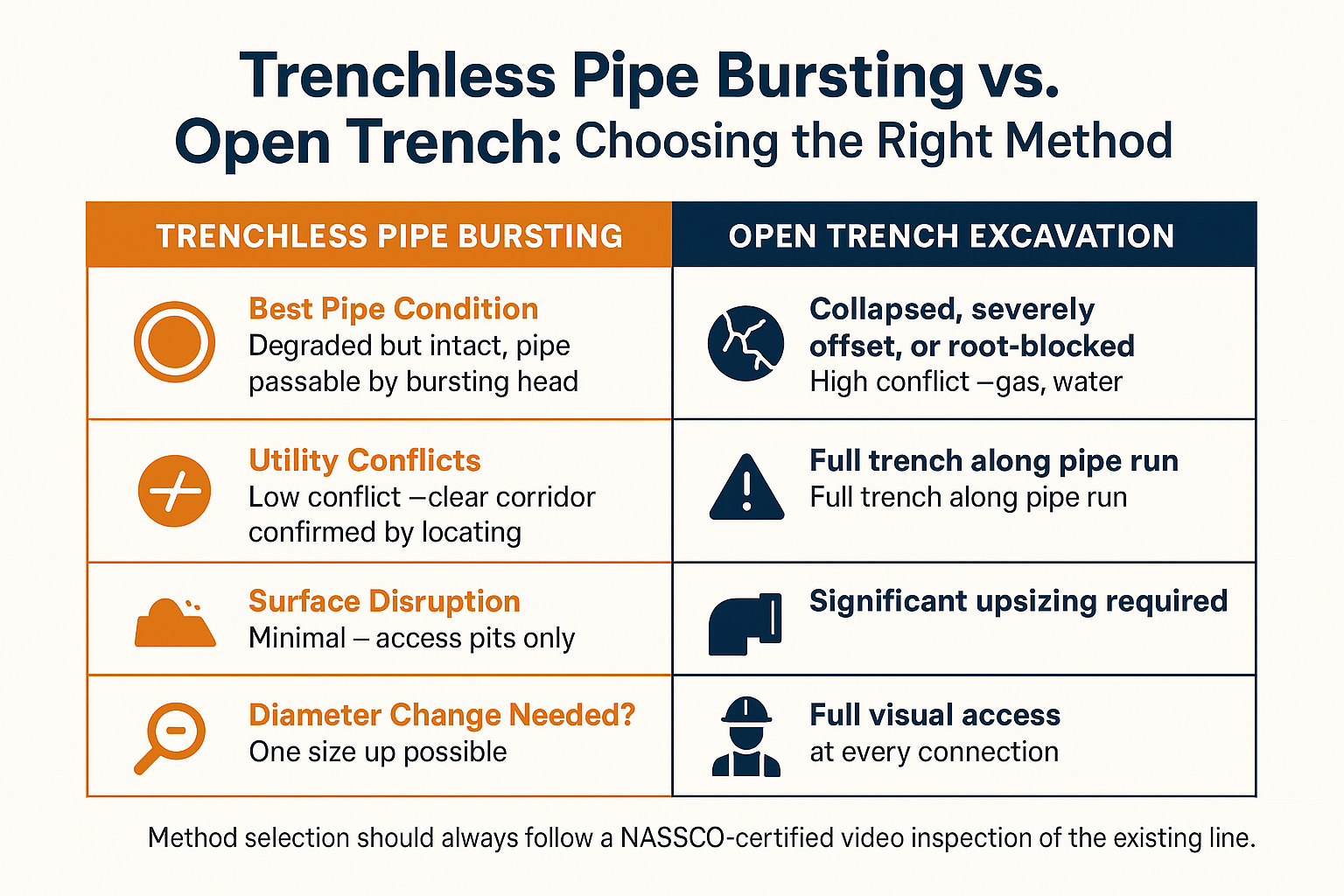
This side-by-side comparison walks through the key project conditions that push a sewer replacement toward one method or the other.
Method Comparison at a Glance
This table summarizes the practical differences between pipe bursting and open trench replacement across the factors that matter most on Central Coast projects.
| Factor | Pipe Bursting | Open Trench |
|---|---|---|
| Typical cost range (residential lateral) | $8,000–$18,000 | $7,000–$20,000+ |
| Surface restoration required | Minimal (pit patches only) | Full trench restoration per county standards |
| Works on collapsed pipe | No | Yes |
| Utility conflict risk | Higher — pipe displaced outward | Lower — crew has direct visual control |
| Municipal inspection access | End-point only | Full run accessible |
| Diameter upgrade flexibility | Limited (one size up) | Unrestricted |
| Encroachment permit required (public ROW) | Yes | Yes |
| Schedule risk near Oct. 15 grading deadline | Lower (less soil disturbance) | Higher (larger open excavation) |
The Role of the Pre-Job Video Inspection — and Why It’s Not Optional
The single biggest mistake we see on sewer replacement projects is choosing a method before running a proper NASSCO-certified PACP video inspection of the existing line. That inspection tells you the pipe material, the condition rating, whether there are offsets or bellies, where root intrusion is located, and whether the pipe path is clear enough for a bursting head to travel.
Without that data, a contractor is guessing. And guessing on method selection leads to quotes that vary wildly — because different contractors are pricing different assumptions about what they’ll find.
In Monterey County, a significant portion of residential sewer laterals were installed in the 1950s through 1970s using Orangeburg pipe, vitrified clay, or cast iron. Each of those materials degrades differently and responds differently to pipe bursting. Clay pipe that’s cracked but still holds its profile can be burst effectively. Orangeburg that has softened and deformed into an oval or flattened shape may not allow a bursting head to pass at all.
And in Santa Cruz County, where the sewer lateral ordinance requires lateral inspection and certification at point of sale on many properties, getting a video inspection on record before any repair work begins protects the property owner and documents the pre-repair condition for the municipality.
Surface Restoration and the Hidden Cost of “Less Disruption”
One reason trenchless gets sold as the obvious winner is the reduced surface restoration cost. With pipe bursting, you’re patching two small access pits instead of restoring a full trench run. In a driveway or landscaped yard, that difference can be $2,000 to $6,000 depending on the surface material and the length of the run.
But that math only holds when the trenchless work actually completes without complications. If a bursting job stalls midway due to an obstruction and the crew has to convert to open trench, you’re paying for both approaches — the mobilization and pit excavation for the trenchless attempt, plus the full trench work to finish the job.
For projects in the public right-of-way — say, a lateral crossing under a city street in Salinas or a storm drain connection in Marina — the asphalt restoration standards for trench patches are set by the agency regardless of method. Monterey County and most cities require a minimum 2-inch asphalt overlay over a compacted base for any trench restoration in a traveled roadway, and some jurisdictions require full-width resurfacing of the lane affected. That cost applies to either method when the work crosses pavement.
Knowing the full restoration scope before selecting a method — not after — is what keeps a project budget accurate.
Frequently Asked Questions About Trenchless Sewer Replacement
Can pipe bursting damage my other underground utilities?
Yes, it can — and this is one of the most underappreciated risks of trenchless work. When the bursting head fractures the old pipe outward, it displaces soil and can shift or crack adjacent lines. Before any pipe bursting job, utility locating (811 call plus private locating if needed) and a review of as-built drawings should confirm what’s in the ground nearby. If a gas line or water main runs within 18 to 24 inches of the pipe path, open trench is the safer choice.
Is trenchless sewer replacement approved by Monterey One Water and local agencies?
Generally yes, but approval depends on the specific connection point and inspection requirements. Monterey One Water requires permits and inspections for sewer lateral work, and some connections — particularly at the mainline tap — require direct visual access that trenchless methods don’t always provide. Your contractor needs to coordinate with the agency before the job, not after.
How do I know if my pipe is a good candidate for pipe bursting?
A NASSCO-certified PACP video inspection is the only reliable way to know. The inspection will show the pipe’s condition rating, material type, any offsets or belly sections, and whether the bore is clear enough for a bursting head to travel. Trying to select a method without that data is guesswork.
Does trenchless sewer replacement require a permit in Monterey County?
Yes. Any sewer lateral work — trenchless or open trench — that connects to a public sewer system requires a permit from the relevant agency. If the work crosses public right-of-way, an encroachment permit from the city or county is also required. Permit requirements for underground utility work vary by jurisdiction, so it’s worth confirming early in the project.
Is trenchless always faster than open trench?
Usually, but not always. A straightforward pipe burst on a 50-foot residential lateral can often be completed in a single day. But if the job requires multiple access pits due to bends, or if the crew encounters an obstruction that forces a conversion to open trench, the timeline stretches. Open trench on a well-planned project with clear utility locates and staged restoration can be just as fast.
Does the new HDPE pipe from pipe bursting last as long as open trench pipe?
Yes. HDPE pipe installed via pipe bursting carries a design life of 50 years or more under normal conditions — the same as HDPE installed in an open trench. The installation method doesn’t affect the pipe material’s longevity. What affects longevity is proper bedding, correct pipe sizing, and a good mainline connection — all of which apply to both methods.
Not Sure Which Method Makes Sense for Your Project?
Coastal Pipeline serves residential, commercial, and municipal clients across Monterey and Santa Cruz counties — and we run NASSCO-certified video inspections before recommending any replacement method. If you have a sewer lateral that needs evaluation, reach out through our website contact form or call us directly to talk through the project. We’ll tell you what the pipe actually needs, not what’s easiest to sell.