
Direct Answer: The water utility owns the main line in the street. You own the service lateral from the meter to your building. Anything between those two points is your responsibility to repair.
A water line fails somewhere between the street and your building. A contractor shows up, locates the break, and then comes the question nobody prepared for: who pays for this? Most property owners in Monterey County have never looked at a service map or a utility agreement — and that gap gets expensive fast.
The answer isn’t always simple. Ownership boundaries vary by water district, and in Monterey County, you’re dealing with multiple providers — Monterey One Water, California American Water, and various municipal systems depending on where your property sits. Each one draws the line differently between their infrastructure and yours.
This article breaks down where utility ownership ends, where your responsibility begins, and what the repair process actually looks like when something goes wrong underground.
The Ownership Split: Where the Water District’s Responsibility Ends
Every water service connection has a dividing line. On one side is the utility’s infrastructure. On the other side is yours. Most property owners never think about this until there’s a problem.
Generally, the split works like this:
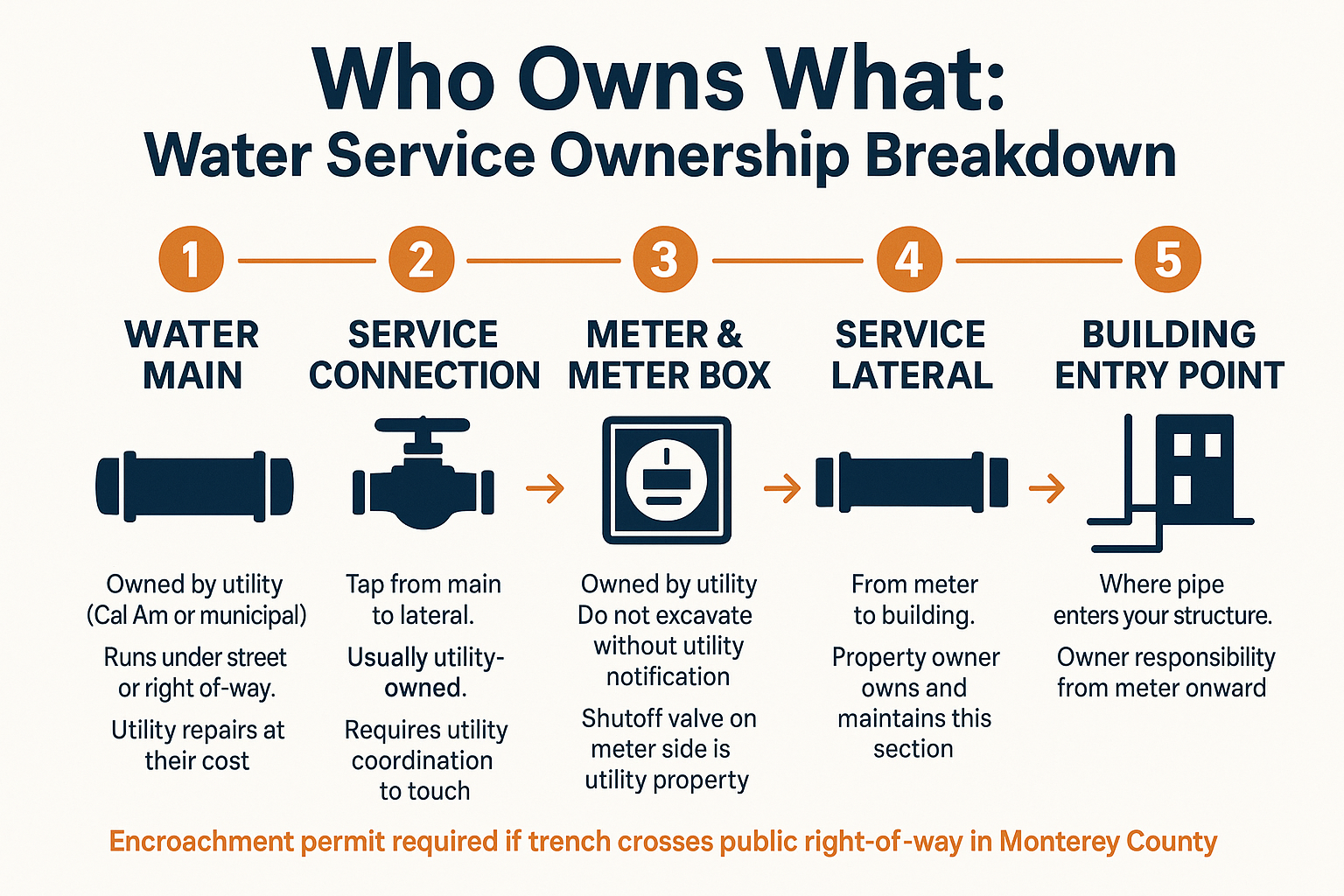
- The water main in the street or right-of-way belongs to the utility
- The meter and meter box are typically owned and maintained by the utility
- The service lateral — the pipe running from the meter to your building — belongs to you
- The meter valve (the shutoff at the meter) is usually utility property; the curb stop or PRV downstream may be yours
With California American Water (Cal Am), which serves much of the Monterey Peninsula including Pacific Grove, Carmel, and parts of Seaside, the utility owns up to and including the meter. Everything downstream is the property owner’s responsibility. That includes the entire run from meter to building, whether it’s 20 feet or 200 feet.
Monterey One Water primarily handles wastewater, so if your water comes from Cal Am or a municipal system, those district rules apply. It’s worth pulling your original service agreement or calling your provider directly to confirm where your ownership begins — especially before any excavation work.
For a deeper look at what the installation and replacement process involves, the Water Main Installation and Replacement: A CA Coast Guide covers the scope in detail.
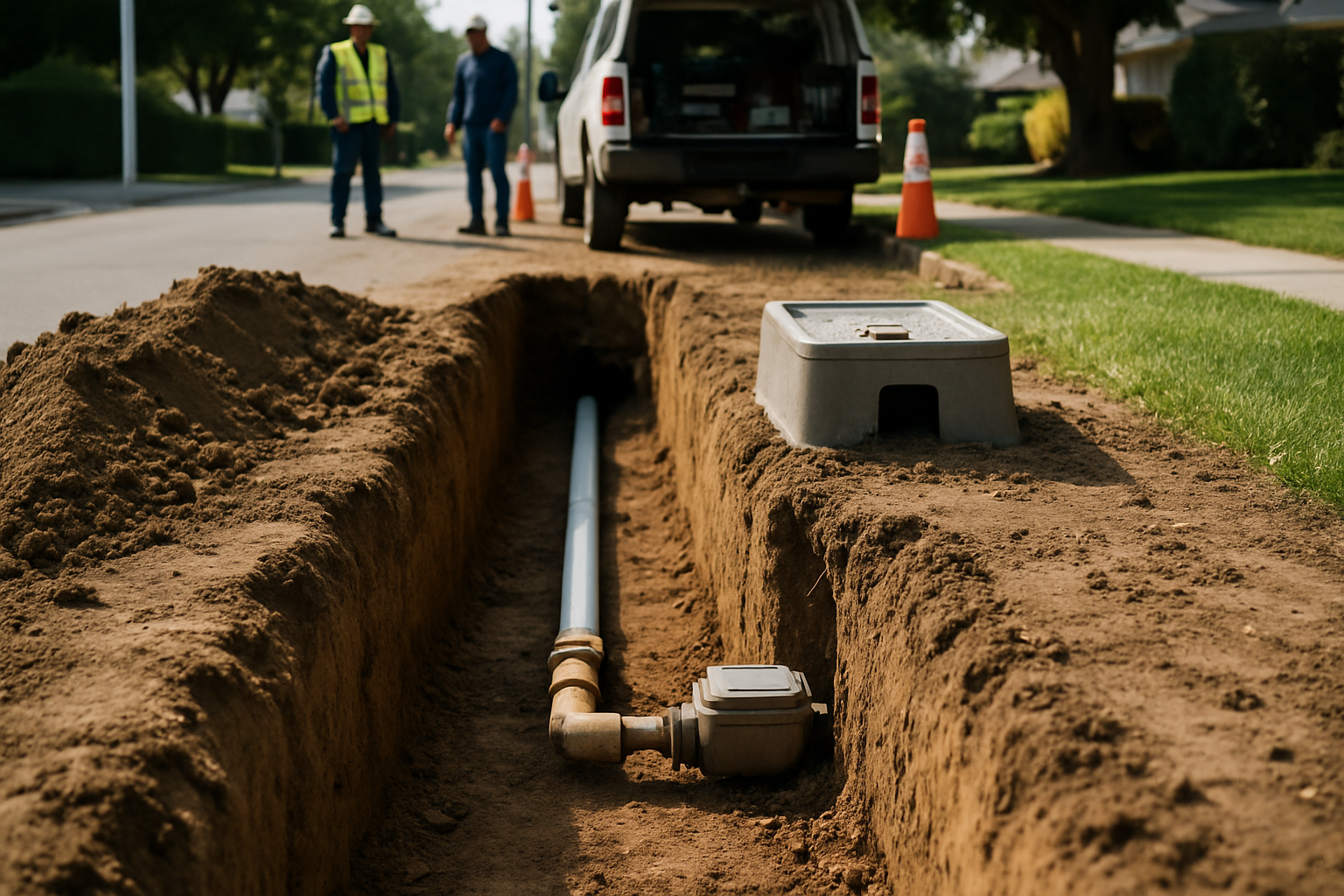
What That Means When Something Actually Breaks
The ownership split matters most when a pipe fails. If the main in the street develops a leak, the utility handles it — you make a call and wait. But if the failure is on your side of the meter, you’re scheduling a contractor, pulling permits, and writing a check.
Service lateral failures on the Central Coast often come down to a few specific causes:
- Age and material — many laterals in Monterey and Seaside are galvanized steel or older copper installed in the 1950s through 1970s
- Soil movement — the expansive clay soils common in the Salinas Valley and parts of Marina shift seasonally, which stresses rigid pipe joints over time
- Root intrusion — less common than in sewer systems but still a factor near mature oak and eucalyptus stands
- Corrosion — coastal salinity accelerates external corrosion on metallic pipe, particularly in properties within a few miles of the Bay
A failed lateral typically means trenching from the meter to the building foundation, installing new pipe (usually Type K copper or HDPE, depending on soil conditions and local standards), pressure testing, and then restoring whatever surface got cut — concrete, asphalt, or landscaping.
In most Monterey County jurisdictions, this work requires an encroachment permit if the trench crosses any public right-of-way. That’s a step many homeowners don’t anticipate, and it adds both time and cost to the project. If you want to understand what that permit process looks like, this guide to underground utility permits walks through the requirements.
Water Service Ownership: From Main to Meter to Building
This infographic maps out where utility ownership ends and property owner responsibility begins along a typical water service connection.
The Real Cost of a Service Lateral Replacement in Monterey County
Costs vary significantly based on run length, depth, surface restoration requirements, and permit fees. But for residential and light commercial work in Monterey County, here’s what the field actually looks like.
A standard residential lateral replacement — roughly 40 to 80 linear feet, shallow depth, with trench patch restoration — typically runs $8,000 to $18,000 in this market. That range moves based on:
- Whether the trench crosses an improved public street (which triggers encroachment permit fees and often requires engineered backfill and asphalt restoration to county or city spec)
- The existing pipe material — removing old galvanized steel with fittings that have been in the ground since 1960 takes more time than pulling copper
- Depth — water service lines in Monterey County are generally installed at 18 to 30 inches, but older laterals can run deeper depending on the original contractor
- Access conditions — lateral runs under concrete driveways, patios, or established landscaping add cost
For commercial properties with larger meters (1.5-inch or 2-inch service) or longer lateral runs, projects in Salinas and Marina have run $22,000 to $45,000+ depending on the scope.
If you’ve already received quotes and want to understand the breakdown, this article on water line replacement pricing explains what drives variation and what a fair quote actually looks like.
Typical Water Service Lateral Replacement Costs — Monterey County
These ranges reflect field conditions on the Central Coast — not national averages. Permit fees, surface restoration, and depth all affect final cost.
| Project Type | Typical Range | Key Cost Drivers |
|---|---|---|
| Residential lateral replacement (40–80 LF) | $8,000–$18,000 | Surface restoration, permit fees, pipe depth |
| Lateral crossing improved street ROW | $12,000–$22,000 | Encroachment permit, engineered backfill, asphalt patch to county spec |
| Commercial lateral (1.5″–2″ service) | $22,000–$45,000+ | Larger pipe, longer runs, pressure testing, meter coordination |
| Emergency repair (pinhole or joint failure) | $3,500–$9,000 | Excavation depth, access, temporary service needs |
| Full replacement with trench restoration in Seaside | $15,000–$30,000 | Seaside’s street excavation moratorium may restrict timing and method |
One Detail Most Property Owners Miss: The Seaside Moratorium and Permit Timing
If your property is in Seaside, there’s an additional layer to plan around. The City of Seaside has a street excavation moratorium that restricts open-cut work on recently resurfaced streets. If your lateral run crosses a moratoried street, your options narrow — you may need to consider a directional bore or wait for the moratorium window to open.
Across Monterey County more broadly, the October 15 grading and rainy-season restriction deadline matters for any lateral work that involves significant excavation, backfill, or site disturbance near a drainage pathway. Starting an underground water line project in October without accounting for that cutoff can put you in a difficult spot with the county.
Permit lead times through the City of Monterey, Seaside, and unincorporated Monterey County typically run 2 to 4 weeks for standard encroachment permits. In Salinas, the Public Works department has been running closer to 3 to 5 weeks depending on workload. Factor that into your project schedule before committing to a start date.
For restoration work after the trench is filled and compacted, Asphalt Restoration Standards for Underground Utility Work in Monterey County explains what the county actually requires before they’ll sign off on a trench patch.
Frequently Asked Questions About Water Line Ownership and Repairs
My water pressure is low. How do I know if the problem is the utility’s line or mine?
The fastest way is to check your pressure at the meter connection point. If pressure is low at the meter, call the utility — it’s their problem. If pressure is normal at the meter but low inside the building, the issue is almost certainly on your side of the meter. A pressure reading at two points usually answers the question without any excavation.
Can I just repair a section of my service lateral instead of replacing the whole thing?
Sometimes, yes. If the pipe is otherwise in good condition and you have an isolated joint failure or a pinhole from external corrosion, a spot repair can buy time. But on older galvanized steel or undersized copper laterals, one failure usually means others are close behind. A NASSCO-certified video inspection can confirm pipe condition before you commit to either approach — and it’s usually $400 to $800 versus a repair you might have to dig up again in two years.
Does my homeowner’s insurance cover service lateral repairs?
Standard homeowner’s policies in California generally do not cover underground service lateral failures. Some insurers offer a water service line endorsement as an add-on. A few utilities sell optional service line protection programs. Check your policy declarations page, but don’t count on coverage without confirming it first.
Who do I call first — the water district or a contractor?
If you’re losing water or see surface saturation near your meter, call the utility first to confirm the main is not the source. Once they’ve cleared their side, a licensed contractor can locate the break and give you a scope. If you call a contractor first, a good one will tell you to loop in the utility before anyone picks up a shovel near the meter.
Does replacing a water lateral require a permit in Monterey County?
Yes, in almost every case. If the work crosses any public right-of-way — street, sidewalk, or utility easement — you need an encroachment permit from the city or county. Work confined entirely to private property may still require a building permit depending on the jurisdiction. The permits guide for underground utility work covers this in more detail by project type.
Not Sure Where Your Responsibility Starts?
Coastal Pipeline works with property owners, developers, and facility managers across Monterey and Santa Cruz counties to scope, permit, and complete water service lateral projects from meter to building. If you’re dealing with a suspected line failure or planning infrastructure work and need a clear answer on scope and cost, reach out through the contact form at coastalpipelineinc.com or call us directly to talk through your project.