
Direct Answer: A water line repair becomes a full replacement when the pipe material is failing systemwide, not just at one spot. Repeated leaks, galvanized or aging pipe, and low pressure after a repair are the clearest signs.
A water line leak gets called in, the crew digs, and what looks like a straightforward repair suddenly becomes a conversation about replacing the entire service lateral. It happens more often than property owners expect — and on the Central Coast, it happens for some very specific reasons.
Older water service infrastructure in Monterey County runs the range from galvanized steel installed in the 1950s to early-generation copper that’s been through decades of soil movement and seasonal ground saturation. When one section of that pipe fails, it’s often a sign the whole run is close behind.
This article breaks down the two decisions that actually matter: how to tell when a repair won’t hold, and what a full water line replacement actually involves once that call gets made.
The Moment a Repair Stops Making Sense
Most water line repairs are straightforward — a coupling failure, a joint leak, a localized crack from ground shift. You excavate the damage, cut out the bad section, install new material, pressure test, and restore. That works when the rest of the pipe is structurally sound.
But there are conditions that make a repair a temporary fix at best:
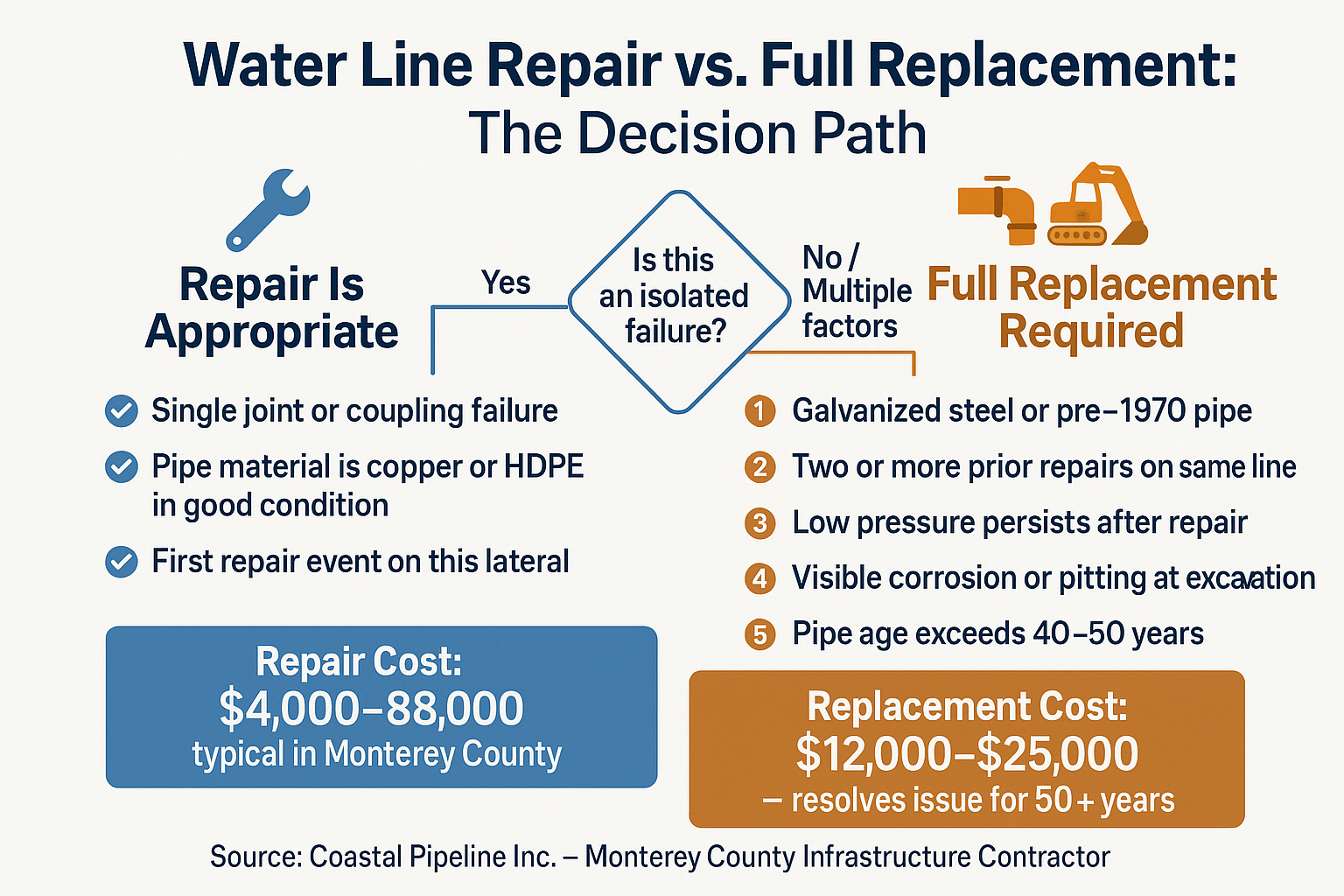
- Galvanized steel pipe — common in Monterey and Salinas properties built before 1970 — corrodes from the inside out. You can fix the leak you found, but the next one is already forming.
- Multiple repair history — if a lateral has been patched two or more times in the past decade, the pipe wall is failing along its full length, not just at the repair sites.
- Persistent low pressure — after a repair is made, pressure that still reads low often indicates internal corrosion buildup restricting the entire run, not just the damaged section.
- Visible pitting or exterior scale — when the exposed pipe shows heavy oxidation or scaling at the excavation point, that condition extends beyond what you can see.
For a water main installation and replacement project to make financial sense over repeated repairs, the math usually comes into focus around the second or third repair event. At that point, the cost of another repair — including excavation, traffic control if applicable, and surface restoration — can run $4,000 to $8,000 for a typical residential lateral in Monterey County. A full replacement on the same lateral ranges from $12,000 to $25,000 depending on length, depth, material, and trench restoration requirements. But that replacement resolves the problem for 50 years or more with modern HDPE or Type K copper.
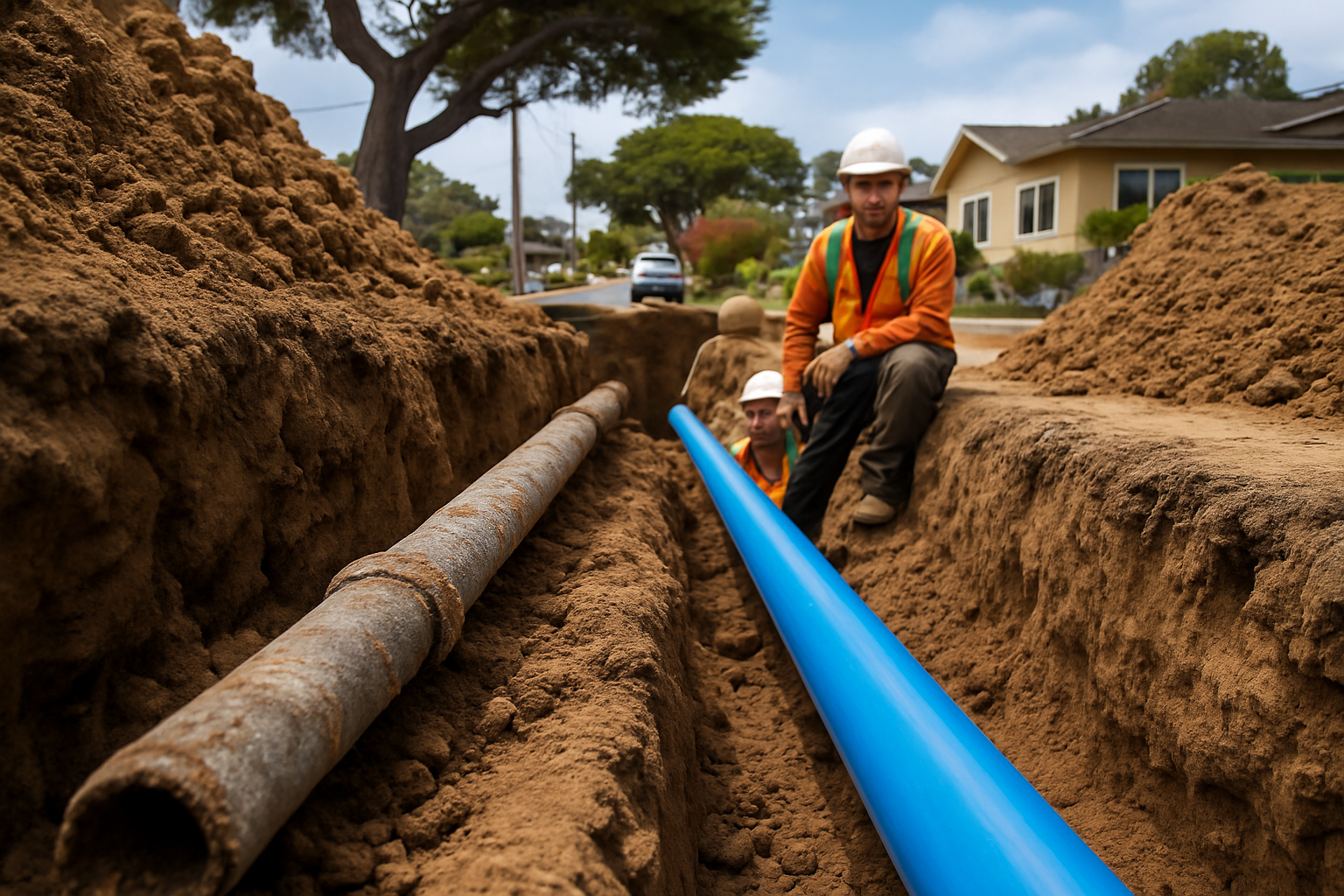
What a Full Water Line Replacement Actually Involves
A full service lateral replacement is not just a longer repair. It’s a planned infrastructure project with permitting, inspection, coordination, and surface restoration built into the scope.
Here’s what the process looks like from start to finish:
- Encroachment permit — if the lateral runs under a public street or sidewalk, Coastal Pipeline pulls an encroachment permit from the city or county before any work begins. In Monterey and Seaside, this process typically takes 5 to 10 business days.
- Water meter coordination — the meter must be shut off and the service isolated. Work in Monterey One Water’s service area requires coordination with their connection and permitting process before service restoration.
- Excavation and pipe removal — the old lateral is excavated from the main connection to the meter, or from meter to building depending on who is actually responsible for which section. In heavier soils like the clay-dominant ground common in Marina and Seaside, trench walls may require shoring.
- New pipe installation — most replacements today use Type K copper or HDPE (high-density polyethylene), both of which are corrosion-resistant and approved by local water purveyors for service laterals.
- Pressure testing — before backfill, the new lateral is hydrostatically pressure tested to verify joint integrity and no leakage under working pressure. Monterey One Water and the City of Monterey both require documented test results before inspection sign-off.
- Backfill and compaction — backfill is placed in lifts and compacted to the geotechnical specifications required by the encroachment permit. This is not an optional step — failed compaction causes future road sag and can trigger re-inspection.
- Surface restoration — trench patch asphalt must meet local standards for base depth, compaction, and surface texture. In Monterey County, asphalt restoration for utility work follows county right-of-way specifications — minimum 2 inches of compacted base rock and T-cut edges before paving.
The full timeline from permit application to final inspection sign-off typically runs 3 to 5 weeks for a residential lateral in Monterey County, assuming no agency delays.
Water Line Repair vs. Full Replacement: How the Decision Gets Made
This flow shows the key conditions that move a project from a targeted repair to a full lateral replacement — and what drives the cost difference.
Repair vs. Replacement: Cost and Longevity Comparison
These ranges reflect typical residential service lateral work in Monterey County. Commercial and municipal laterals will vary based on pipe diameter, depth, and traffic control requirements.
| Scenario | Estimated Cost Range | Expected Service Life |
|---|---|---|
| Targeted repair — isolated leak, good pipe condition | $4,000 – $8,000 | Variable — depends on remaining pipe condition |
| Full lateral replacement — HDPE or Type K copper | $12,000 – $25,000 | 50+ years with proper installation |
| Full replacement under paved street with T-cut restore | $18,000 – $30,000+ | 50+ years; surface restoration adds cost |
| Emergency repair — same-day response, no permit window | $6,000 – $12,000 | Short-term; full replacement still recommended |
The Permit and Inspection Reality in Monterey County
Property owners sometimes push back on the permitting step — it adds time and cost to a project that already feels overdue. But skipping it creates a bigger problem.
In Monterey County, any water service lateral work that touches the public right-of-way requires an encroachment permit from the county or the applicable city public works department. Work on private property still requires a building permit tied to utility work in most jurisdictions. These are not bureaucratic extras — they’re the mechanism that protects the property owner if something fails later.
Un-permitted water line work that later causes property damage, soil erosion, or street sag creates liability exposure that falls entirely on the property owner. And if the work gets flagged during a property sale, unpermitted utility work can hold up or kill escrow.
For projects involving underground utility permits specifically, the inspection process also includes final sign-off from the water purveyor before service restoration. Monterey One Water requires their own connection permit separate from the county encroachment permit — which means two parallel permit tracks on many projects. That’s a coordination task that needs to be managed from the beginning of the project, not after the trench is open.
One seasonal factor worth building into project planning: Monterey County’s October 15 grading and rainy-season deadline applies to projects involving significant soil disturbance. Water line replacements that require substantial excavation — especially on sloped lots or near drainage features — need to start early enough to reach backfill and compaction before that window closes. Starting a trench project in late October in the Carmel Valley or on hillside properties in Pacific Grove creates real risk of compaction failures if rain arrives before the trench is restored.
Frequently Asked Questions About Water Line Repair and Replacement
Can I just repair the section that’s leaking and wait on the rest?
Sometimes, yes — if the pipe material is copper or HDPE and this is the first failure on the lateral. But if the pipe is galvanized steel or has been repaired before, patching one spot while the rest of the line continues corroding usually means you’re spending repair money twice within a few years. A short-run cost comparison usually makes full replacement the better call.
How long does a full water line replacement take in Monterey County?
Plan on 3 to 5 weeks from permit application to final inspection, assuming standard agency turnaround. The physical work on a typical residential lateral takes 1 to 3 days once permits are in hand. The timeline depends heavily on how quickly Monterey One Water or the applicable city processes the connection permit.
Does the city or county own any part of my water service line?
The water purveyor owns and maintains the water main in the street and typically the meter at the property line. Everything from the meter to the building is the property owner’s responsibility to maintain and replace. That said, the exact boundary varies by jurisdiction. There’s a full breakdown of this in our article on who is responsible for the water line to your property.
What pipe material will be used for the replacement?
Most residential service lateral replacements in Monterey County use Type K copper or HDPE (high-density polyethylene). Both are approved by local water purveyors and are corrosion-resistant. HDPE is increasingly common because it handles soil movement well — relevant in coastal areas with expansive clay soils — and is available in longer continuous runs that reduce the number of fittings and potential failure points.
Do I need to be home during the work?
Not necessarily for the full duration, but you’ll want to be reachable. Water service will be off during the replacement, which affects the entire building. We coordinate service shutoff windows with property owners in advance so the interruption is planned and predictable.
Will the street or driveway be restored after the work?
Yes — trench patch and surface restoration are part of a properly scoped replacement. In the public right-of-way, the encroachment permit specifies the restoration standard. On private property, the scope should include compacted base rock and asphalt patch back to match the existing surface. Make sure any quote you evaluate includes both backfill compaction documentation and surface restoration — not just the pipe work. More on what that standard looks like is covered in our asphalt restoration guide for Monterey County.
Not Sure Whether You Need a Repair or a Full Replacement?
Coastal Pipeline serves property owners, developers, and facility managers across Monterey and Santa Cruz counties — and we’ve pulled enough galvanized laterals out of the ground to give you a straight answer without overselling the scope. If you’re dealing with a water line issue and want a second opinion on whether a repair will hold or a replacement is the better path, reach out through our website contact form or give us a call directly. We’re happy to talk through what you’re seeing before anything gets scheduled.