Getting accessible parking right is more than just following rules. It's about building safe, usable spaces that protect you from expensive fixes and legal trouble later on.
A standard accessible parking spot must be at least 8 feet wide with a 5-foot access aisle next to it. But as any experienced contractor knows, the real challenge is in the details, from the slope of the pavement to the placement of the signs. We'll break it all down, step by step.
Getting Accessible Parking Right From The Start

For contractors, understanding accessible parking dimensions is a must. It’s not just about painting lines on asphalt. It’s a key part of site development that affects safety, your legal responsibility, and your professional reputation. This guide is your field manual for avoiding common mistakes and doing the job right from the ground up.
Drawing from our team's experience with grading and paving projects at Coastal Pipeline, we’ll go beyond the basic rules. We'll show you how the measurements on a blueprint connect to the real-world work needed to get it right. A successful project starts with precise surface preparation to ensure the final lot is both durable and truly accessible for years. This focus on planning is the key to preventing problems and staying on budget.
ADA Dimensions: The National Standard
First, let's cover the federal rules. The 2010 ADA Standards for Accessible Design are the national baseline, and you have to get them right. They set the minimum sizes for both standard and van-accessible parking spots.
Here's a quick table to keep the main numbers straight. Every local rule is built on this foundation.
ADA Accessible Parking Stall Quick Reference
| Feature | Standard Accessible Stall | Van-Accessible Stall |
|---|---|---|
| Minimum Stall Width | 8 feet (96 inches) | 11 feet (132 inches), or 8 feet (96 inches) |
| Minimum Access Aisle | 5 feet (60 inches) | 8 feet (96 inches), if stall is 8 ft wide |
| Aisle Location | Next to the stall | Next to the stall |
| Marking | Must be marked with the International Symbol of Accessibility | "Van-Accessible" sign required at stall |
Remember, these are the minimums. Real-world projects often need more planning, especially when local rules are involved.
Beyond Federal Guidelines: What Else To Watch For
A smart contractor knows that federal rules are only part of the story. Local regulations often add more requirements, and you can't afford to miss them.
Here’s what you need to keep in mind from day one:
- Local Code Differences: Don't assume the ADA standards are all you need. Monterey County, like many places, has its own specific rules. These can affect anything from sign height to the total number of required spots. Always check local laws.
- Site-Wide Connections: An accessible spot is useless if you can't get from it to the building. It must connect to a safe, compliant path. Planning how it ties into sidewalks and entrances is crucial for passing inspection.
- Long-Term Durability: Proper surface preparation is everything. If the ground isn't graded correctly, the pavement can crack, hold water, or shift. This can quickly make a spot non-compliant. Do it right the first time to ensure it lasts.
- Project Security: When you start work on a parking lot, one of the first steps is to set up comprehensive construction site security measures to protect your materials and equipment.
The Blueprint For Compliant Parking Dimensions
On any job site, success is measured in inches. For accessible parking, those inches are legal requirements. Getting them wrong means a failed inspection and expensive rework. To turn a blueprint into perfect asphalt, you have to know these numbers by heart.
Think of an accessible parking space as a complete system. It has two main parts: the stall itself and the "safe zone" next to it called the access aisle. This striped area is required. It gives someone the room they need to use a wheelchair lift or open their door fully. Getting the dimensions of both parts right is the key to compliance.
For any contractor, knowing these numbers is essential. If you want to better understand how these details appear on project plans, learning how to read construction blueprints is a skill that will save you time and money.
Breaking Down Standard Accessible Stalls
The most common space you'll build is the standard accessible stall. The federal ADA guidelines are very clear on the measurements.
- Stall Width: A standard accessible parking space must be at least 8 feet (96 inches) wide. This is enough room for most cars.
- Access Aisle Width: Next to the stall, you need a marked access aisle that is at least 5 feet (60 inches) wide. This area must be marked with stripes to show it's a no-parking zone.
When you add them together, the 8-foot stall and the 5-foot aisle create a total space of 13 feet. It's also good to know that two accessible stalls can share one access aisle between them. This is a common and efficient layout.
This simple visual shows the core numbers you need to get right every time.
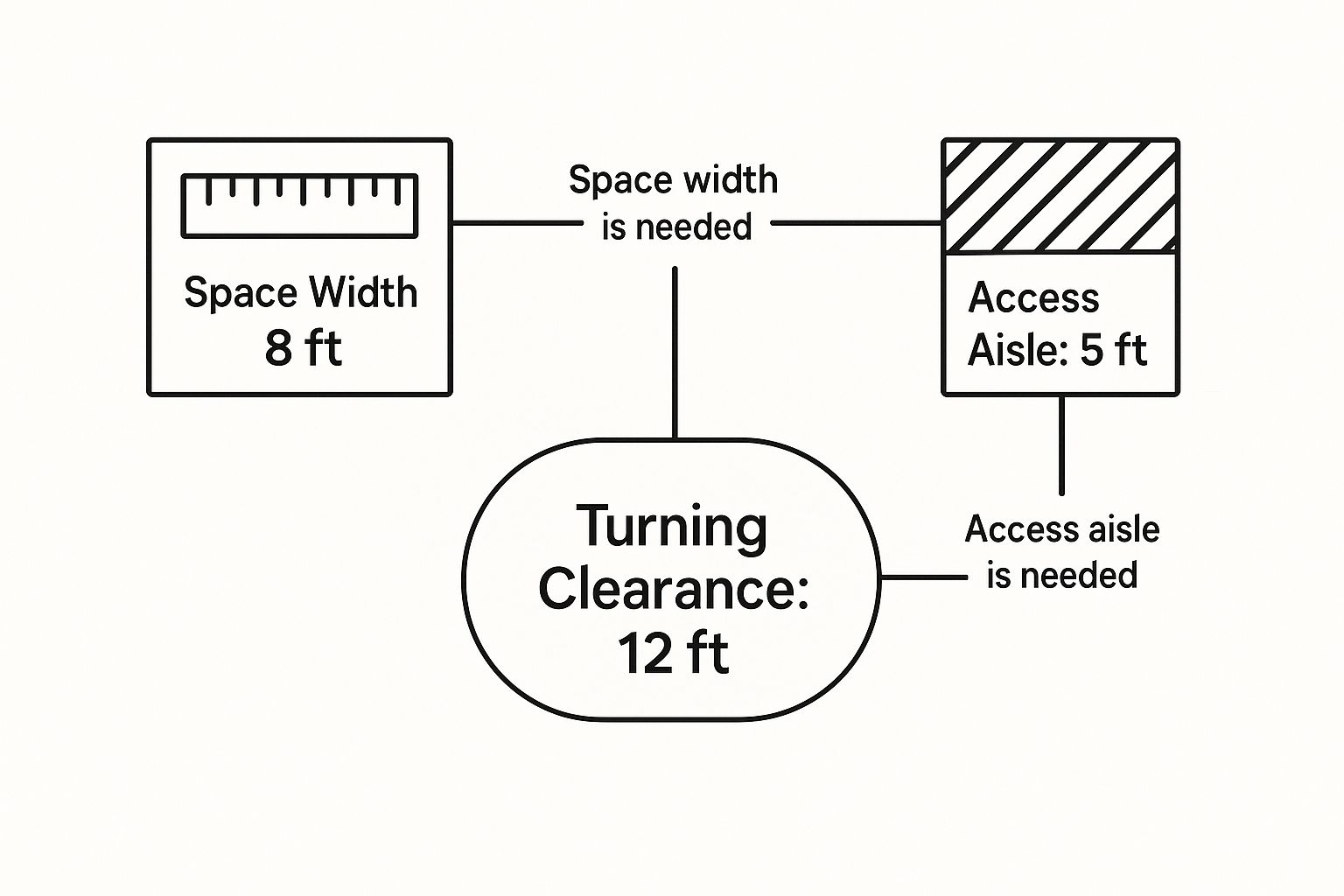
As you can see, the stall and the access aisle are measured separately, but they work together to create one usable space.
Meeting The Needs Of Van-Accessible Stalls
While standard stalls work for many people, the ADA also requires spots for larger vans. These vehicles often need more room for side-mounted ramps and lifts. The rule is that at least one of every six accessible spaces must be van-accessible.
There are two ways to create a van-accessible space:
- The Wide Stall Option: Make the parking stall itself wider, at least 11 feet (132 inches). With this option, the access aisle next to it can be the standard 5-foot (60-inch) width.
- The Wide Aisle Option: Keep the stall at the standard 8-foot (96-inch) width, but make the access aisle much wider—at least 8 feet (96 inches).
Both layouts are legal and get the job done. The best choice often depends on the design of the parking lot. In our experience, the second option—an 8-foot stall with an 8-foot aisle—is often easier because it keeps the stall widths the same across the lot, which simplifies painting.
A Critical Detail: For a van-accessible space, the sign is very important. You must install a sign that says "Van-Accessible" below the wheelchair symbol. Forgetting this small detail is a common reason for failed inspections.
Beyond Width: The Details That Matter
Getting the stall and aisle widths right is a big step, but it's not the whole job. A few other details are just as important, and they are often missed by less experienced crews.
One of the biggest is vertical clearance. Van-accessible stalls, and the route to get to them, must have a minimum vertical clearance of 98 inches. This ensures taller vans can actually enter the lot and use the space without hitting low pipes, tree branches, or building overhangs.
Another key rule is the slope. The surface of both the parking stall and the access aisle cannot have a slope steeper than 1:48 in any direction. This is equal to a 2.08% grade. A steeper slope can make it very difficult or dangerous for someone in a wheelchair. This is where expert grading is essential. This exact slope has to be built into the ground, not just smoothed over with asphalt.
Why The Groundwork Guarantees Compliance
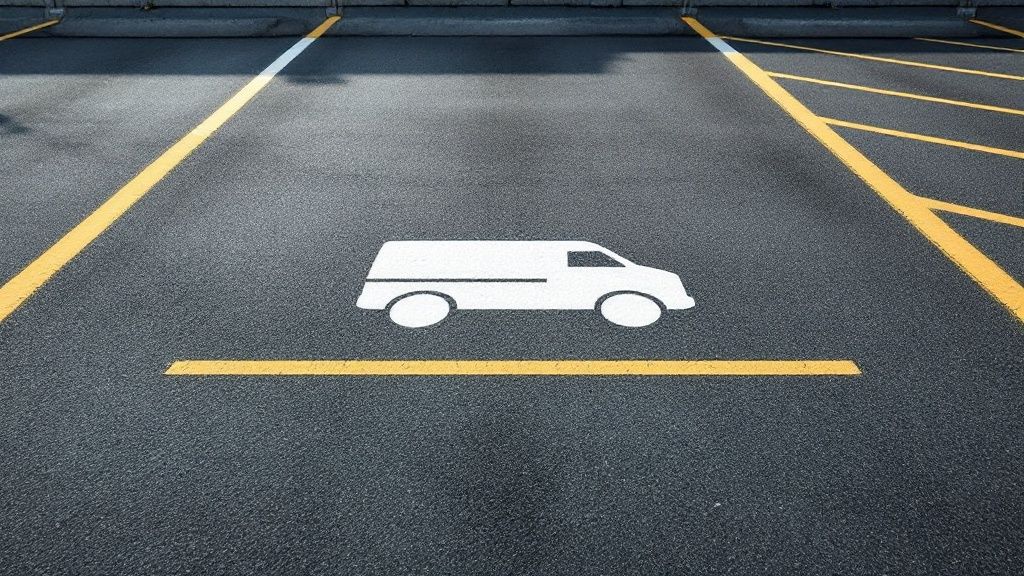
You can have perfect lines, but if the surface underneath is bad, they mean nothing to an inspector. The most important work for creating accessible parking happens long before the painters arrive. The groundwork—grading and paving—is what determines if a spot will stay compliant for years. As our team at Coastal Pipeline has seen, precise surface preparation is the only way to ensure long-term safety and compliance.
Think of the parking surface like a house foundation. You wouldn't build on shifting sand. The same idea applies here. Without a solid, well-prepared base, the asphalt on top is going to fail.
We've seen how cutting corners on surface prep leads to expensive problems down the road. An expert approach to the groundwork is the real secret to building accessible parking that not only passes inspection but also lasts.
Achieving The Perfect Slope Through Expert Grading
That maximum 2.08% slope is one of the strictest rules in ADA compliance. You can't just eyeball it or fix it with extra asphalt. This precise grade has to be engineered into the ground from the start.
This is where proper grading comes in. It's the careful process of shaping the land to make sure water drains correctly without creating slopes that are too steep for a wheelchair. When grading is done right, you get a smooth, stable surface with no puddles in the access aisles.
Coastal Pipeline's On-Site Insight
We treat grading like a science. Using laser-guided equipment, we make sure every inch of the stall and aisle meets that sub-2.08% rule. Trying to fix a bad grading job with asphalt is a temporary fix that will fail. It often leads to a complete, expensive tear-out and redo.
Building A Base That Prevents Future Failures
Under the smooth asphalt of a good parking lot is a layered system designed for strength. If that system is weak, the surface will crack and sink, turning a compliant space into a major problem. The key is to focus on what’s underneath.
A strong, long-lasting parking surface comes down to two steps:
- Proper Soil Compaction: First, the dirt has to be packed down tightly to create a stable base that won't shift. Skipping this step leads to sinking and cracking.
- A Solid Sub-Base: Next, a layer of crushed rock is spread over the compacted soil. This sub-base distributes the weight of cars and provides a solid platform for the asphalt.
When these steps are done correctly, they prevent common problems that make a parking stall non-compliant, like cracking or sinking that create dangerous slopes. Professional grading and paving services ensure this foundation is built to last.
The Final Touch: Finishing The Surface
With a perfect base in place, it's finally time for asphalt. But a quality finish is more than just a smooth look. It's about creating a durable, non-slip surface that's safe in all weather.
The paving process must maintain the exact slope set during grading. An experienced crew applies the asphalt at a consistent depth, then rolls it to the right density without creating low spots. This attention to detail locks in compliance and guarantees a surface that is both safe and built to last.
Navigating Monterey County's Unique Parking Rules
For any contractor working on the Central Coast, meeting federal ADA rules is just the first step. A true local professional knows that Monterey County's specific regulations add another layer of rules to your project. These aren't just suggestions—they are codes that can lead to failed inspections and expensive rework.
From our team's hands-on experience in the region, we know that many contractors overlook these local details. Forgetting a Monterey County-specific rule about signage height or stall counts is a common and costly mistake. Anticipating these local requirements from the start is what makes a project run smoothly.
Beyond The ADA: What Monterey County Requires
While the ADA provides a good baseline, Monterey County often has stricter rules that can catch crews by surprise. For example, a local planning department might have its own requirements for signs that go beyond the federal minimum.
You need to pay close attention to these local details:
- Coastal Zone Regulations: If your project is in the coastal zone, a whole different set of rules can apply. This could change how you calculate the number of stalls or require specific materials for drainage.
- Unique Signage Mandates: The ADA says a sign must be at least 60 inches off the ground, but some local rules here demand more. They might also require specific wording on the sign about fines or towing.
- Stricter Slope Inspections: The federal maximum slope is 2.08%, but don't be surprised if local inspectors check this very carefully, especially on tricky sites. A precise grading plan is your best defense.
Sourcing Local Codes and Avoiding Surprises
The biggest mistake is assuming all the rules are in one place. You have to actively find and understand Monterey County's codes. The last thing you want is an inspector pointing out a mistake after the asphalt is already down.
We always say that the local planning department is your best resource. A quick call or a visit to their website before you start can answer questions on everything from stall counts to path of travel connections. That five-minute check can save you thousands of dollars.
Building a compliant project means seeing the big picture. Accessible parking rules vary around the world, but they all share the same goal: creating a safe route from the vehicle for everyone. Understanding the "why" behind both federal and local rules helps you make better decisions on the job.
A Contractor's Checklist For Local Compliance
To stay ahead of local issues, build these steps into your pre-construction plan. This will help you plan more accurately and build your reputation as a contractor who knows the local rules.
- Review the Monterey County Code: Before you finalize a bid, check the latest version of the county's building and zoning codes online.
- Contact the Local Planning Department: Talk to a planner about your project. Ask them directly if any special rules, like a historic district or coastal zone, apply to your site.
- Document Everything: Keep a record of your conversations and any written guidance you receive from local officials. This can be a lifesaver if questions come up during an inspection.
Taking these extra steps is about more than just checking a box. It's how you become known as a thorough and professional contractor. A deep understanding of all the rules for handicap parking spaces, both federal and local, sets you apart.
Connecting Parking To The Bigger Picture
An accessible parking stall isn't just a parking spot—it's the start of a journey. While getting the dimensions right is key, a truly compliant site requires looking beyond a single space. It's about how that one stall connects to the rest of the property. For a project to be successful, you must plan how accessible parking ties into larger infrastructure like sidewalks and utilities for seamless site development.
This foresight is what turns a good job into a great one. It's about planning a clear, barrier-free route from the vehicle to the building's front door. From our experience, we know this kind of planning prevents costly mistakes that can make a perfect stall useless. You have to think about how drainage, utility lines, and foot traffic will affect the accessible route.
The Path Of Travel: From Vehicle To Entrance
The accessible path of travel is the link between the parking stall and the building. If this path has even one barrier, the whole system fails. A common mistake is a perfect stall that leads directly into a curb or a patch of grass.
This path must be a continuous, clear route with no sudden level changes, obstacles, or steep slopes. It needs to connect smoothly to curb ramps, sidewalks, and any crosswalks along the way.
A Critical Connection: Think of the parking stall as the first link in a chain. If any other link—the curb ramp, the sidewalk, or the crosswalk—is broken, the entire chain is useless. The person is stranded, and the site is not compliant.
Good site planning includes this path in the design from day one.
Infrastructure Tie-Ins And Site Development
The best site development integrates accessible parking with major infrastructure planning right from the start. This proactive approach avoids problems later on. Before you start digging, you have to think about how everything underground will affect the accessible route.
This means planning for:
- Underground Utilities: Know where the sewer, water, and storm drain lines are. An unplanned repair could force you to tear up a compliant path. Smart planning keeps utilities away from key accessibility features.
- Surface Drainage: The grading plan has to manage water runoff across the whole lot. You can't have water pooling in access aisles or on the accessible path. This requires a well-engineered drainage system.
- Lighting and Safety: The path of travel must be well-lit so it's safe to use at night. Light poles should be placed where they won't become obstacles.
Bringing these elements together requires a deep understanding of site mechanics. As our cities change, so do parking lots. Experts are now figuring out how to add new technologies, a topic explored in this resource on Integrating EV Charging into Urban Planning.
Accessible Path of Travel Checklist
Here's a checklist to help you spot common problems with the path of travel before they become expensive fixes.
| Site Element | Key Compliance Check | Common Contractor Mistake |
|---|---|---|
| Curb Ramps | Must have a slope no steeper than 1:12 and have flared sides or level landings. | Building the ramp too steep or placing it where it leads into traffic. |
| Sidewalks | Must have a clear width of at least 36 inches and a cross slope no more than 2.08%. | Letting signs, poles, or landscaping block the required clear width. |
| Crosswalks | Must be clearly marked and line up directly with curb ramps. | Misaligning the crosswalk and curb ramps, forcing people into the street. |
| Building Entrance | The landing area must be level, and the doorway must be wide enough. | Overlooking the final connection and creating a step or steep threshold at the door. |
By using this checklist and thinking about the bigger picture, contractors can deliver a safe, thoughtful, and fully accessible site that serves everyone.
Answering Your Top Questions About Accessible Parking
Even when you know the rules, every job has its challenges. Here are answers to the most common questions our team at Coastal Pipeline hears in the field.
How Do I Figure Out The Number Of Accessible Spots Needed?
This isn't guesswork. The number of accessible spots you need is based on the total number of parking spaces in the lot. The ADA has a simple chart that tells you what to do.
For example, a small lot with 1 to 25 total spots needs only 1 accessible space. A lot with 76 to 100 spots needs 4 of them. The other key rule to remember is this: for every 6 accessible spaces you have, at least one must be a van-accessible spot.
You can see the official ADA ratios and tables on adata.org.pdf) to get the full breakdown. Always double-check the federal ADA chart with local Monterey County codes, because local rules can be stricter.
What Are The Biggest Mistakes Other Contractors Make?
We see the same expensive mistakes over and over. If you can avoid these common errors, you'll save yourself a lot of trouble.
Here are the top three mistakes we see:
- Getting the Slope Wrong: This is the most expensive mistake to fix after the asphalt is laid. The surface slope must be less than 2.08% (a 1:48 ratio) in all directions. Anything steeper is an automatic fail and usually requires a full tear-out and repaving.
- Mis-measuring the Access Aisle: We often see a standard 5-foot aisle next to an 8-foot stall with a "van-accessible" sign. That’s wrong. For a van spot, you have two choices: make the stall wider (11 feet) or make the access aisle wider (8 feet).
- Using Incorrect Signage: This seems small, but it will fail an inspection. Signs installed below the 60-inch minimum height, forgetting the "Van Accessible" text, or placing the sign where a parked van will block it are all common errors.
Can Two Parking Spots Share One Access Aisle?
Yes, absolutely. This is the most common and efficient way to lay out accessible spots. You can place a single access aisle between two accessible stalls, and it can serve both cars.
This design is fully compliant and saves space and materials. It ensures a person has the clear ground space they need, no matter which of the two stalls they use.
What Happens If My Completed Work Is Not Compliant?
Finding out a job is non-compliant after you're done is a nightmare. The property owner could face large fines and lawsuits.
For you, the contractor, the results are immediate. You will almost certainly have to fix the problem at your own cost. That could mean simply changing a sign, or it could mean repaving an entire section of the lot. Besides the cost, it hurts your professional reputation. Getting accessible parking right isn't just about following rules—it's about protecting your business.
At Coastal Pipeline Inc., we know that getting the details right from the start is what makes a project successful. From precision grading to expert paving, we deliver solutions that are built to last and designed for compliance. If you need a reliable partner for your next paving or utility project on the Central Coast, visit us at https://coastalpipelineinc.com.