
Trying to nail down the cost of a new asphalt driveway? Most homeowners find themselves spending somewhere between $3,126 and $7,388 for a full installation. On a square-foot basis, that usually works out to $7 to $15.
Of course, that's a pretty wide range. Your final price tag will depend on a handful of key factors, which we’ll break down here.
What Is the Average Cost for an Asphalt Driveway?
Budgeting for a new driveway can feel a bit like trying to hit a moving target, but getting a handle on the typical costs gives you a solid place to start. Think of it as your financial roadmap before you start collecting quotes from local contractors.
Based on recent projects, the national average cost to install a new asphalt driveway lands right around $5,257. Keep in mind, this is just an average. The final number on your estimate will be shaped by your driveway's size, how deep the asphalt needs to be, the slope of your property, and even the specific type of asphalt mix used. You can find more details on these cost factors from paving industry experts.
Asphalt Driveway Cost at a Glance
Before we get into the nitty-gritty of a contractor’s quote, it helps to see a quick, high-level overview. The table below breaks down the typical pricing you can expect to see.
| Cost Metric | Average Range |
|---|---|
| Total Project Cost | $3,126 – $7,388 |
| Price Per Square Foot | $7 – $15 |
| National Average Cost | ~$5,257 |
A well-built asphalt driveway is much more than just a surface to park on; it's a long-term investment in your home's curb appeal and daily function. The upfront cost is a direct reflection of the quality of the materials and the skill needed to get a durable, professional finish.
These numbers give you a realistic baseline for what you should plan to spend. The main things that will push your final price up or down are:
- Your Location: Labor rates and the cost of materials can vary quite a bit from one region to another.
- Driveway Size: It’s simple math—bigger driveways cost more overall. However, they often come with a lower price per square foot.
- Prep Work: The condition of the ground underneath is a huge factor. If it needs a lot of excavation, grading, and prep, that will add to the cost.
Understanding these key elements is the first and most important step toward getting a fair and accurate estimate for your project.
Decoding Your Quote: Materials vs. Labor Costs
Every asphalt driveway quote you receive is really a combination of two things: the cost of the raw materials and the price of the skilled labor needed to put it all together. Think of it like baking a cake—the quality of your flour and sugar (the asphalt mix) and the expertise of the baker (the installation crew) both have a huge impact on the final result.
Getting a handle on this balance is the key to understanding your asphalt driveway pricing. The asphalt itself is a commodity, meaning its price can fluctuate with things like global oil markets and local availability. But the labor? That’s where the real skill and long-term value come from, ensuring the material performs correctly for years, not just seasons.
Breaking Down Material Costs
"Asphalt" isn't just one thing. The specific mix your contractor plans to use will play a big role in both the project's final cost and how long your driveway lasts. For most residential driveways, the go-to choice is hot-mix asphalt. This is a tough, durable blend of stone, sand, and a liquid asphalt binder that's heated to over 300°F before it's laid down.
Nationally, you can expect hot-mix asphalt to run anywhere from $100 to $200 per ton. A standard mix usually falls in the $100 to $150 per ton range, while premium or specially formulated mixes can climb to $200 or more. Recycled asphalt is much cheaper at around $10 to $20 per ton, but it's not the typical choice for a brand-new driveway surface.
The most important thing to remember is that cheaper materials don't automatically equal better value. Going with a lower-grade mix might save you a few bucks today, but it often leads to premature cracking, potholes, and a driveway that needs replacing much sooner than it should.
What Your Labor Rate Really Covers
When you look at the labor rate on a quote, you're paying for a lot more than just a few hours of work. You're investing in the crew's expertise, which is what turns a pile of raw materials into a smooth, functional surface that can withstand traffic and weather. This work is meticulous, physically demanding, and requires a professional touch.
That labor portion of your bill, which typically averages $2 to $6 per square foot nationally, includes several critical tasks:
- Precision Grading: Making sure the base is sloped just right so water flows away from your house and foundation, not toward it.
- Proper Compaction: Using heavy rollers to pack down the sub-base and each layer of asphalt. This is absolutely vital for preventing the driveway from settling and cracking later on.
- Skilled Operation: The hands-on experience needed to run heavy machinery like pavers and rollers to get that perfectly smooth, even surface without ugly seams or low spots where puddles form.
- Finishing Work: The final, detail-oriented touches, like creating crisp, clean edges and ensuring the new asphalt meets your garage floor or sidewalk seamlessly.
Some property owners have unique situations and ask if it’s possible to just pave over an old surface. Our guide on paving asphalt on top of concrete dives into the specific challenges and requirements for that kind of job. At the end of the day, professional labor is what guarantees every step—from the hidden foundation work to the final pass of the roller—is done right.
The Unseen Costs of Groundwork and Excavation
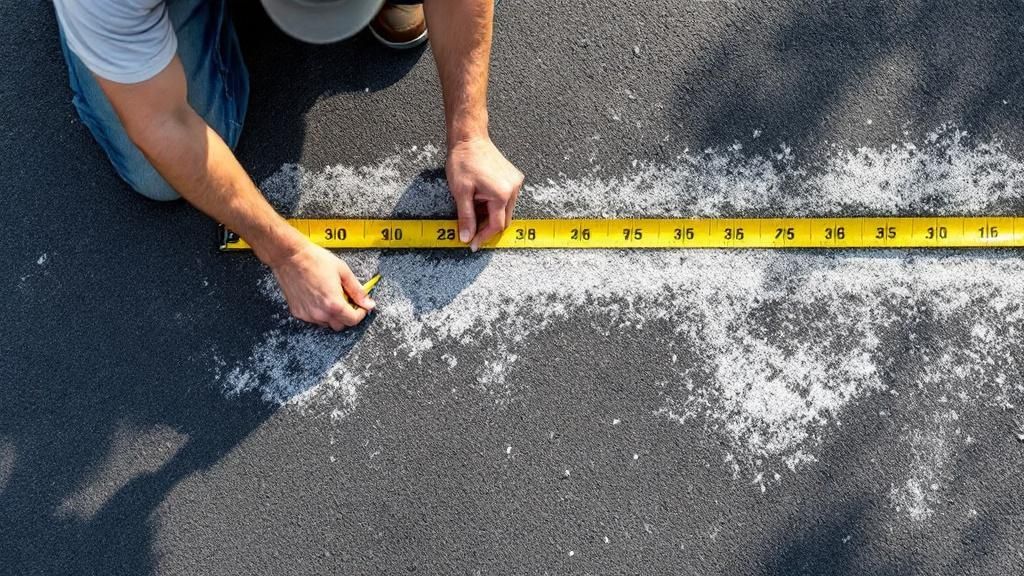
A great asphalt driveway isn't just about the smooth black surface you see; it’s about the solid foundation you don't. A significant part of your asphalt driveway pricing goes into the critical groundwork that happens long before any asphalt arrives. This prep work is truly the unsung hero of a long-lasting driveway.
Think of your driveway like a house—without a strong, stable foundation, whatever you build on top is destined to fail. The same principle applies here. If the base layer is weak, improperly graded, or poorly compacted, your brand-new asphalt will quickly develop cracks, sinkholes, and drainage problems.
This is why we dedicate so much time to excavation and grading. We aren't just clearing a space; we are engineering a stable platform that can support thousands of pounds and withstand years of weather. This non-negotiable step is what separates a driveway that lasts 5-10 years from one that lasts 20-30 years.
Factoring in Site Conditions
Not all properties are created equal, and your land's specific challenges will directly influence the cost. If a contractor finds stable, well-draining soil, the prep work might be straightforward. However, unexpected issues can easily add to the labor and material costs.
Common groundwork challenges include:
- Poor Soil Quality: Clay-heavy or overly sandy soil doesn't compact well and must be removed and replaced with a stable aggregate base, often called a "sub-base." This can add $1 to $4 per square foot to the project.
- Steep Slopes: A significant grade requires more complex engineering to ensure proper water runoff and prevent erosion. This meticulous work demands more time and skill.
- Obstacle Removal: Large tree roots, buried rocks, or other debris must be fully excavated. Failing to do so creates weak spots that will eventually compromise the asphalt above.
A contractor's quote for excavation isn't just for digging dirt. It covers the skill and machinery needed to create a perfectly compacted and graded base, which is the most critical factor for driveway longevity.
Removing the Old Surface
If you’re replacing an existing driveway, the first step is demolition and removal. This process is more involved than just tearing up the old surface; it requires heavy machinery and proper disposal, which adds to the overall cost.
The cost to remove an old driveway typically ranges from $1 to $3 per square foot. The price depends on the material being removed—cracked concrete is generally tougher and more expensive to break up and haul away than old, crumbling asphalt.
Ensuring your driveway is correctly graded is a key part of this process. To understand the details, you can learn more about expert driveway grading and leveling and how it contributes to a successful project. Ultimately, this clean slate ensures the new sub-base and asphalt have a perfect canvas to bond with, giving you the best possible result.
Why Driveway Pricing Changes by Location
Ever wonder why an asphalt driveway quote in one town seems so different from another? The final price you pay is shaped by a whole lot more than just the square footage of your property. A contractor doesn’t just pull a number out of thin air; that quote is a direct reflection of local market conditions, how far materials have to travel, and even the time of year.
Think of asphalt driveway pricing like the cost of fresh produce at the grocery store. A tomato grown right here in the Central Valley is almost always cheaper than one shipped across the country. It’s the same with asphalt. The distance those heavy materials have to be hauled from the production plant to your home plays a huge role. Those transportation costs get baked right into your final quote.
The Impact of Local Economics
Beyond the simple logistics of moving materials, local economic factors can create some pretty significant price swings. If there's a construction boom happening in your area, that means higher demand for both materials and skilled labor, which naturally drives up prices for everyone.
Here are a few key local factors that really move the needle:
- Labor Wages: It's no secret that the cost of living varies. Paving crews in areas with a higher cost of living command higher wages, and that labor is a substantial part of your total project cost.
- Regional Demand: Is every contractor in town booked solid for months? If your region is experiencing a building frenzy, they can charge more. In slower markets, you’ll often find the pricing is much more competitive.
- Permit and Disposal Fees: Local rules matter. Every city and county has different fees for permits, inspections, and getting rid of old materials like concrete or asphalt. All of those fees get passed on to you, the customer.
The price of asphalt is fundamentally tied to crude oil prices. Since asphalt is a petroleum product, when global oil prices rise, the cost to produce hot-mix asphalt follows suit, creating price ripples felt by homeowners everywhere.
Global and Seasonal Influences
The ripple effect doesn't just stop at your county line. Global demand for infrastructure projects has a direct impact on the availability of raw materials. The global asphalt market was valued at approximately USD 65.91 billion in 2024 and is projected to keep growing, thanks to worldwide development. As analysts at Grand View Research point out, this increasing demand puts pressure on supply, which can ultimately affect your quote.
Finally, the season you choose for your paving project makes a big difference. Paving needs warm, dry weather to be done right, which creates a "paving season" that peaks during spring and summer. If you book your project during this busy time, you'll likely face higher prices. You might find more competitive rates during the shoulder seasons in fall or early spring, as long as the weather cooperates.
For homeowners exploring their options, understanding the different surface treatments available can also provide valuable context. Learning about the benefits of different approaches, like those we cover in our guide on driveway resurfacing in Monterey County, will help you make a more informed decision when comparing quotes.
New Installation or Resurfacing: Which Is Right for You?
When your driveway starts showing its age, you’re faced with a big decision. Do you go for a full-blown replacement, which is a major project, or can you get away with a simpler resurfacing job? It’s a classic fork-in-the-road moment, and the path you choose will directly affect both your budget and the long-term health of your property.
I like to think of a driveway’s foundation like the frame of a car. If the frame is bent and rusted through, a shiny new paint job isn't going to fix the real problem. In the same way, if your driveway's base is failing, just pouring a new layer of asphalt on top—a process we call an overlay or resurfacing—is really just a temporary patch.
When Resurfacing Is a Smart Choice
Don't get me wrong, resurfacing can be a fantastic, cost-effective option, but only if your driveway is a good candidate. An overlay is perfect when the issues are just cosmetic or "skin-deep."
Your driveway might be a great fit for resurfacing if you're seeing:
- Minor Surface Cracks: We're talking about small, hairline cracks that haven't worked their way deep into the asphalt.
- A Solid Foundation: The base layer is still stable and solid, with no major sinking, heaving, or soft spots when you walk on it.
- Good Drainage: Water still runs off the surface properly, away from your home's foundation. No major puddles.
- An Age Under 15-20 Years: The original structure is generally still in good shape and hasn’t reached the end of its life.
If this sounds like your driveway, an overlay could save you a significant amount—often 40-60% compared to a full tear-out and replacement. You get that fresh, new look for a fraction of the cost.
Red Flags That Signal a Full Replacement
On the other hand, some problems are dead giveaways that the trouble runs much deeper than the surface. Paving over these red flags is like putting a bandage on a broken arm; it might hide the problem for a little while, but it won't be long before the issues reappear, and you’ll have wasted your money.
A new layer of asphalt is only as strong as the foundation it's built on. If the base has failed, any new surface laid on top is doomed to crack, sink, and crumble prematurely.
You almost certainly need a full replacement if you notice:
- Deep “Alligator” Cracking: This is the big one. Widespread, interconnected cracks that look like a reptile's skin are a telltale sign of base failure.
- Poor Drainage and Puddles: If you have large, standing pools of water long after it rains, it means your driveway has sunk and lost its proper grading.
- Crumbling Edges: The sides of your driveway are breaking apart and turning back into gravel. This means the asphalt has lost its integrity.
- Multiple Potholes: Deep potholes that go through several layers of asphalt are a clear sign that water has gotten into the base and washed it out from underneath.
While asphalt is a durable and popular choice, it's not your only option. If you're looking at a complete overhaul anyway, it might be the perfect time to explore our comparison of asphalt vs. pavers to see what material best suits your home’s look and long-term goals.
Deciding between a new installation and a resurfacing overlay involves weighing the initial cost against the long-term value and lifespan. This table breaks down the key differences to help you make an informed choice.
| Factor | New Installation | Resurfacing (Overlay) |
|---|---|---|
| Average Cost | $7 to $13 per square foot | $3 to $7 per square foot |
| Lifespan | 20-30 years | 7-15 years |
| Best For | Driveways with deep cracks, poor drainage, crumbling edges, or a failed foundation. | Driveways with minor surface-level cracks, good drainage, and a stable foundation. |
| Process | Complete removal of old asphalt, regrading the base, and laying all-new asphalt layers. | Applying a new 1.5-2 inch layer of asphalt over the existing, cleaned surface. |
| Value | Higher upfront cost but offers the longest-lasting solution and a full reset of the surface. | Lower upfront cost, providing a "facelift" and extending the life of a structurally sound driveway. |
Ultimately, a new installation is a long-term investment for a severely damaged driveway, while an overlay is a cost-effective maintenance solution for a driveway that's still in decent shape.
The infographic below shows just how much average costs per square foot can shift based on where you are in the country.
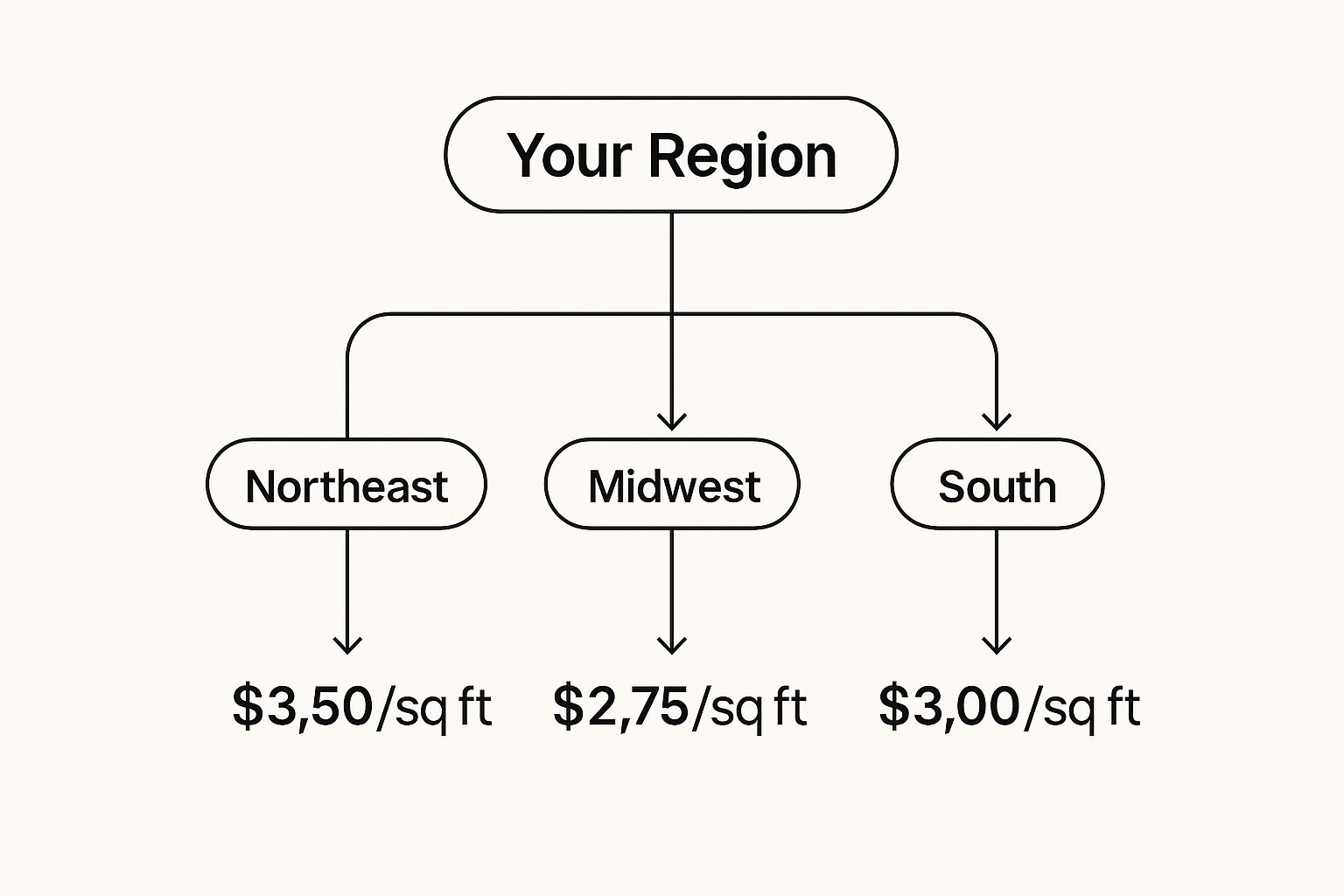
This really drives home the point that even a straightforward resurfacing job will have different price tags depending on your location, all thanks to local labor rates and material supply costs.
Budgeting for Long-Term Driveway Care
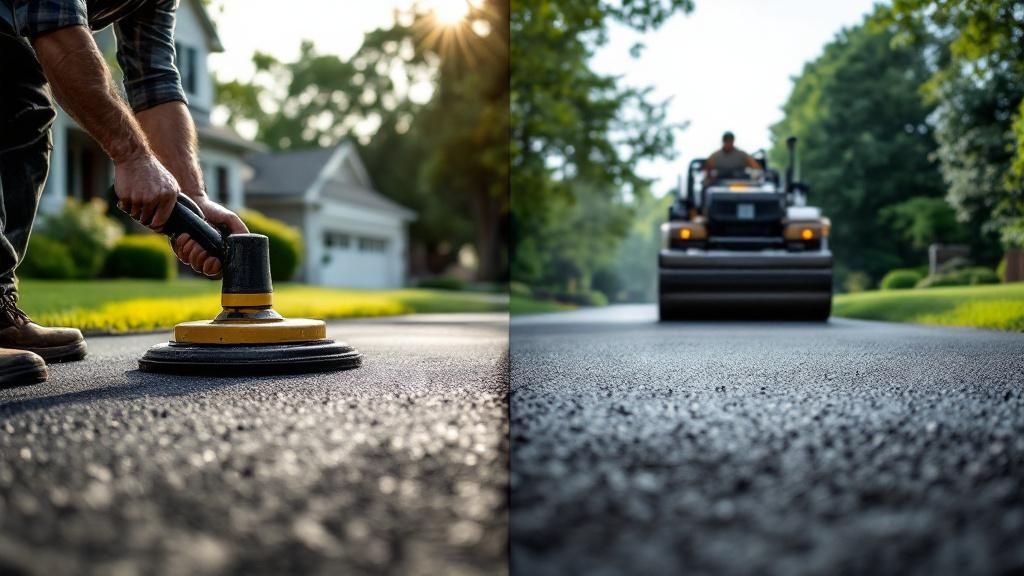
Putting in a new asphalt driveway is a major investment, but the costs don't end when the installation crew packs up. That fresh surface is just the starting point; getting it to last its full potential 20-30 year lifespan isn't automatic. The secret to getting the most out of your investment comes down to proactive maintenance.
Thinking about long-term care helps you budget for the total cost of ownership, not just the upfront price. If you let basic upkeep slide, you can cut your driveway's life short and turn a small repair into a premature—and very expensive—full replacement. It’s the classic "ounce of prevention is worth a pound of cure" situation.
When you plan for these future expenses from the beginning, you create a realistic budget that will keep your driveway in great shape and help you avoid any nasty financial surprises.
Essential Upkeep and Associated Costs
To keep your asphalt surface healthy, a few key maintenance tasks are simply non-negotiable. These jobs protect your driveway from its biggest enemies: the sun, water, and California's temperature swings.
-
Sealcoating: This is easily the most important maintenance you can do. Sealcoating applies a protective liquid layer that acts as a shield against UV rays, water, and chemical spills. This should be done every 2-4 years, with a typical cost of $0.20 to $0.70 per square foot.
-
Crack Filling: As asphalt ages, small cracks are bound to appear. It's critical to fill them right away with a rubberized sealant, which usually costs between $1 to $3 per linear foot. This simple step stops water from getting into the base layer, where it can freeze, expand, and turn a tiny hairline crack into a massive pothole.
Neglecting small cracks is the fastest way to compromise your driveway's foundation. Water intrusion is the primary cause of base failure, leading to the kind of "alligator" cracking that requires a full replacement.
If you find that the surface damage has become more widespread but the foundation is still in good shape, professional help is the next step. Looking into expert driveway resurfacing services can be a smart, cost-effective choice instead of a full replacement, especially when regular maintenance has been missed. Budgeting for these tasks ensures your driveway not only looks great but also performs as it should for decades.
Common Questions About Driveway Paving
Even after you've crunched the numbers, a few practical questions almost always come up when you're thinking about a new driveway. Getting clear, straightforward answers is the key to feeling confident about your investment. Think of this as the final check-in before you start calling contractors.
We'll cover some of the most common things homeowners ask, from the best time of year for paving to what a good, honest quote should actually contain. These are the practical details that help you get the best value for your money.
When Is the Best Time of Year to Pave?
With asphalt, timing is everything. The perfect window for paving is during warm, dry weather, which for us on the Central Coast usually means late spring through early fall. Asphalt mix needs the ambient temperature to be at least 50°F and rising to stay pliable enough for proper spreading and compaction.
Trying to pave in the cold is a big gamble. The asphalt cools down way too fast, making it nearly impossible to compact correctly. This leads to a weaker, less durable driveway that’s likely to fail much sooner than it should. Scheduling your project when the weather is on your side is the single best way to ensure a great result.
How Long Does an Asphalt Driveway Last?
A professionally installed and well-cared-for asphalt driveway should give you 20 to 30 years of solid service. That lifespan isn't automatic, though. It really boils down to three key things:
- A Solid Base: The quality of the excavation and the compacted sub-base beneath the asphalt is the true foundation of your driveway's longevity.
- Proper Installation: The asphalt has to be laid at the correct thickness and compacted to the right density. There are no shortcuts here.
- Consistent Maintenance: This is the big one. Regular sealcoating and filling cracks as soon as they appear are non-negotiable for protecting your investment.
Neglect is the fastest way to cut a driveway's lifespan in half. Water getting into unfilled cracks and constant sun exposure are the two main culprits that break down asphalt, leading to major problems and a much more expensive replacement down the road.
What Should I Look for in a Good Quote?
A professional quote is much more than a single number at the bottom of a page. It’s a detailed blueprint of the entire job, designed to eliminate surprises and ensure you know exactly what you're paying for.
Any trustworthy quote should clearly specify:
- The exact square footage of the project.
- The final compacted depth of the new asphalt layer (e.g., compacted to 3 inches).
- Details about the excavation, grading, and base prep work.
- The type of materials being used, like hot-mix asphalt.
- A clear breakdown of costs for materials, labor, and equipment.
- Payment terms and an estimated project timeline.
This level of detail in the asphalt driveway pricing protects both you and the contractor and is the hallmark of a true professional.
At Coastal Pipeline Inc., we believe in transparent, detailed quotes that give you the power to make an informed decision. If you're ready to invest in a high-quality driveway built to last on the Central Coast, contact us for a professional consultation. Learn more about our paving and excavation services.