
Direct Answer: Every patch buys time, but a structurally failing sewer line will eventually collapse or cause sewage backups that cost far more than a planned replacement would have.
A single sewer repair feels like a reasonable call. The line backed up, a crew came out, they fixed the section that failed — done. But when that same line needs attention again six months later, and then again the following winter, the math starts to shift.
In Monterey County, this pattern is common in neighborhoods with aging clay or cast-iron sewer laterals built before the 1980s. Areas like Old Town Seaside, parts of Pacific Grove, and older commercial corridors in Salinas see repeated patch work on lines that were never going to hold indefinitely. The pipe material is the problem, not the specific failure point.
This article breaks down what actually happens — structurally and financially — when a failing sewer line gets patched repeatedly instead of replaced. And it explains what a proper evaluation looks like before you commit to either path.
Why Patches Fail on a Structurally Compromised Line
A patch addresses one location on a pipe. It does not change what the rest of that pipe is doing.
When a sewer lateral or mainline has reached the point of repeated failure, the cause is usually systemic — not isolated. Common conditions that make patching a losing approach include:
- Root intrusion that has penetrated multiple joints along the line, not just the section that backed up
- Pipe deflection or sag where the bedding has shifted and standing water is collecting in low spots, accelerating corrosion
- Longitudinal cracking in clay or vitrified clay pipe, which spreads under ground movement and load cycles from traffic or soil saturation
- Offset joints caused by soil settlement, especially in areas with expansive soils common in the Salinas Valley
- Hydrogen sulfide corrosion in older concrete pipe — a slow process that hollows pipe walls from the inside out
When any of these conditions exist along a significant portion of the line, patching one section just shifts where the next failure occurs. You’re not fixing the pipe — you’re moving the problem a few feet down the line.
A NASSCO-certified video inspection is the only way to know how much of the line is compromised. Without it, repair decisions are guesses.
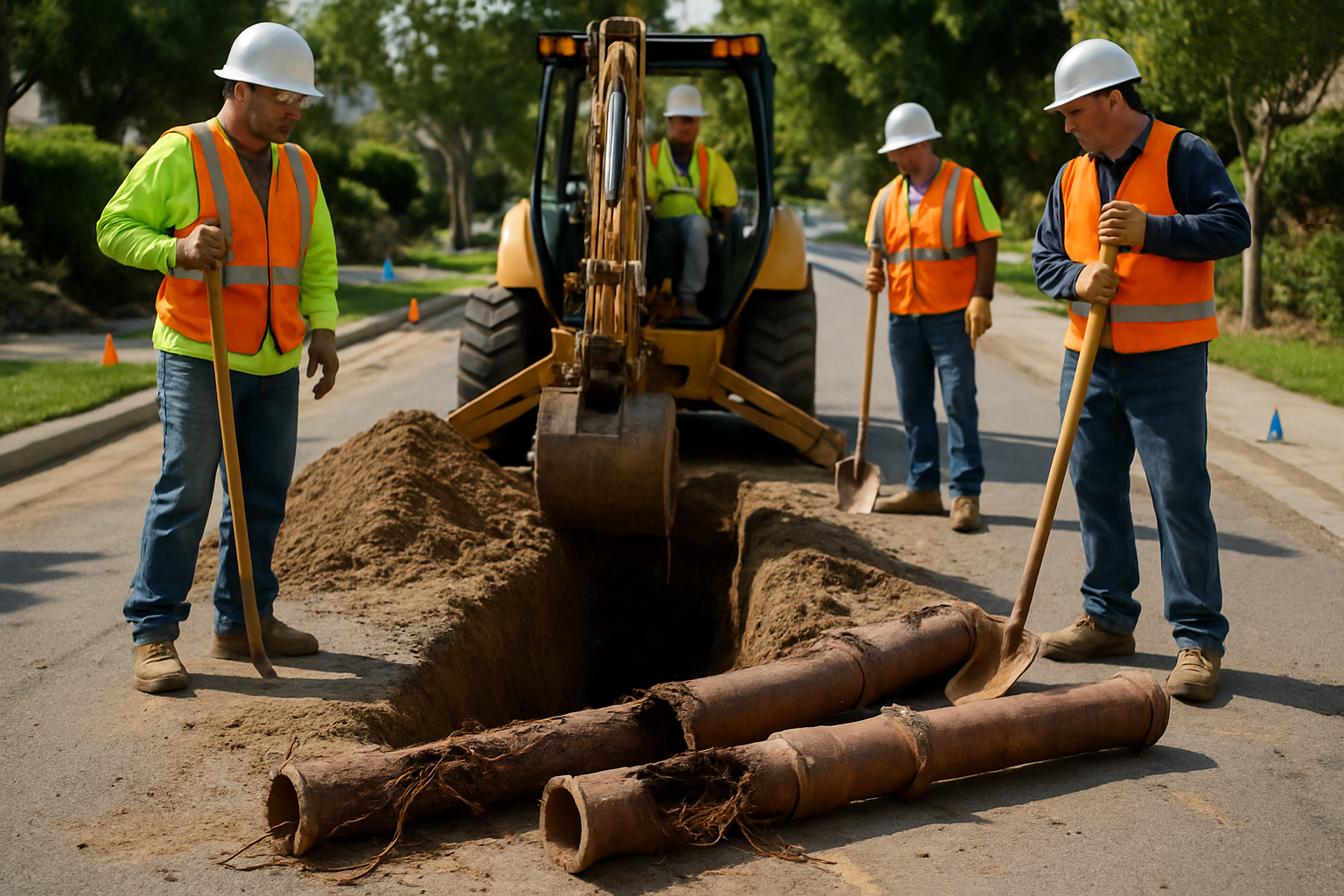
The Real Cost of Repeated Repairs vs. One Replacement
The argument for patching is almost always cost. A spot repair on a residential sewer lateral in Monterey County typically runs $1,500 to $4,500 depending on depth, access, and surface restoration. A full lateral replacement — trench to surface — usually falls in the $8,000 to $18,000 range for a standard residential property, more if the line runs under a driveway or public right-of-way.
But that comparison only holds if the patch actually holds.
If a line needs two or three repairs over three to five years — which is common on pre-1980s clay pipe — the cumulative repair cost often exceeds what replacement would have cost at the first failure. And each repair event carries its own overhead: mobilization, permit fees, and surface restoration.
In Monterey County, trench patches in public rights-of-way also have to meet city or county standards for asphalt restoration. Seaside, for example, enforces a street excavation moratorium on recently resurfaced roads, which can push restoration costs higher or complicate scheduling. Those costs add up fast when you’re opening the same trench repeatedly.
If you’re evaluating whether a quoted repair is reasonable, this breakdown on water and sewer line costs gives useful context on what drives pricing in this region — the same factors apply to sewer work.
Patch vs. Replacement: What You’re Actually Comparing
This table reflects typical cost and outcome ranges for residential sewer laterals in Monterey County. Actual numbers vary by depth, access, material, and permit jurisdiction.
| Factor | Repeated Patching | Full Replacement |
|---|---|---|
| Upfront cost per event | $1,500 – $4,500 | $8,000 – $18,000 |
| Permits required | Usually yes, ROW work | Yes — city/county encroachment permit |
| Surface restoration | Trench patch each time | One-time full restoration |
| Solves root cause | No | Yes |
| Expected next failure | Months to 2 years | 20–50 years (HDPE or PVC) |
| Video inspection needed | Recommended before each repair | Required before replacement design |
| Trenchless option available | Spot liner possible | Pipe bursting or open trench |
How a Failing Sewer Line Deteriorates Over Time
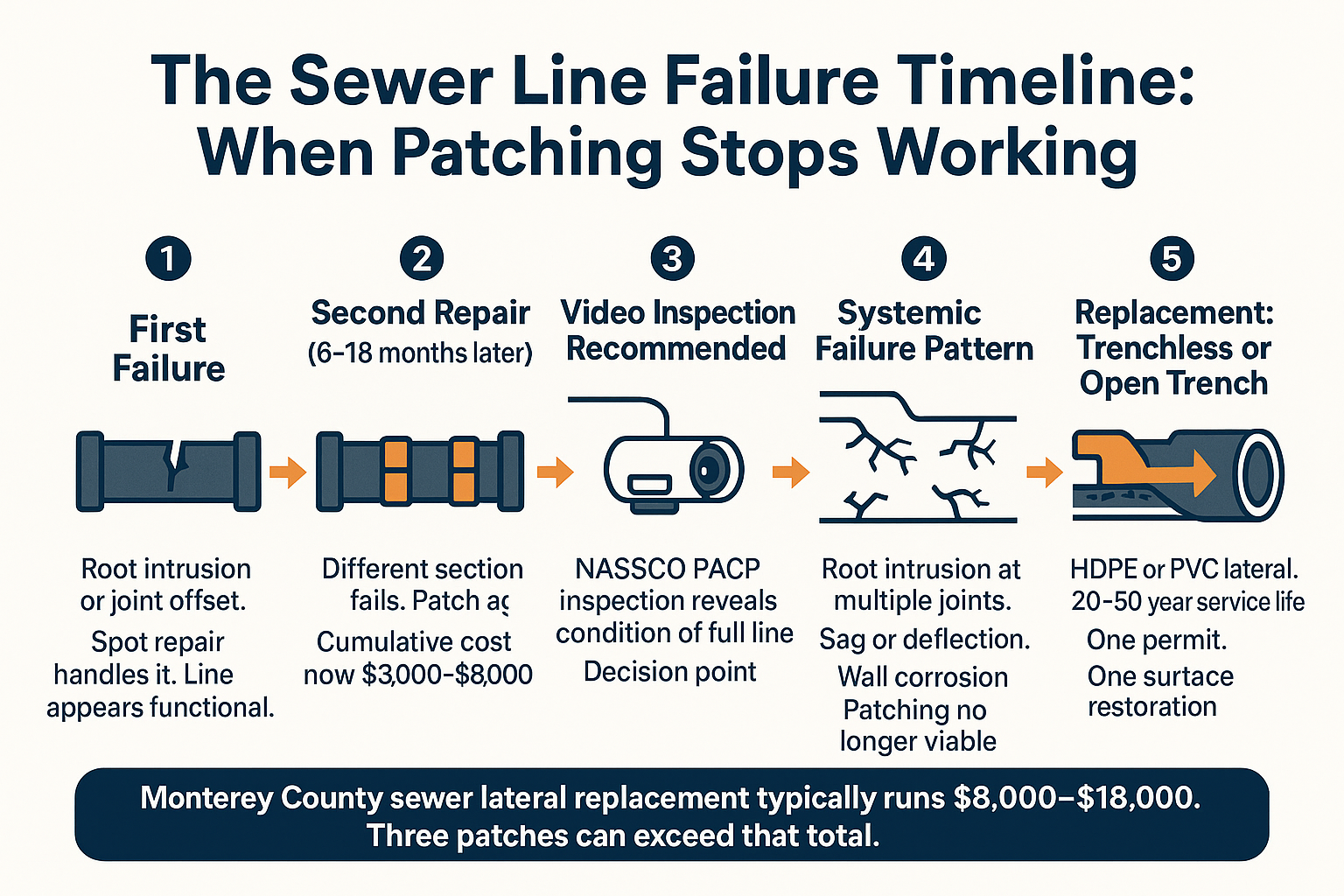
This infographic shows the typical progression from first failure to full system compromise — and where the decision point between patching and replacing actually falls.
When Trenchless Pipe Bursting Makes Sense — and When It Doesn’t
If the video inspection confirms the full lateral is compromised but the pipe path is relatively straight and accessible, trenchless pipe bursting is often the right call. The process pulls a new HDPE pipe through the existing pipe corridor while fracturing the old pipe outward — no full trench required along the pipe run.
For residential laterals in Pacific Grove or Carmel where mature landscaping or concrete flatwork lines the pipe route, this method can reduce surface restoration significantly. The cost difference between trenchless and open trench replacement in Monterey County is typically $2,000 to $5,000, with trenchless running higher on labor but lower on restoration.
But trenchless pipe bursting has limits. It doesn’t work well when:
- The existing pipe has severe offset joints or significant directional changes
- Depth exceeds roughly 10–12 feet without adequate working pits
- The line runs beneath structures or has multiple service connections in close proximity
- The pipe wall has collapsed in sections, leaving no continuous path for the bursting head
A proper evaluation requires both a CCTV inspection and a site visit — not just a phone estimate. Any contractor quoting trenchless work without first running camera footage is guessing.
Compliance Considerations in Monterey County Sewer Work
Sewer lateral work in Monterey County isn’t just a contractor decision — it involves permitting, agency coordination, and in some cases, compliance with specific local ordinances.
Monterey One Water (formerly MRWPCA) governs connection permitting for sewer systems in much of the county. Any lateral replacement that connects to the public main requires a connection permit and typically a pre-construction inspection. Work in public rights-of-way also requires an encroachment permit from the city or county — and in Seaside, street excavation in recently resurfaced corridors may trigger additional requirements under the city’s moratorium ordinance.
For projects in Santa Cruz County, the sewer lateral ordinance adds another layer. Property owners may be required to inspect and certify laterals upon sale or upon triggering a permit threshold — making a video inspection not just useful, but legally required in some situations. You can find a broader overview of what permits apply to underground utility work in this guide to underground utility permits.
And timing matters. Monterey County’s October 15 grading and rainy-season restriction deadline affects open excavation work — projects that require significant trenching should be scoped and permitted before mid-October or planned for the following dry season window starting in April.
Frequently Asked Questions About Failing Sewer Lines
How do I know if my sewer line is actually failing or just had a one-time problem?
A single backup caused by something flushed down a drain is different from a structural failure. The way to tell the difference is a NASSCO-certified CCTV inspection — it shows you the actual condition of the pipe wall, joints, and bedding. If the inspection comes back clean after a backup, you likely had a blockage. If it shows root intrusion, cracking, or deflection along a significant portion of the line, you have a structural problem.
Can I just keep patching until I’m ready to replace?
You can, but understand what you’re doing. Each patch is a short-term fix on a line that will keep failing at new locations. If you’re two or three repairs in, you’ve probably already spent $5,000 to $10,000 on a pipe that still needs to be replaced. At some point, that math stops working in your favor — especially once you factor in surface restoration costs each time.
Does replacing a sewer lateral require permits in Monterey County?
Yes. Work in public rights-of-way requires an encroachment permit from the city or county. Connection to the public sewer main requires a permit through Monterey One Water or the applicable agency. Your contractor handles this coordination — but you should confirm they’re pulling the right permits before any trench opens.
What pipe material should a replacement lateral be built with?
HDPE and PVC are the standard materials for new sewer laterals in residential and light commercial applications. HDPE is particularly resistant to root intrusion because it has no joints along the run — the pipe is continuous. PVC SDR 35 is also widely used and meets standard specifications. Clay and cast iron are not installed in new work.
How long does a sewer lateral replacement take from permit to closeout?
For a standard residential lateral in Monterey County, plan on 1 to 3 weeks from permit issuance to final inspection and surface restoration. The excavation and pipe installation typically takes one to two days. Permitting and agency coordination is usually what drives the timeline, not the field work itself.
Ready to Get an Honest Assessment of Your Sewer Line?
If you’re dealing with a sewer line that keeps needing attention in Monterey County, Coastal Pipeline can run a NASSCO-certified video inspection and give you a straight answer on whether repair still makes sense or whether replacement is the right move. Reach out through the contact form at coastalpipelineinc.com or call us directly to talk through your project — no pressure, just an honest evaluation from a contractor who works in this market every day.