Think of commercial excavation contractors as the unsung heroes of any major building project. These are specialized firms that handle all the heavy lifting—earthmoving, grading, and site preparation—for everything from new office parks and retail centers to public works projects. Choosing the right one is a huge decision that directly impacts your project's timeline, budget, and even its long-term structural integrity.
Your Project's Success Starts Underground
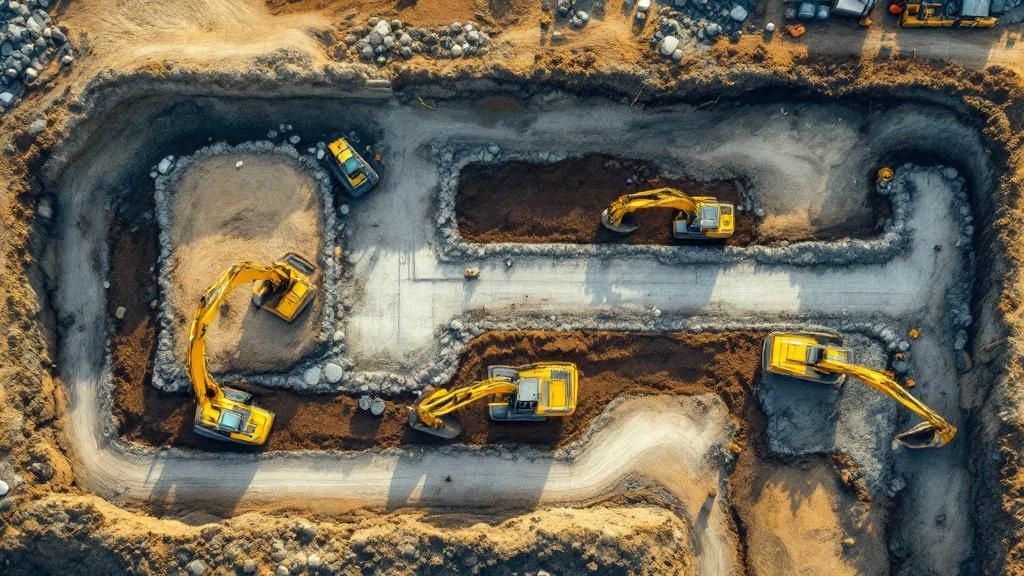
The success of your entire construction project really does hinge on the work done before a single foundation is poured. Picking the right commercial excavation contractor isn't just about comparing prices; it's the first critical step that influences everything from site safety to staying on budget. This guide will give you a real-world framework for properly vetting potential partners.
Think of this as your playbook for avoiding common headaches and finding a contractor who becomes a genuine asset. Our goal is to make sure your project is built on solid ground, right from the start.
It's More Than Just Moving Dirt
Exceptional excavation is so much more than digging holes. It's a precise, calculated process that demands meticulous planning, deep technical know-how, and a solid understanding of soil mechanics and local building codes. A top-tier contractor doesn't just show up with heavy machinery; they bring a strategic mind to the entire site development phase.
This strategic approach is what separates a reliable partner from a potential liability. They're the ones who anticipate challenges—like unexpected soil conditions, groundwater issues, or utility coordination snafus—before they can cause expensive delays and frustrating change orders.
The commercial excavation industry is a major player in the U.S. economy, with a market size expected to hit around $145.4 billion. After growing by 4.9%, it’s projected to climb another 2.5% in the coming year. You can dive into the full industry report over at IBISWorld.com.
Core Pillars of Evaluation
As you begin your search, it helps to break down your evaluation into a few key areas. Focusing on these pillars will help you compare companies apples-to-apples and make a much more informed decision.
To help you stay organized, here's a quick-glance table covering the essential areas to investigate when you're vetting potential excavation partners.
Key Evaluation Pillars for Excavation Contractors
| Pillar | What to Look For | Why It Matters |
|---|---|---|
| Verified Credentials | Proper licensing, comprehensive insurance, and sufficient bonding capacity. | These are non-negotiable safeguards that protect your project, budget, and liability. |
| Proven Experience & Safety | A strong portfolio of similar projects and a low Experience Modification Rate (EMR). | This demonstrates they can handle your job's scope and prioritize a safe work site. |
| Modern Equipment & Tech | A well-maintained fleet and use of tools like GPS-guided grading. | Modern tech ensures greater accuracy, efficiency, and can prevent costly rework. |
| Transparent Bidding & Comm. | Detailed, clear proposals and open lines of communication from the start. | A vague bid often hides future costs. Clarity builds trust and prevents surprises. |
Think of this table as your initial checklist. If a contractor falls short in any of these fundamental areas, it's a major red flag that's worth a closer look before you move forward.
Verifying Essential Contractor Credentials
Before you even start looking at bids, you need to do some homework. The first step is to weed out any contractors who are unqualified or just plain risky. This isn't the exciting part, but skipping it is like building a house on a shaky foundation—it's a recipe for disaster down the road.
Think of it as creating a shortlist of serious professionals. Your initial check should focus on the absolute non-negotiables that every legitimate commercial excavation contractor must have.
Insurance Is Your Financial Shield
First things first: insurance. Never, ever take a contractor’s word that they’re covered. You need to see the proof for yourself by requesting a Certificate of Insurance (COI), and it should come directly from their insurance provider, not from the contractor.
This piece of paper is your financial backstop. You're looking for two key policies:
- General Liability Insurance: This covers property damage or injuries to a third party that might happen during excavation. For most commercial jobs, you’ll want to see coverage of at least $1 million to $2 million. Larger, more complex projects will definitely require higher limits.
- Workers' Compensation Insurance: This is non-negotiable and legally required. It covers the contractor's own employees if they get hurt on your property. If they don't have it, you could be on the hook financially and legally if an accident occurs.
Key Takeaway: A Certificate of Insurance is more than just paperwork; it’s your protection. An underinsured contractor is a huge liability, transferring all that risk directly onto you. Always verify that their coverage is adequate for the scale of your project.
Understanding Contractor Bonding
Beyond insurance, you need to look at their bonding capacity. It’s a common point of confusion, but bonding is not the same as insurance. A bond is a financial guarantee that protects you if the contractor fails to complete the job or meet their obligations.
Essentially, a surety bond ensures there are funds available to finish the project or cover your losses if the original contractor defaults. For any large-scale commercial work, this is a critical layer of security.
Ask potential contractors about their bonding capacity and if they can secure a performance bond specific to your project's value. A contractor with a strong bonding capacity is one that a surety company has already thoroughly vetted and deemed financially stable and reliable. For a deeper look into what separates the best from the rest, you can find valuable insights on what makes for trusted excavation contractors.
Once you've thoroughly verified licenses, insurance, and bonding, you'll have a solid list of professional partners. This is the foundational work that allows you to move on to comparing bids with confidence, knowing every company you're considering is legitimate, compliant, and financially sound.
Gauging Their Equipment And Technology
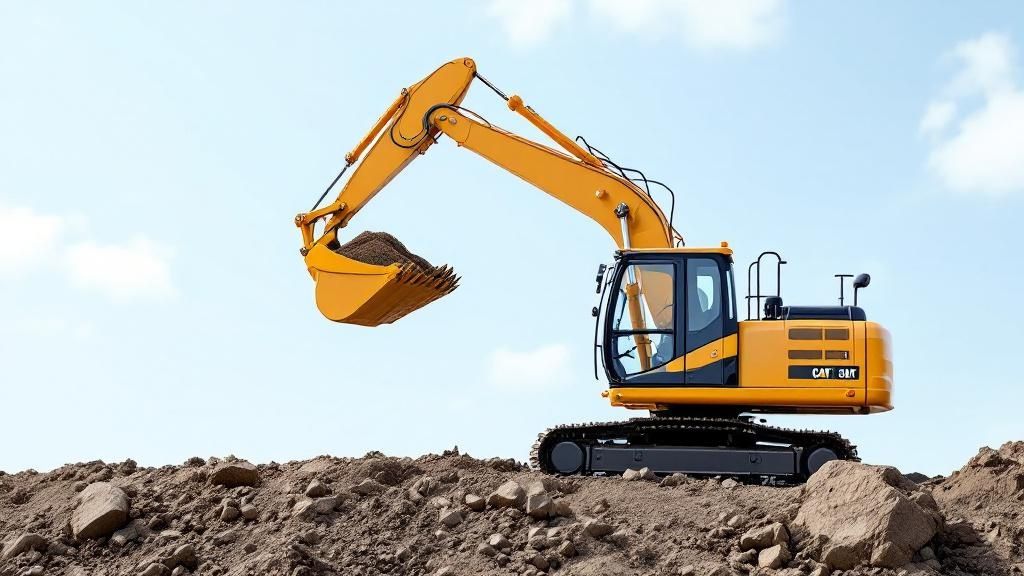
When you’re vetting a contractor, you’re not just hiring a team—you’re hiring their entire fleet of machinery. The equipment a company brings to your site says a lot about its professionalism and ability to get the job done right. Old, poorly maintained machines are a recipe for delays, costly breakdowns, and serious safety issues.
Look at the size and variety of their fleet. A top-tier contractor will have more than just one big excavator. They should have a diverse range of equipment, from massive bulldozers for heavy earthmoving down to nimble skid-steer loaders for detailed work. This ensures they have the right tool for every single task, from clearing the site to precision grading.
The Right Tools for the Job
A well-stocked fleet shows a contractor is ready for anything. For example, if your site has a high water table, do they have the dewatering pumps needed to manage it? If it’s a tight urban lot, do they have compact excavators that can maneuver without issues? Their inventory is a clear indicator of how prepared they are for both the expected and the unexpected.
This isn't just about having options; it's about efficiency. You'd never use a sledgehammer to hang a small picture frame. In the same way, a true professional won’t bring a giant dozer for a job that needs a delicate touch. Having the right machinery on hand is a fundamental part of providing quality excavation services in Monterey and the surrounding areas.
Don’t be shy about asking direct questions about their equipment:
- What does your maintenance schedule look like? They should have a clear, routine plan to keep their machines in top shape.
- Do you own your primary equipment or rent it? While some renting is normal, owning the core machinery often points to a more financially stable and established company.
- How does your fleet specifically match my project's needs? A good contractor can walk you through exactly which machines they plan to use and why they’re the best fit.
Getting clear answers here helps you understand just how professional and prepared they really are.
Technology's Role in Modern Excavation
These days, it’s about more than just brute force. The best contractors are the ones who embrace technology to boost accuracy, safety, and speed.
Take GPS-guided equipment, for instance. This technology allows operators to grade a site to exact digital plans, often with accuracy down to a fraction of an inch. It practically eliminates the old-school method of using stakes and lasers, which saves on labor costs and drastically reduces the chance of human error.
The global market for construction equipment is booming, projected to jump from $171.98 billion to over $271.30 billion by 2032. This surge reflects a massive industry-wide investment in more advanced, efficient machinery. You can dig deeper into these trends in this detailed report from Fortune Business Insights.
Modern tech doesn’t stop there. Things like drone surveying can create incredibly precise topographical maps of a job site in just a few hours—a task that used to take a ground crew days to complete. This data is pure gold for planning, tracking progress, and calculating soil volumes. When a contractor invests in these tools, they’re really investing in your project's success.
Investigating Safety Records and Past Projects
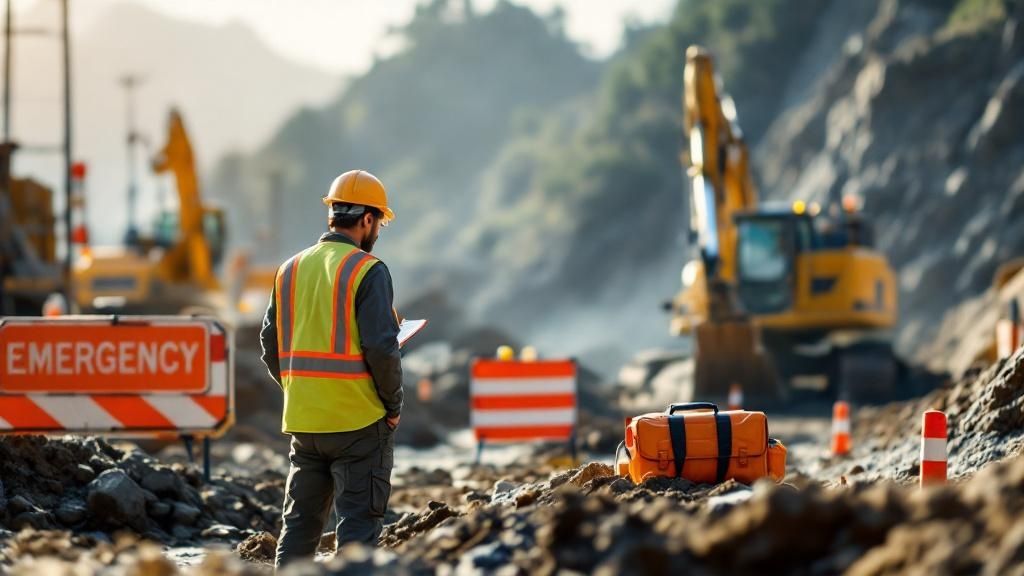
A contractor's track record is the best crystal ball you have. Before you sign anything, you have to do your homework and dig into their safety culture and project history. This is where you move past the shiny brochures and curated website testimonials to get a real, unvarnished look at how a company performs when things get tough.
Start with the hard data. While licenses and insurance prove a company is legally compliant, their safety metrics tell you about their discipline on the job, day in and day out.
Decoding the Safety Numbers
The single most important safety number to look at is the Experience Modification Rate (EMR). Insurers calculate this rate by comparing a company's workers' compensation claims history against the industry average. It’s a straightforward way to see how they stack up.
Think of an EMR of 1.0 as the industry baseline. Anything below 1.0 means the contractor has a better-than-average safety record. A number above 1.0 is a warning sign, suggesting they have more on-the-job accidents than their peers. Any professional, reputable company will share this number with you without hesitation.
Expert Tip: An EMR of 0.85 or lower is what you really want to see. This signals a proactive safety culture—a team that's committed to preventing incidents, not just reacting to them. A high EMR isn't just a number; it’s a major red flag that could mean project delays and potential liabilities for you.
Asking References the Right Questions
Talking to past clients is essential, but you can't just ask, "Were you happy with their work?" To get the real story, you need to ask questions that reveal how they communicate, solve problems, and stick to a schedule.
Instead of generic questions, try getting specific to see how they really operate:
- On Communication: "Can you tell me about a time there was an unexpected issue or a simple misunderstanding? How did the project manager handle it?"
- On Problem-Solving: "Did you run into any major challenges, like discovering bad soil or hitting an unmarked utility line? What was their process for fixing it?"
- On Scheduling: "How accurate was their initial timeline? If there were delays, how did they let you know and what did they do to get back on track?"
The answers you get are gold. They tell you about a contractor’s character under pressure. For example, how a team handles an unmarked pipe is a huge deal—one mistake can shut down services for an entire block. You can get a better sense of these complexities by reviewing a guide that explains underground utilities and their installation.
Taking the time for this deep dive ensures you’re partnering with a team that isn't just skilled, but also reliable, transparent, and safe.
Deconstructing the Bid to Find True Value
Getting proposals from several commercial excavation contractors is a great step forward, but this is where the real work begins. It’s tempting to jump straight to the bottom line, but I can tell you from experience: the lowest number on the page is rarely the best deal in the long run. To find a true partner for your project, you have to dig into each bid to understand what’s included and, more importantly, what’s not.
A price-only comparison is a fast track to painful change orders and project delays. Think of this stage as a value assessment, not just a price check. Lay the bids out side-by-side and go through them line by line. A professional, high-quality bid will be incredibly detailed, breaking down the costs for mobilization, site clearing, bulk excavation, backfilling, final grading, and demobilization.
Looking Beyond the Bottom Line
Vague language is your biggest red flag. Be wary of phrases like "handle unsuitable soils as needed" or "site dewatering per requirements." That's far too ambiguous. A professional bid gets specific. For instance, it should detail a clear plan for soil management, including the estimated volume of soil to be moved off-site and the associated tipping fees.
Likewise, if you’re dealing with a high water table, a solid proposal will outline a clear dewatering strategy, not just mention it as a vague possibility. These are the details that separate a thorough, honest bid from one that's designed to win on price and make up the difference on extras later.
This chart shows how costs can vary for different excavation tasks. It’s a good visual reminder of how different phases of the work are priced.
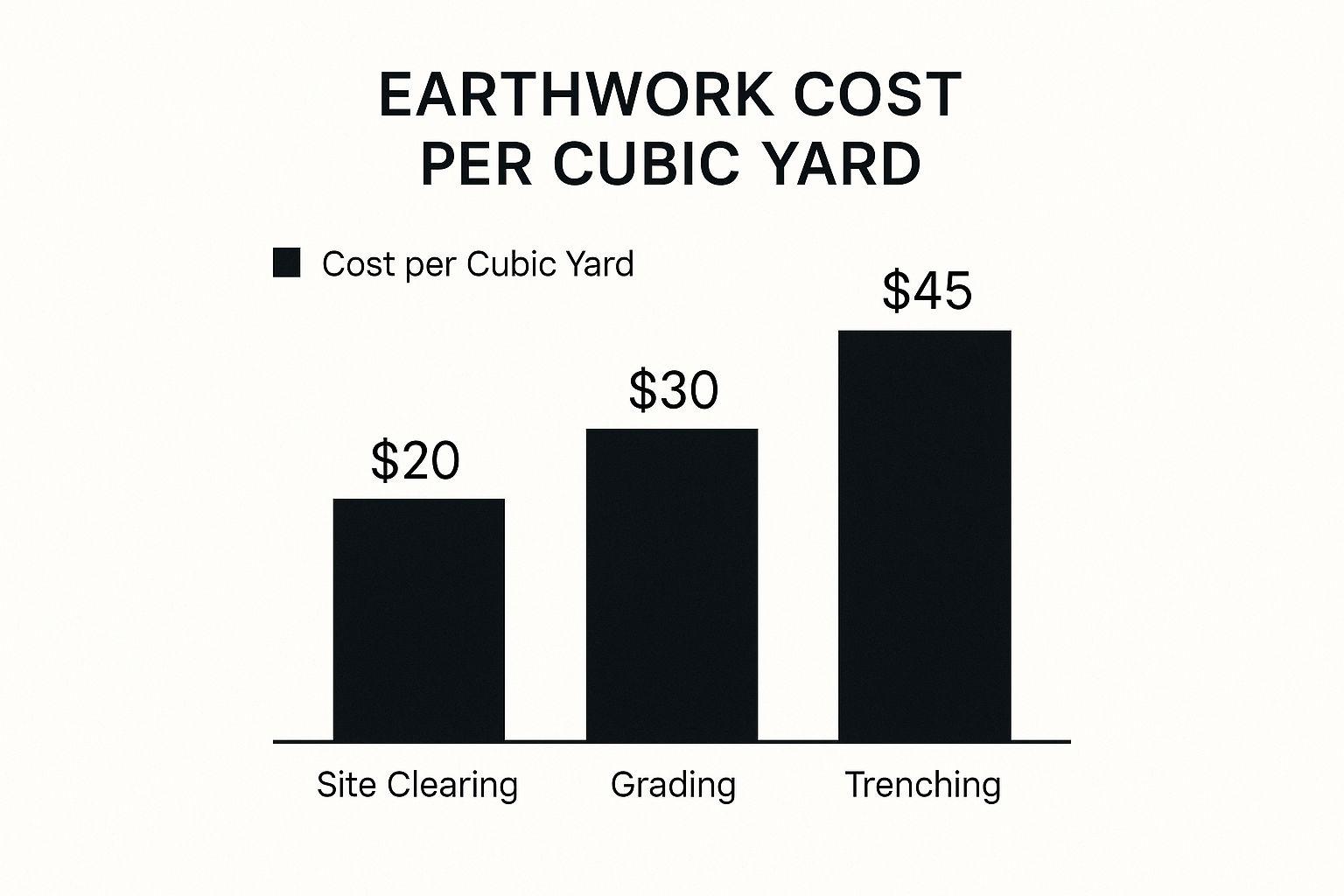
As you can see, specialized work like trenching often carries a higher unit cost than general site clearing because of the precision and extra safety measures required.
Bid Comparison Checklist
To make this easier, use this checklist to systematically compare the bids you receive. It helps you look past the total price and focus on the details that determine the best overall value for your project.
| Evaluation Item | Contractor A | Contractor B | Contractor C |
|---|---|---|---|
| Total Bid Price | |||
| Scope of Work Detailed? | |||
| Soil Management Plan Included? | |||
| Dewatering Strategy Defined? | |||
| Realistic Project Timeline? | |||
| Permit Fees Included? | |||
| Utility Protection Plan? | |||
| Backfilling & Compaction Specs? | |||
| Site Cleanup Included? | |||
| Contingency Allowances? | |||
| Insurance & Licensing Verified? | |||
| Overall Confidence Level |
By filling this out for each contractor, you’ll quickly see which company has truly thought through your project and which one just threw a number on a page.
Analyzing Timelines and Inclusions
Finally, take a hard look at the proposed timeline. Does it actually seem realistic? An overly aggressive schedule can be a major warning sign. It might mean the contractor has underestimated the complexity of the work or is just telling you what you want to hear to secure the job. Don't be afraid to ask them to walk you through their project phasing and key milestones.
The excavation and demolition sector is a massive global industry—valued at around $560.01 billion and projected to climb to $628.19 billion by 2029. This scale means that established professionals have refined their bidding processes to a science.
Key Takeaway: A detailed bid is the mark of a true professional. It shows they’ve thoroughly analyzed your plans, anticipated potential challenges, and priced the work transparently. The best bid gives you confidence, not just a low number.
Double-check the fine print for specific inclusions and exclusions. Does the bid cover costs for:
- Permit Fees: Make it crystal clear who is responsible for pulling and paying for all necessary permits.
- Utility Protection: What specific measures will they take to locate and safeguard existing underground utilities?
- Backfilling and Compaction: This is a crucial step for ensuring ground stability. Properly defined backfilling in excavation is non-negotiable and must be spelled out in the bid.
- Site Cleanup and Restoration: The proposal should explicitly state that the site will be left clean, safe, and secure when the work is done.
Taking the time for this level of detailed review transforms your process from a simple price check into a genuine assessment of which commercial excavation contractor offers the best value and lowest risk for your project.
Common Questions About Hiring Excavators
Even if you’ve got a detailed plan in your hands, you’re bound to have questions when it’s time to hire a commercial excavation contractor. It's a complex process with a lot of moving parts, and getting straight answers is the only way to move forward with confidence.
We get asked a lot of the same questions by project managers and developers. Let's cut through the jargon and get you the practical advice you need.
Is Commercial Excavation Really Different from Residential?
People often wonder if there's a real difference between digging for a new house and digging for a new shopping center. The short answer? Yes, a huge one. While both involve moving dirt, the scale, equipment, and regulations are in completely different leagues.
Residential jobs usually mean smaller equipment for simpler tasks, like digging a single home's foundation. Commercial excavation is a whole other beast—think office buildings, retail developments, or public infrastructure. This kind of work absolutely requires:
- Heavy-duty and specialized equipment for moving massive amounts of earth and handling specific site challenges.
- Deep knowledge of complex regulations, from OSHA safety rules to intricate local building codes.
- Advanced technical skill to manage things like shoring deep trenches, dewatering a soggy site, and coordinating with a dozen different utility companies.
A contractor who’s great at residential projects likely doesn’t have the right experience or machinery for a large-scale commercial site. You need a firm that lives and breathes commercial work.
The key takeaway here is simple: commercial excavation is a different game. Your contractor must have a proven track record of managing large, complex sites, navigating the maze of permits, and ensuring the safety of a much more significant project.
How Much Does Commercial Excavation Cost?
This is usually the first question on everyone's mind, but there’s no quick answer. The cost of commercial excavation can vary dramatically depending on the specifics of your project. It's never a one-size-fits-all price.
The main cost driver is the volume of soil that needs to be moved, typically priced per cubic yard. But that's just the start. A professional, detailed bid will also account for:
- Mobilization: The cost of getting all that heavy equipment to your site and back again.
- Site Accessibility: Is the site wide open or tucked away in a tight spot? Difficult access means more time and labor.
- Soil Conditions: Hitting unexpected rock or dealing with contaminated soil requires special equipment and disposal methods, which can drive up the price.
- Scope of Work: The final price tag depends on what’s included—just the bulk digging, or does it also cover utility trenching, final grading, and hauling away excess soil?
This is why getting multiple, highly detailed bids is so important. You can get a better sense of what a professional proposal looks like by learning how to evaluate bids from experienced excavation contractors in Monterey County.
Who Is Responsible for Getting the Permits?
Figuring out the permitting process is a critical step you can't afford to get wrong. In most cases, either the project's general contractor or the commercial excavation contractor will handle all the necessary permits.
The most important thing is to get it in writing. Your contract must clearly state who is responsible before a single shovel hits the ground.
A reputable excavation firm will know the local permit requirements inside and out and likely has good relationships with the municipal inspectors. They should be able to manage the entire process for you, from submitting the application to scheduling the final inspection. This ensures your project stays compliant and you avoid costly stop-work orders. Never assume it's being handled—confirm it in your contract.
At Coastal Pipeline Inc., we bring decades of hands-on experience to every project, ensuring your site is prepared with precision and professionalism. If you need a reliable partner for your next commercial project, visit us at https://coastalpipelineinc.com to learn more about our services.