
At its heart, storm water drainage system design is the master plan for how a community or property handles rain and runoff. Think of it like a carefully engineered circulatory system for a neighborhood, designed to prevent "clots" like flooding while keeping the environment healthy. A properly designed system doesn't just get rid of water—it guides it safely, protects natural habitats, and meets tough regulatory standards.
Why a Solid Storm Water Drainage Design is Non-Negotiable
Picture a heavy downpour in a city. Without a smart drainage plan, you know what happens: streets become canals, basements fill with water, and dirty runoff pours into local streams and rivers. An effective storm water drainage design is your first and best defense against this kind of chaos. It's more than just a network of pipes; it's critical infrastructure that protects people, property, and the environment.
A modern design goes far beyond just moving water from point A to B. It’s about balancing public safety, ecological health, and legal duties.
To get it right, every design needs to hit three key objectives. Below is a quick look at what we're aiming for with every project.
Core Objectives of Storm Water Drainage Design
| Objective | Key Considerations | Primary Outcome |
|---|---|---|
| Flood Prevention & Property Protection | Calculating runoff from peak rainfall, pipe/channel capacity, and overflow routes. | Safe communities with minimized risk of water damage to homes, roads, and businesses. |
| Water Quality Preservation | Runoff pollutants (oil, sediment, chemicals), treatment methods (bioswales, ponds). | Cleaner rivers, lakes, and coastal waters free from urban and industrial contaminants. |
| Regulatory & Environmental Compliance | Federal, state, and local laws like the Clean Water Act, permits, and discharge limits. | Legal, fine-free projects that demonstrate responsible environmental stewardship. |
These three goals work hand-in-hand. Focusing on just one or two is a recipe for system failure, expensive fixes, or environmental trouble down the road.
The Three Pillars of Modern Drainage Design
A truly effective design is built on three interconnected goals. Get one wrong, and the whole system is at risk.
- Flood Prevention and Property Protection: The most obvious job is stopping floods. We calculate the massive amount of water a severe storm can produce and then design a system with the capacity to handle it, directing it safely away from homes, businesses, and critical roads. This is all about protecting property values and, more importantly, keeping people safe.
- Water Quality Preservation: When rain washes over parking lots, roads, and rooftops, it picks up all sorts of nasty stuff—oil, fertilizers, heavy metals, and dirt. A modern storm water drainage system design includes features like detention ponds and vegetated bioswales that act as natural filters, cleaning this runoff before it pollutes our rivers and lakes.
- Regulatory and Environmental Compliance: There are strict rules from local, state, and federal agencies that dictate how clean stormwater discharge must be. A compliant design meets all these legal requirements, helping property owners avoid huge fines and liability. It’s also about being a good neighbor to the environment.
A well-designed drainage system doesn't just manage a nuisance; it transforms a potential hazard into a manageable resource. It's about proactive engineering that prevents problems before they start, ensuring the long-term viability and health of a community.
It's Much More Than Just Pipes
The stakes are incredibly high. An undersized system can lead to catastrophic flooding, causing millions in damages and forcing people from their homes. A system that ignores water quality can poison local ecosystems, leading to things like toxic algal blooms and fish kills.
On the other hand, getting the storm water drainage system design right adds tremendous value. It makes it possible to build safely in areas that get a lot of rain, boosts property values by reducing flood risk, and protects the natural beauty of our local watersheds. It’s the invisible workhorse that makes modern communities possible, turning a destructive force of nature into something we can manage.
The Evolution of Storm Water Management
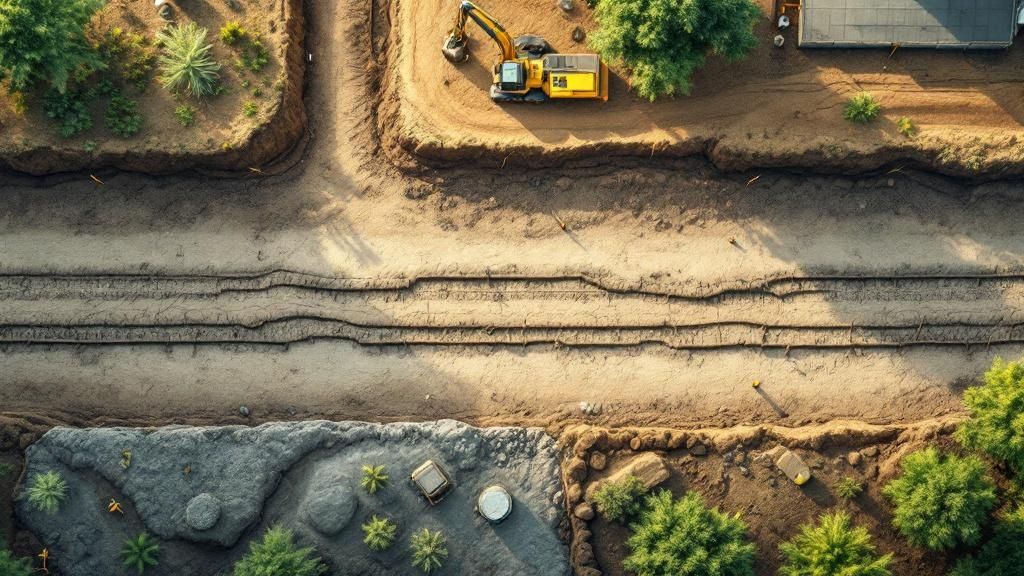
To really get a handle on modern stormwater drainage design, it helps to look back at where it all started. This isn't a new problem—far from it. Civilizations have been trying to solve the puzzle of rainwater runoff for thousands of years, and the principles we count on today were built on centuries of trial and error.
The journey began in ancient times. Way back around 2000 BC, the Minoan civilization on Crete built sophisticated storm drains and channels to manage rainfall in cities like Knossos. The Indus Valley Civilization had similarly advanced systems, with covered sewers running beneath the streets of Harappa and Mohenjo-daro. Even then, it was clear that organized water management was essential for a functioning city.
For a long time, the goal was simple: get the water away from populated areas as fast as possible. This philosophy of rapid conveyance was the go-to approach for centuries.
The Shift Toward Urban Systems
Fast forward to the 18th and 19th centuries. As cities boomed during the Industrial Revolution, the old methods just couldn’t keep up. Porous, absorbent earth was paved over, creating vast impermeable surfaces that sent huge volumes of water rushing through developing urban centers. This created massive flooding and serious public health issues.
In response, cities started building the first formal storm sewer networks. Cincinnati, for example, began constructing a dedicated system back in 1828 to fight off constant flooding. While these systems were a major step forward, many eventually became combined sewers, mixing stormwater with raw sewage—a decision that created a whole new set of environmental problems for future generations to solve.
A New Philosophy Emerges
The 20th century brought a harsh reality check. The old "convey and dispose" model was causing real damage. Funneling polluted runoff straight into rivers, lakes, and oceans was devastating local ecosystems, and it became clear a change was needed.
The modern approach to storm water drainage system design is not just about disposal. It's about management. The focus has shifted from rapidly removing water to slowing it down, cleaning it, and integrating it back into the natural water cycle.
This new way of thinking is what powers today's sustainable and integrated methods. Modern design is all about mimicking nature's own processes. Instead of relying only on pipes to whisk water away, we now incorporate smarter solutions:
- Detention Ponds: These basins act like temporary holding tanks for excess runoff, releasing it slowly to prevent downstream flooding and erosion.
- Infiltration Trenches: Gravel-filled channels are designed to let stormwater soak back into the ground naturally, which helps recharge vital aquifers.
- Green Infrastructure: This includes things like rain gardens, green roofs, and permeable pavement that absorb and filter water right where it falls.
This evolution shows how far we've come. By learning from the past, today’s engineers can design smarter, more resilient storm water management systems that protect both our communities and the environment. This history is key to understanding why today's standards are so focused on sustainability and water quality.
Understanding Modern Hydrology and Design Principles

A truly effective storm water drainage system design starts with a deep respect for how water behaves on the land. That's where modern hydrology comes in—it’s the science of tracking a raindrop’s journey from the sky to its final destination. This understanding forms the bedrock for every pipe, channel, and basin we build.
Our starting point is always a hypothetical storm, what we call the design storm. This isn't just a random downpour; it’s a specific, statistically-defined event that the system must handle without failing. Based on historical weather data and local rules, engineers define its intensity and duration, like a "25-year storm."
Once we know the storm we're designing for, we have to figure out how much of that rain actually becomes runoff.
Runoff Coefficients and Time of Concentration
Think about what happens when you pour water on two different surfaces: a dry sponge versus a slick pane of glass. The sponge soaks up a lot of water, while the glass sheds almost all of it instantly. This simple idea is exactly what a runoff coefficient measures.
- High Coefficients: Impervious surfaces like asphalt parking lots or rooftops have high coefficients, around 0.95. This means about 95% of the rain that falls on them becomes runoff.
- Low Coefficients: Grassy fields and forests have low coefficients, maybe 0.20, because they absorb a huge amount of rainfall.
Another critical piece of the puzzle is the time of concentration. This is how long it takes for water from the farthest point of a property to reach the drainage system's outlet. A short, steep, paved driveway will have a fast time of concentration, while a long, flat lawn will have a much slower one. These two factors are essential for calculating the peak flow the system must manage.
The biggest change in modern design is a shift away from the old "get rid of it fast" mentality. Today, our goal is to slow water down, clean it, and release it in a way that mimics nature's own water cycle.
This new philosophy has led to a smarter approach called Low Impact Development (LID).
From Rapid Conveyance to Sustainable Management
Instead of just funneling all water into a big pipe, LID uses a mix of natural features and green infrastructure to manage stormwater right where it falls. These techniques work to detain, retain, and infiltrate runoff.
This approach doesn't just reduce the burden on traditional "gray" infrastructure; it also brings powerful environmental benefits.
| Management Technique | Primary Function | How It Works |
|---|---|---|
| Detention | Reduces Peak Flow | A detention basin temporarily holds a large volume of stormwater, releasing it slowly to prevent downstream flooding and erosion. |
| Retention | Manages Volume & Quality | A retention pond holds a permanent pool of water, which allows pollutants to settle out and provides a habitat for wildlife. |
| Infiltration | Recharges Groundwater | Systems like infiltration trenches and permeable pavers let stormwater soak directly into the ground, filtering pollutants and refilling local aquifers. |
These strategies are the building blocks of a modern storm water drainage system design. For instance, our expert stormwater trenching solutions in Monterey often use infiltration methods to handle runoff sustainably. By combining these smart techniques, we create resilient systems that protect property, improve water quality, and meet all environmental regulations—often while reducing the size and cost of the pipe network.
Calculating Runoff and Sizing Your System
Once we have a solid grasp of hydrology, we can roll up our sleeves and get into the practical engineering that makes a storm water drainage system design work. This is where theory hits the dirt, turning rainfall data and site features into a functional network of pipes and channels. Getting the math right isn't just a technicality—it’s the only way to ensure your system can stand up to a major storm without failing.
For most small to mid-sized sites, the calculations start with a time-tested formula known as the Rational Method. It’s a straightforward, reliable way to estimate the peak runoff rate a drainage system needs to handle.
Demystifying the Rational Method (Q = CIA)
Think of the Rational Method as a simple recipe for predicting the worst-case scenario for water flow. It’s an elegant equation that ties together the key variables we’ve already discussed. The formula is Q = CIA, and each letter represents a crucial ingredient:
- Q (Peak Flow Rate): This is the number we're solving for. It represents the maximum amount of water, usually measured in cubic feet per second (cfs), that will pour into the drainage system at the peak of the storm.
- C (Runoff Coefficient): This is the "sponge vs. glass" factor. It’s a value between 0 and 1 that reflects how much rain will actually run off the surface. Pavement has a high C-value, while a dense forest has a very low one.
- I (Rainfall Intensity): Pulled from historical weather data, this tells us how hard the rain is expected to fall (in inches per hour) during a specific design storm, like a 25-year or 100-year event.
- A (Drainage Area): This is simply the total size of the property or watershed, measured in acres, that drains to a single point in our system.
By multiplying these three values, we can accurately predict the peak flow (Q) the pipes and channels must be built to handle. Getting accurate data for C, I, and A is the foundation of a safe, effective design.
The Rational Method gives us a critical snapshot of the peak stress a drainage system will face. That single number, Q, drives every design decision that follows, from pipe diameter to channel slope.
This is where the calculated peak flow rate directly influences the physical components of the system, like pipe size and material choices.
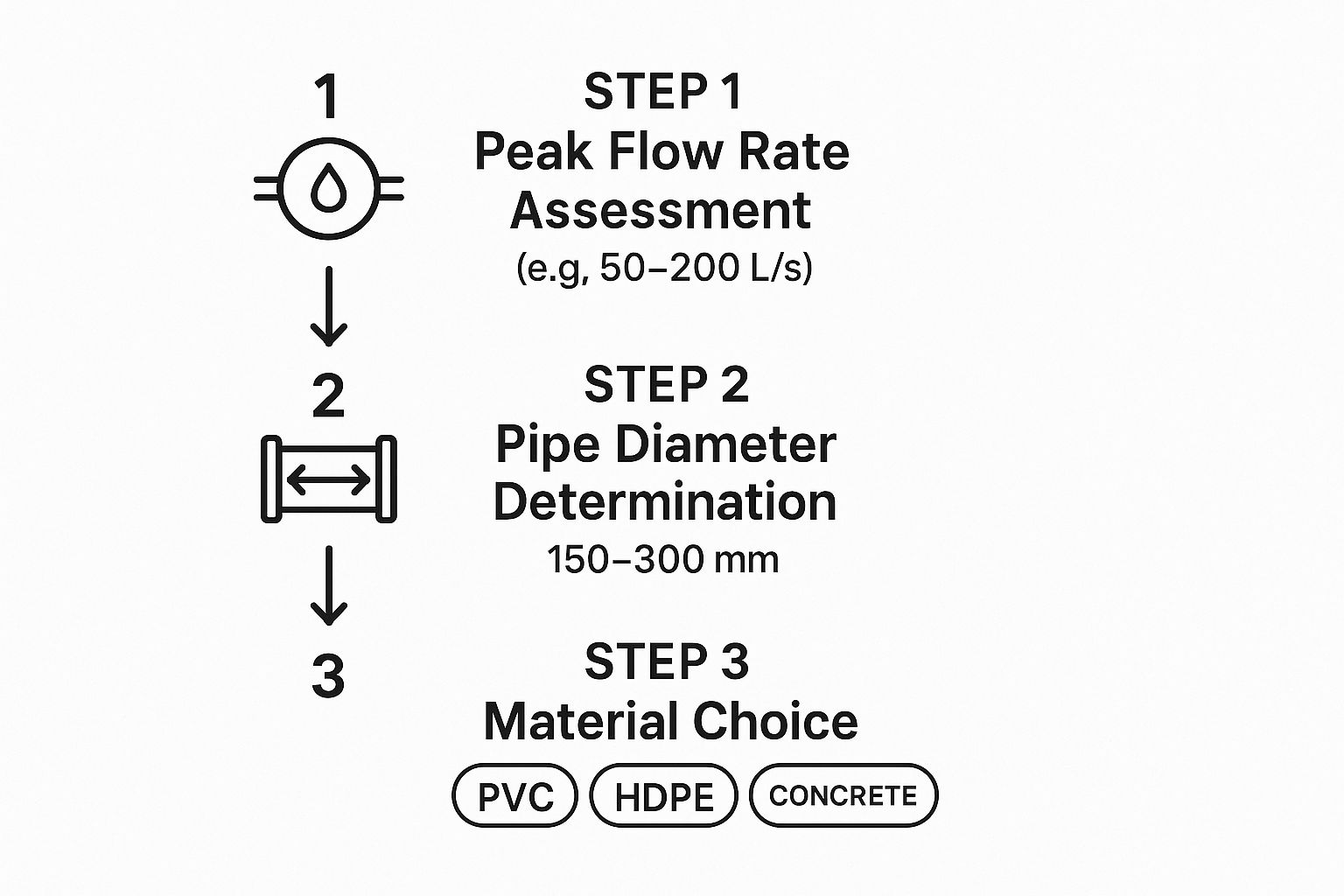
As you can see, a higher peak flow rate forces the use of larger pipes, which in turn might require stronger materials to manage the increased volume and pressure.
Sizing Pipes and Channels with Manning's Equation
Once we know our peak flow (Q), the next logical step is to design the conduits that will carry that water away safely. We can't just guess on pipe size. The pipes need to be large enough to move the water without backing up, but not so oversized that they become prohibitively expensive.
This is where another essential engineering tool, Manning's Equation, enters the picture. It helps us calculate the flow capacity of an open channel or a pipe that isn't flowing completely full. It accounts for a few key real-world factors:
- Pipe Roughness: Different materials create different amounts of friction. Water flows much more freely through a smooth PVC pipe than a rough corrugated metal or concrete one. This "roughness coefficient" is a huge part of the calculation.
- Channel Slope: Gravity is the engine powering the whole system. A steeper slope makes water move faster, which increases a pipe's overall capacity.
- Hydraulic Radius: This is a technical term that essentially measures how efficiently a pipe or channel's shape can carry water.
By balancing these variables, engineers can precisely size every piece of the storm water drainage system design. They can lock in the exact diameter and slope needed for each pipe run to manage its calculated flow. This careful work ensures the entire network functions as a cohesive unit, preventing bottlenecks and protecting the property from flooding when the big storm finally hits.
Choosing the Right Materials and Components
Even the most brilliant storm water drainage system design is only as strong as its weakest link. Once the math is done and the flow rates are locked in, the real work begins: selecting the physical hardware that will form the backbone of your entire network. This isn't just about finding what's cheapest upfront—it's a critical decision that dictates durability, long-term maintenance costs, and whether the system will hold up for decades to come.
The most fundamental choice you'll make is the pipe itself. Think of pipes as the system's arteries, built to move massive volumes of water reliably, year after year. While many materials exist, two tend to dominate the industry for very good reasons, but they each serve different needs and budgets.
Comparison of Common Storm Drain Pipe Materials
Choosing the right pipe material is always a balancing act. You're weighing strength, cost, and how efficiently water can move through it. For generations, Reinforced Concrete Pipe (RCP) was the undisputed workhorse, prized for its raw structural strength and incredible longevity. More recently, High-Density Polyethylene (HDPE), a tough and flexible plastic, has emerged as a modern alternative with its own unique advantages.
Here's a look at how these two common materials stack up against each other.
Comparison of Common Storm Drain Pipe Materials
| Material | Key Advantages | Key Disadvantages | Typical Lifespan | Best Use Cases |
|---|---|---|---|---|
| Reinforced Concrete Pipe (RCP) | Incredible structural strength; resists immense soil and traffic loads. Can't be crushed easily. | Heavy and rigid, requiring heavy equipment for installation. Higher upfront material and labor costs. | 75-100+ years | Underneath heavy-load roadways, deep burial applications, or where structural integrity is the top priority. |
| High-Density Polyethylene (HDPE) | Lightweight, flexible, and highly resistant to corrosion and abrasion. Smooth interior for better flow. | Lower structural rigidity compared to RCP; may not be suitable for extreme load-bearing situations. | 50-100 years | Systems in corrosive soil, projects with tight budgets, or areas where installation access is difficult. |
Ultimately, the right choice depends entirely on the project's specific demands. For a system buried deep under a busy highway, the unyielding strength of RCP is probably the non-negotiable choice. But for a drainage network in salty coastal soil or on a site with a tight budget, the chemical resistance and lower installation cost of HDPE make it the smarter pick.
More Than Just Pipes: The Other Essential Components
A drainage network is so much more than just a series of pipes buried underground. A whole host of other components work in harmony to collect, direct, and manage stormwater before it ever reaches the pipe. Get any of these wrong, and the whole system can fail.
- Catch Basins: These are the grated drains you see along curbs and in parking lots. Their job is simple but vital: act as the front door for runoff, capturing water and funneling it into the pipe network. They also have a sump at the bottom to trap leaves, trash, and sediment, which helps prevent clogs downstream.
- Manholes: Think of these as the system's service hatches. Placed at key junctions, turns, or long straight runs, they provide critical access points for inspection, cleaning, and maintenance. They're what allow crews to get cameras or high-pressure water jetters inside to keep things flowing freely.
- Outlet Structures: This is the end of the line, where all the collected stormwater is safely discharged back into the environment—whether that's a river, a detention pond, or an infiltration field. These are carefully engineered with headwalls and rock armor (riprap) to slow the water down and prevent erosion at the discharge point.
All these pieces have to fit together and function perfectly. You can learn more about how they create a complete system in our guide on what a drainage trench is and how it works.
The selection of materials and components is a balancing act. It requires weighing upfront investment against the long-term operational costs and the specific environmental stresses the system will face over its lifetime.
Trying to save a few dollars with cheaper, lower-quality components is a recipe for disaster. It often leads to premature failure, emergency repairs that cost a fortune, and serious liability down the road. A carefully considered selection ensures your storm water drainage system design will perform exactly as it should for generations.
Navigating Environmental and Regulatory Compliance
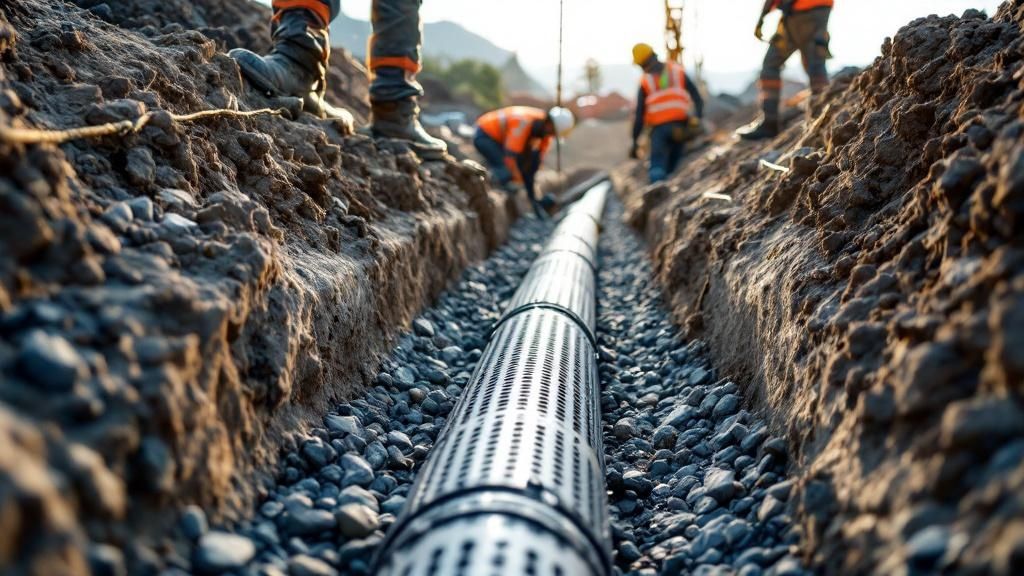
Designing a modern storm water drainage system is much more than just an engineering puzzle—it’s a serious legal and environmental responsibility. Long gone are the days when simply moving water from point A to point B was good enough. Today, every design must actively protect our natural waterways, a major shift that’s a direct result of decades of environmental advocacy and landmark regulations.
This change was kickstarted by a massive, nationwide problem called Combined Sewer Overflows (CSOs). For many years, older cities relied on a single pipe system for both sanitary sewage and stormwater. When a heavy storm hit, these systems were easily overwhelmed, discharging a foul mix of raw sewage and polluted runoff straight into our rivers and lakes.
The environmental damage was immense. In the mid-20th century, cities with these combined sewers were major polluters. During the 1930s, for example, it wasn't uncommon to see visible floating sewage in the Mississippi River. To turn the tide, cities like Minneapolis launched huge, multi-decade projects in the 1960s to separate their sewer systems, a critical move that dramatically improved water quality.
The Clean Water Act and NPDES Permits
The widespread pollution from CSOs and industrial waste eventually led to the creation of the Clean Water Act (CWA). This was a game-changer. The CWA set up the framework for regulating any pollutant discharges into U.S. waters and gave the Environmental Protection Agency (EPA) the power to enforce pollution control programs.
Out of the CWA came the National Pollutant Discharge Elimination System (NPDES) permit program, which is now the backbone of stormwater regulation.
An NPDES permit is basically a license for a construction site or facility to discharge stormwater. But it comes with a catch: the discharge must meet strict requirements designed to protect water quality. It’s what turns environmental goals into legally binding rules.
Getting and maintaining an NPDES permit is a non-negotiable part of any land development project. It forces designers to prove that their system will properly treat runoff and won't harm the local ecosystem. Failing to comply can lead to hefty fines and legal battles, which is why it's a central focus of any modern storm water drainage system design.
Proving Compliance with Advanced Modeling
So, how do engineers actually prove their design will work before anyone even breaks ground? The answer lies in powerful computer modeling tools that can simulate exactly how a system will behave during a storm. The go-to tool for this is the EPA’s Storm Water Management Model (SWMM).
First developed between 1969 and 1971, SWMM lets designers create a virtual model of their proposed drainage network. They can plug in real-world data like rainfall patterns, soil conditions, pipe sizes, and land use to predict crucial outcomes:
- Peak flow rates throughout the system.
- The total volume of runoff created.
- The concentration of pollutants in the final discharge.
- How effective green infrastructure like detention ponds will be.
By running these simulations, engineers can tweak and perfect their designs, show regulators that the plan works, and ensure it truly protects the environment. This kind of detailed modeling is a key piece of the comprehensive services needed for today's storm drainage systems in Monterey and Santa Cruz County. It’s the final step that connects engineering precision with environmental responsibility.
Frequently Asked Questions About Drainage Design
Even with a perfect plan on paper, questions always come up during a storm water drainage system design. Modern projects face new hurdles from climate change, evolving regulations, and new technologies, making things more complex. Here are some straightforward answers to the questions we hear most often from engineers and project owners.
The biggest challenge we face today is designing for a changing climate. Rainfall is getting more intense and more frequent, which means historical data just isn't the reliable guide it used to be. This forces us to engineer systems for storms much more severe than what past records show. It often means bigger pipes, stronger materials, and integrating green infrastructure to handle those unpredictable peak flows.
Green Versus Gray Infrastructure
One common point of confusion is the difference between "green" and "gray" infrastructure. It's a key distinction that shapes how we approach modern drainage.
- Gray Infrastructure: This is the traditional stuff. Think concrete pipes, curbs, gutters, and large vaults built to get water off-site as fast as possible.
- Green Infrastructure: This approach copies natural systems to manage stormwater right where it lands. Things like rain gardens, permeable pavers, and vegetated bioswales absorb and filter runoff, releasing it slowly to ease the burden on the main pipe network.
Today, the most effective systems often blend the two, pairing the reliability of gray infrastructure with the sustainable, long-term benefits of green solutions.
System Lifespan and Long-Term Viability
Another big question is always, "How long will it last?" The lifespan of a storm drainage network really depends on the materials. High-quality reinforced concrete pipes can last 75 to 100 years, while top-tier plastics like HDPE or PVC have a service life of 50 to 100 years in the right conditions.
But the material is only half the battle.
A system's true service life is heavily impacted by what's happening around it. Factors like soil chemistry, the quality of the installation, daily traffic loads, and how often it's maintained all determine whether a system will actually last as long as it was designed to.
This long-term performance is a huge concern. Right now, the U.S. has about 3.5 million miles of storm sewers, and over 60% of utilities say that aging infrastructure is one of their biggest operational headaches. The cost to fix this is enormous—an estimated $115.3 billion is needed over the next 20 years, which is way more than current federal funding provides. You can dig into the data on the Infrastructure Report Card website to see the full scope of the challenge.
Proper design, material selection, and maintenance are critical to making sure a new system doesn't just add to this problem. Understanding the benefits of a well-constructed drainage trench is a great place to start when building for true longevity.
At Coastal Pipeline Inc., we build resilient, compliant, and durable storm drainage systems designed to last. From initial design consultation to final installation, our expert teams ensure your infrastructure meets the highest standards of performance and safety. Contact us today to discuss your next project at https://coastalpipelineinc.com.