
Direct Answer: Every patch buys a little time but leaves the underlying failure in place. Eventually the line collapses, backs up, or fails a municipal inspection — and the repair cost multiplies.
A sewer line repair feels like the right call in the moment. The line is backing up, you call a contractor, they spot-repair a cracked joint or root intrusion, and the system flows again. But if that same line is failing in multiple places, every patch is just delaying the same conversation.
In Monterey County, property owners and contractors face a specific set of pressures that make this cycle more costly than in most regions. Monterey One Water connection permitting requirements, county encroachment permits, and Santa Cruz County’s sewer lateral ordinance all attach compliance obligations to sewer work — meaning a line that keeps failing eventually triggers a mandatory inspection, not just another repair call.
This article breaks down what actually happens to a sewer system when patching becomes the default strategy, when the math stops working in your favor, and how to recognize the point where a full sewer line replacement is the only decision that makes financial sense.
Why Sewer Lines Keep Failing After Repairs
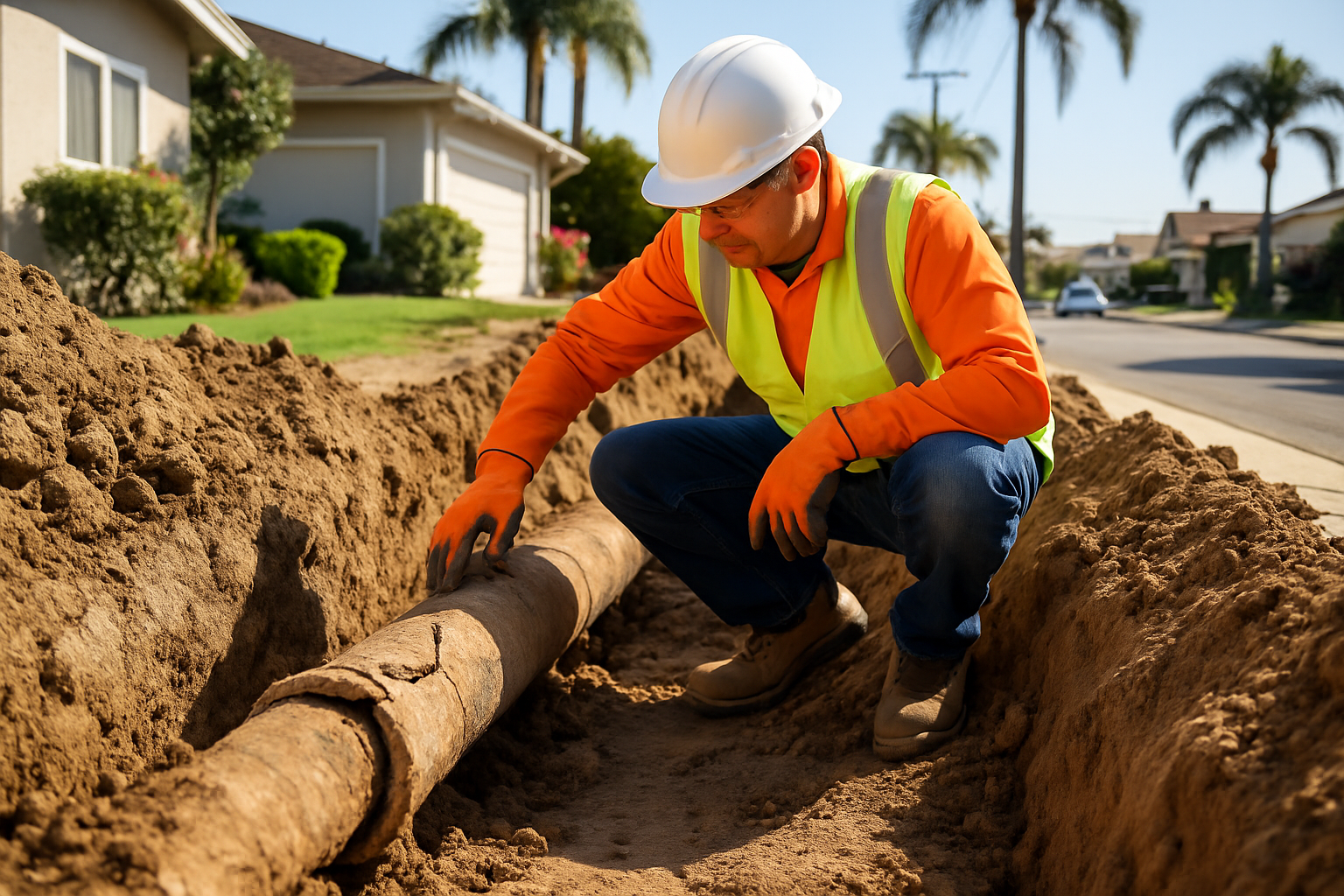
Most sewer line failures aren’t isolated events. When a contractor spots one cracked joint or one section of root intrusion, that’s usually a symptom of a system that’s past its service life — not a single defect on an otherwise healthy line.
The pipe materials commonly found in Monterey County’s older residential and commercial properties include vitrified clay, cast iron, and Orangeburg — a fiber-based pipe material installed through the mid-1970s that degrades into a soft, egg-shaped cross section as it absorbs groundwater. All three materials fail progressively. A patch at one joint puts additional stress on adjacent sections that are already weakened.
Common reasons a patched sewer line keeps failing:
- Root intrusion from coastal cypress, eucalyptus, and pine — all common in Monterey and Pacific Grove — returns within 12 to 24 months at any joint that isn’t fully sealed
- Bellied pipe sections that sag and hold standing water can’t be fixed with a localized repair — the grade has to be corrected
- Corrosion and joint separation in older clay or cast iron systems affects multiple joints, not just the one that showed symptoms first
- Offset joints caused by soil movement or seismic activity — a real factor in the Central Coast — change the pipe alignment entirely
- Pipe wall thinning in older systems means the material between joints is failing even when the joints look acceptable on camera
If a NASSCO-certified video inspection shows Grade 4 or Grade 5 defects across multiple sections, a repair strategy is working against the structural reality of the pipe.
The Real Cost of Repeated Spot Repairs
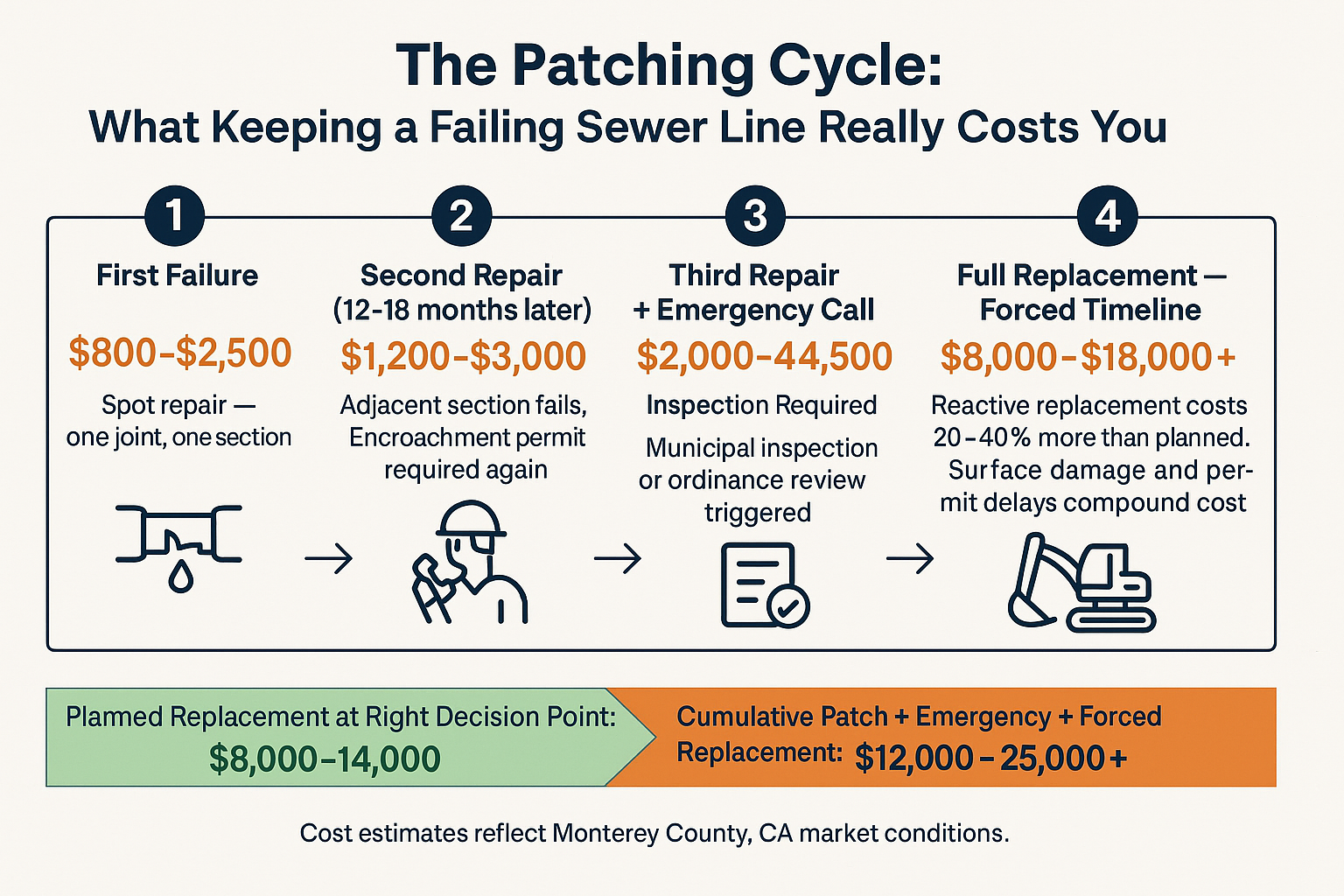
A single spot repair on a residential sewer lateral in Monterey County typically runs $800 to $2,500 depending on depth, access, and whether street or sidewalk excavation is involved. That’s a reasonable number — until it happens three times in four years.
By the third repair, most property owners have spent $4,000 to $7,500 on a line that still hasn’t been resolved. And those numbers don’t include the encroachment permit fees that Monterey County and individual cities like Seaside charge each time work opens a public right-of-way. Seaside, for example, has a street excavation moratorium ordinance that restricts cutting newly resurfaced roads — meaning a repair that falls inside that window triggers additional administrative costs and routing requirements.
Here’s what accumulates when patching becomes the default approach:
- Each repair event requires its own encroachment permit from the county or city — typically $150 to $600 per application depending on scope
- Emergency repair calls carry premium labor rates, often 30 to 50% higher than scheduled work
- Every excavation and backfill cycle in the same area degrades trench compaction quality, which affects surface restoration and pavement life
- Repeated asphalt patches without proper base preparation fail faster, and trench patch standards in Monterey County require compaction testing and base material specifications that add to each repair ticket
- If a backup causes a sewage release into the structure or onto the property, cleanup and damage remediation costs can reach $10,000 to $40,000 depending on the scope
The total cost of keeping a failing line on life support often exceeds a full replacement — without any of the service life that comes with new pipe.
When Patching Triggers a Compliance Problem
In Monterey County and Santa Cruz County, sewer work isn’t just a maintenance issue — it’s a compliance issue. And that changes the calculation significantly.
Santa Cruz County’s sewer lateral ordinance requires that sewer laterals be inspected and certified as part of real estate transfers. A line with repeated documented failures and multiple repair records creates a disclosure problem and often triggers a mandatory replacement condition before a sale can close.
Monterey One Water (formerly MRWPCA) has connection permitting requirements that govern how sewer laterals tie into the collection system. When a line has repeated failures at or near the mainline connection, the agency may require a full lateral replacement as a condition of continued service or permit approval on adjacent work.
For commercial properties and multi-family buildings in Salinas, Marina, or Seaside, repeated sewer failures can also draw attention from building departments. If a code complaint is filed or a municipal inspection is triggered, the scope of required work expands beyond what the owner might have chosen on their own timeline.
Understanding permit requirements for underground utility work before a failure forces the conversation is how experienced developers and facility managers stay ahead of this — rather than reacting to it.
The Patching Cycle: How Costs and Risk Stack Up Over Time
This infographic shows the cumulative cost and risk escalation of repeatedly patching a failing sewer line versus replacing it at the right decision point.
Spot Repair vs. Full Replacement: What You’re Actually Comparing
This table breaks down the key differences between continuing to patch a failing sewer lateral and committing to a full replacement — across cost, service life, compliance exposure, and surface impact.
| Factor | Repeated Spot Repairs | Full Line Replacement |
|---|---|---|
| Upfront cost per event | $800–$2,500 per repair | $8,000–$18,000 total (lateral) |
| Cumulative 5-year cost | $5,000–$12,000+ (multiple events) | $8,000–$18,000 (one project) |
| Service life added | 1–3 years per repair | 50+ years (HDPE or PVC pipe) |
| Encroachment permits | Required for each event | One permit, one closeout |
| Compliance risk | Builds with each failure record | Resolved — new inspection record |
| Surface disruption | Multiple trench patches over time | One full restoration, done correctly |
| Emergency risk | Increases with each deferred repair | Eliminated on replaced segment |
| Trenchless option available | Limited to point repairs | Yes — pipe bursting or open cut |
How to Know When the Line Has Crossed the Threshold
There’s a clear decision point where patching stops being practical. Recognizing it early saves money — and keeps a property owner in control of the timeline instead of reacting to an emergency.
A NASSCO PACP-certified video inspection is the most reliable tool for making this call. NASSCO grading assigns defect scores at every observed defect location. A lateral with multiple Grade 4 or Grade 5 structural defects — meaning active fractures, partial collapses, severe joint offsets, or significant root intrusion — is a line that won’t hold a spot repair reliably.
Signs the threshold has been crossed:
- Two or more repairs on the same lateral within 36 months
- Inspection footage shows defects at more than 25% of the pipe’s total length
- The pipe material is Orangeburg, clay, or unlined cast iron and the system is more than 40 years old
- Bellied sections are present — no spot repair corrects grade
- The failure point is within 10 feet of the mainline connection, where excavation and agency coordination is required regardless of method
- A real estate transaction or permit application is pending and the line’s condition will be scrutinized
At this point, the question isn’t whether to replace the line — it’s whether to do it as trenchless pipe bursting or open-cut traditional replacement, and how to sequence permits and surface restoration to minimize total project cost.
What a Full Sewer Lateral Replacement Actually Involves
A complete sewer lateral replacement in Monterey County is a coordinated infrastructure project — not a service call. Understanding the steps helps property owners and project managers plan accordingly.
The process from start to finish typically runs 3 to 6 weeks from permit application to final surface restoration, depending on the agency, scope, and whether the work enters the public right-of-way.
Key phases of a lateral replacement project:
- Pre-construction video inspection — NASSCO-certified CCTV run to document existing conditions and define replacement scope
- Permit applications — encroachment permit from the county or city public works department; connection permit from Monterey One Water or the applicable sewer authority
- Excavation or pipe bursting setup — trench open-cut for standard replacement; pneumatic or hydraulic bursting for trenchless lateral replacement where existing pipe diameter and soil conditions allow
- New pipe installation — typically SDR 35 PVC or HDPE to current ASTM and local agency standards; proper bedding material and compaction at each lift
- Connection and inspection — tie-in to mainline with agency-approved fittings; air or hydrostatic pressure test; municipal inspector sign-off
- Trench backfill and compaction — compaction testing per county standards; base aggregate and surface preparation
- Asphalt or concrete surface restoration — trench patch to match existing surface; lane marking restoration if in a traveled way
Each of these phases has a permit trigger, an inspection requirement, or a material standard — which is why a contractor’s fluency with local agency requirements matters as much as the physical work itself.
Frequently Asked Questions About Failing Sewer Lines in Monterey County
How many times is it reasonable to repair a sewer line before replacing it?
Most experienced contractors draw the line at two failures within three years on the same lateral segment. After that, the cumulative repair cost approaches or exceeds replacement cost — without the service life gain. A NASSCO-certified video inspection after the second failure gives you the data to make that call objectively.
Can I do trenchless pipe bursting on an old clay or Orangeburg sewer line?
Yes — in most cases. Pipe bursting works well on clay and deteriorated pipe because the method fractures the host pipe outward while pulling new HDPE through. The main limiting factors are pipe diameter consistency, access pit locations, and the presence of live connections along the lateral. A pre-burst video inspection confirms suitability.
Does Monterey One Water require a permit every time I repair a sewer lateral?
Monterey One Water requires a connection permit for work that involves the mainline tie-in or any alteration to the service lateral connection point. Spot repairs entirely within private property and away from the mainline connection may not require a Monterey One Water permit — but they still typically require an encroachment permit if the work enters a public easement or right-of-way.
Will a failing sewer line affect my property sale in Santa Cruz County?
Yes. Santa Cruz County’s sewer lateral ordinance requires inspection and certification of sewer laterals at the point of real estate transfer. A lateral with documented failures and no replacement will likely require corrective work as a condition of sale. Addressing it proactively before listing avoids negotiated concessions and closing delays.
What pipe material should a replacement sewer lateral be installed with?
SDR 35 PVC is the most widely specified material for residential and light commercial sewer laterals in Monterey County. HDPE is used where soil movement, seismic activity, or tight radius bends are a factor — it’s more flexible and handles ground shift better than rigid pipe. The applicable sewer authority’s standard specifications govern the final material selection.
Ready to Get a Clear Answer on What Your Sewer Line Actually Needs?
If you’re on your second or third repair on the same line — or heading into a permit application or property transaction — Coastal Pipeline can run a NASSCO-certified video inspection and give you a straight read on what the line shows and what your options are. We work with property owners, general contractors, and facility managers across Monterey and Santa Cruz counties, and we carry the permits, certifications, and agency relationships to take a project from first inspection through final surface restoration. Reach out through the contact form at coastalpipelineinc.com or call us directly to talk through your project.