
Direct Answer: Open trench gives you full access and works in any condition. Pipe bursting replaces the line without a full trench — when soil and access allow it. The right choice depends on your existing pipe condition, site constraints, and what’s buried nearby.
When a sewer line fails, the first question most property owners ask is whether they can avoid tearing up the yard or the street. That’s a fair question — but the honest answer is that method selection isn’t really about what you prefer. It’s about what the existing pipe, the soil, and the surrounding utilities will actually allow.
In Monterey County, this decision gets complicated fast. Older infrastructure in places like Seaside, Pacific Grove, and parts of Salinas means you’re often dealing with deteriorated clay or Orangeburg pipe buried alongside decades of undocumented utility crossings. What looks like a clean pipe bursting candidate on paper can turn into a full open-trench job once a NASSCO-certified video inspection reveals the real condition underground.
This article breaks down what actually drives the decision between open trench and trenchless pipe bursting — and what each method costs, requires, and rules out. If you’re trying to understand why sewer replacement quotes vary so wildly, the method question is a big part of that answer.
What Open Trench Replacement Actually Involves
Open trench is the traditional method — and it’s still the right call on a large percentage of jobs. A contractor excavates along the full path of the failed line, removes the old pipe, and installs new pipe before backfilling and restoring the surface.
The work itself happens in defined stages:
- Encroachment permit pulled from the city or county if work enters the public right-of-way
- NASSCO PACP-certified video inspection to confirm pipe condition and map crossing utilities
- Saw-cutting and breaking the existing pavement surface
- Precision trenching to the pipe depth — often 4 to 8 feet on residential laterals in this region
- Old pipe removed; new HDPE or PVC pipe installed with proper bedding and slope
- Backfill placed and compacted in lifts to meet county standards
- Trench patch or full pavement restoration depending on permit requirements
Open trench is more disruptive on the surface, but it gives the crew complete visibility of what’s happening underground. If there are unexpected utility crossings, root intrusions into the trench zone, or pipe segments that have shifted significantly, the crew can adapt in real time.
For projects in Seaside, where the city’s street excavation moratorium ordinance restricts when and how pavement cuts are made, the asphalt restoration standards that follow open trench work are just as important to plan for as the excavation itself. A trench patch done out of spec will get rejected at inspection.
How Pipe Bursting Works — and Where It Falls Short
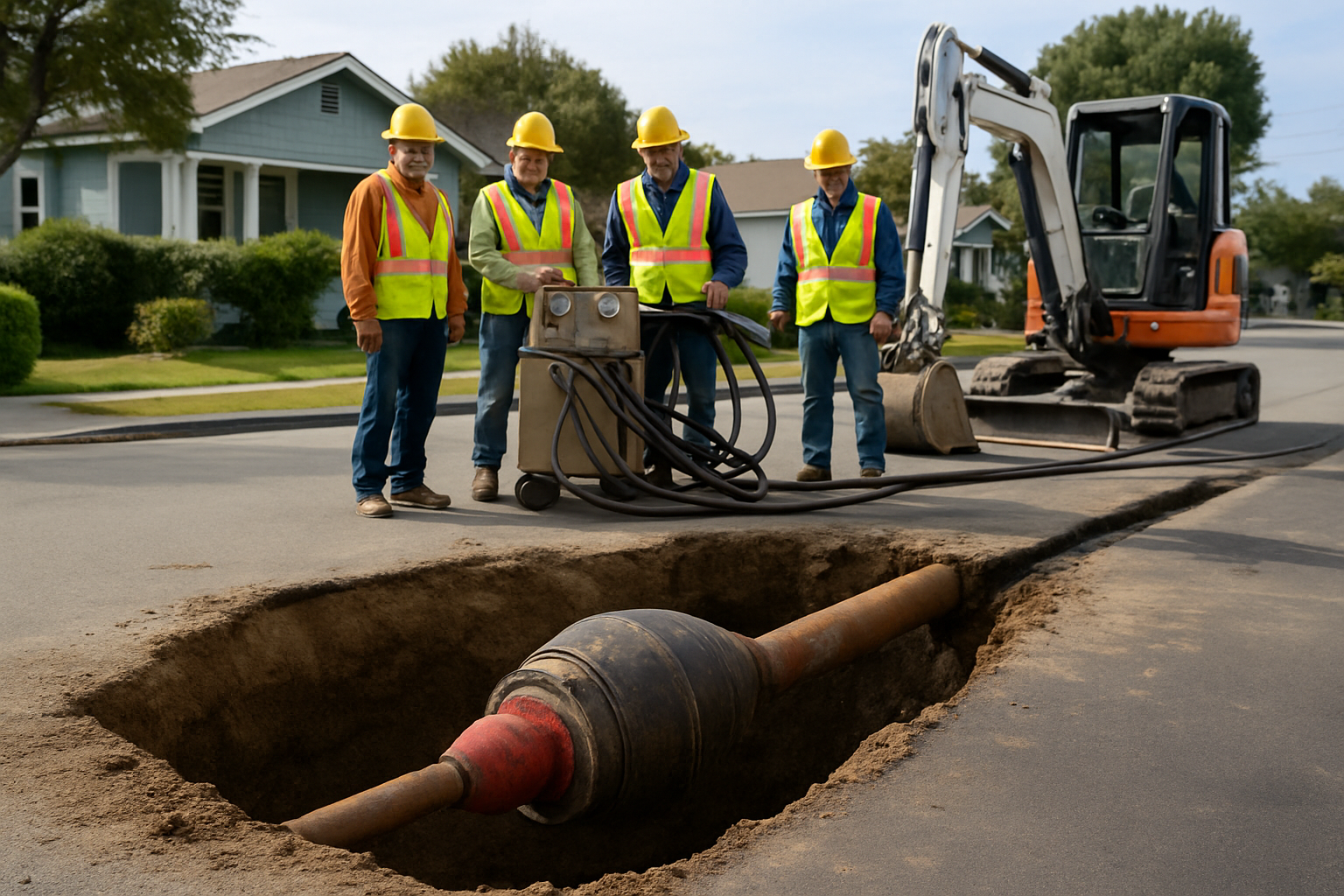
Pipe bursting replaces an existing pipe without excavating the full line length. A hydraulic bursting head is pulled through the old pipe from one pit to another. As it moves, it fractures the existing pipe outward into the surrounding soil and simultaneously pulls a new HDPE pipe into position behind it.
You still need two excavation pits — one at each end of the run. But the ground between them stays undisturbed, which means less pavement cut, less surface restoration, and often a shorter project timeline.
The conditions where pipe bursting works well:
- Brittle host pipe — clay, Orangeburg, or cast iron that will fracture cleanly when displaced
- Consistent pipe depth without major grade changes or significant belly sections
- Adequate soil space around the existing pipe — the burst head displaces pipe fragments outward, so there needs to be room
- No conflicting utilities running parallel and tight to the host pipe
- Straight or gently curved runs — sharp bends require open trench sections regardless
Where it breaks down: if a pre-job video inspection shows the pipe has already collapsed in sections, the bursting head has no intact structure to follow. A collapsed run needs open trench. Similarly, if the existing line runs parallel to a gas main or electrical conduit at close offset — common in older Monterey neighborhoods where utilities share tight corridors — the lateral displacement from bursting can create a conflict that’s not worth the risk.
Pipe bursting also doesn’t upsize as dramatically as some contractors suggest. Moving from a 4-inch lateral to a 6-inch lateral is realistic. Trying to go from 4-inch to 8-inch in a single burst puts excessive stress on adjacent soil and nearby utilities.
The Decision Framework: Open Trench vs. Pipe Bursting
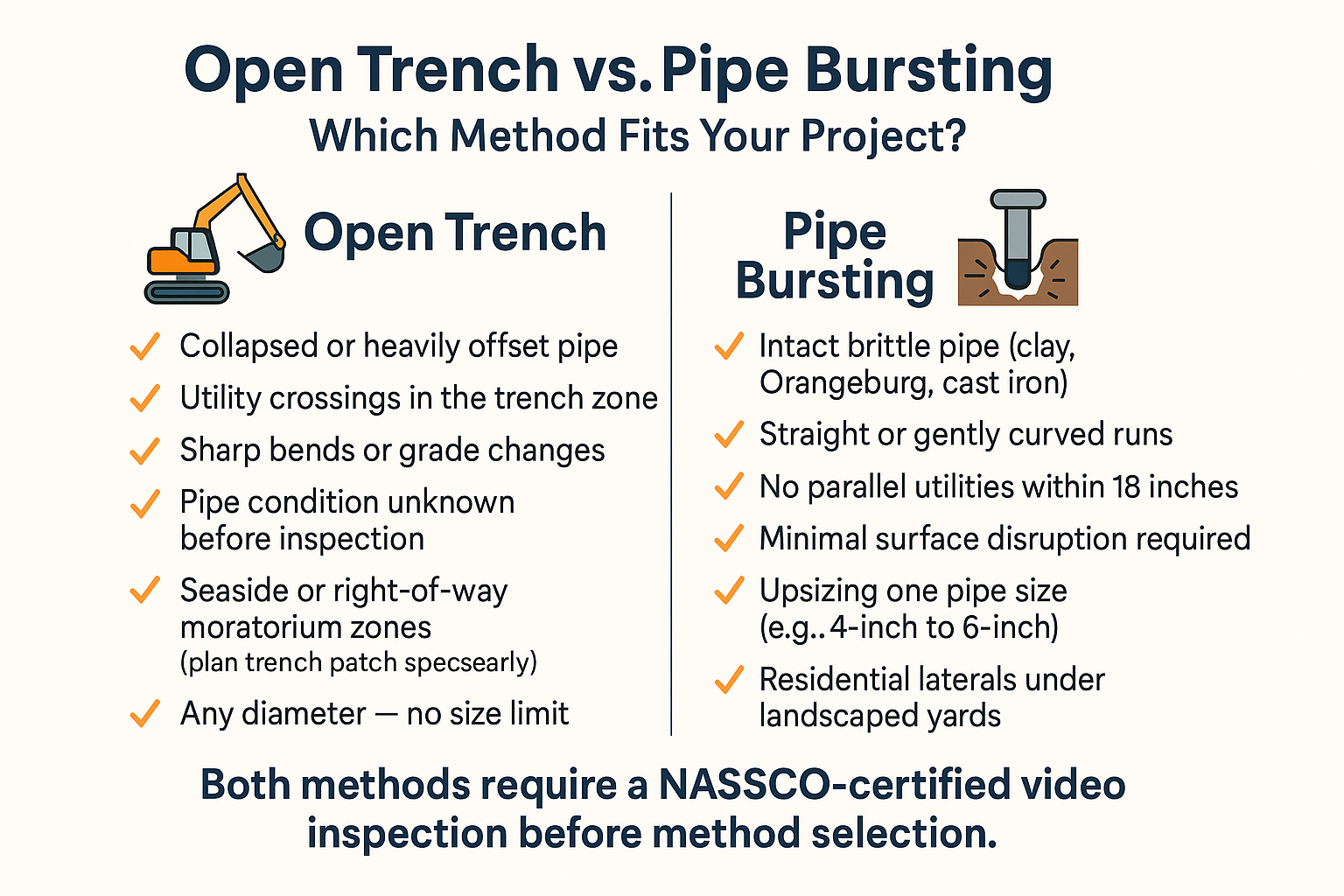
Use this side-by-side breakdown to understand which conditions favor each method before a video inspection confirms the final call.
What These Methods Actually Cost in Monterey County
Cost comparisons between open trench and pipe bursting depend heavily on the run length, depth, soil conditions, and what surface restoration is required. That said, here are realistic ranges for residential sewer lateral work in this market as of 2025.
Open trench sewer lateral replacement on a standard residential run (50 to 80 feet) in Monterey County typically falls between $8,000 and $18,000, depending on depth, pavement involvement, and whether the work crosses the public right-of-way. Encroachment permits from the City of Monterey or Monterey County Public Works add cost and lead time — budget 2 to 4 weeks for permit processing on right-of-way work.
Pipe bursting on the same run often comes in between $6,500 and $14,000. The savings come from reduced excavation volume and less surface restoration — but only if the job is a clean candidate. A pipe bursting quote that doesn’t include a pre-job video inspection should be treated skeptically. The trenchless vs. traditional tradeoff only makes financial sense when the site conditions actually support it.
One cost factor specific to this region: Santa Cruz County’s sewer lateral ordinance requires property owners to inspect and, in many cases, replace laterals at point of sale. That adds urgency to the method decision — the right approach isn’t just the cheapest upfront, it’s the one that passes inspection and closes escrow on schedule.
Open Trench vs. Pipe Bursting: Key Differences at a Glance
This table covers the practical differences that matter most when evaluating a sewer line replacement project in Monterey or Santa Cruz County.
| Factor | Open Trench | Pipe Bursting |
|---|---|---|
| Required pipe condition | Any — works on collapsed, offset, or intact pipe | Must be structurally intact enough to follow |
| Excavation extent | Full trench length | Two access pits at each end only |
| Typical cost (50–80 ft lateral) | $8,000–$18,000 | $6,500–$14,000 |
| Surface restoration required | Yes — trench patch per permit specs | Minimal — pit patches only |
| Sharp bends / grade changes | Handles any configuration | Limited — may require open trench sections |
| Utility conflicts nearby | Visible and manageable in trench | Risk of displacement — requires survey first |
| Upsize capacity | Any diameter | One pipe size up is practical max |
| Pre-job video inspection needed | Recommended | Required — no exceptions |
The Video Inspection Step That Changes Everything
Neither method should be quoted or committed to before a NASSCO PACP-certified video inspection. This isn’t a formality — it’s the single step that determines whether a pipe bursting bid holds up or collapses into a change order.
A camera inspection documents:
- Pipe material — clay, Orangeburg, cast iron, PVC, or a mix
- Defect codes and severity ratings per NASSCO PACP protocol
- Offset joints, root intrusions, and belly sections that affect bursting feasibility
- Approximate depth at multiple points along the run
- Active flow conditions that affect scheduling and bypass requirements
In older Monterey neighborhoods — especially in Pacific Grove and parts of Salinas with pre-1970s infrastructure — it’s common to find mixed-material laterals where one segment is clay and the next is cast iron joined with a rubber coupling. That kind of run can still be burst, but it changes how the equipment is set up and what the crew watches for.
If you’re weighing whether to keep patching or commit to full replacement, this breakdown of what happens when you defer sewer line repairs covers what the inspection record typically shows before a line reaches emergency status.
Frequently Asked Questions About Open Trench and Pipe Bursting
Can pipe bursting be used under a concrete driveway or patio?
Yes — that’s actually one of the strongest use cases for it. If the pipe run passes under existing hardscape you want to preserve, pipe bursting avoids breaking out the concrete entirely. You only excavate the two access pits, which are typically 3 to 4 feet wide. The concrete between them stays in place.
What if my contractor doesn’t do a camera inspection before recommending pipe bursting?
Walk away from that quote. A proper pipe bursting recommendation requires documented proof of pipe condition. Without a NASSCO PACP-certified inspection, there’s no way to confirm the pipe is intact enough to burst cleanly — and if it collapses mid-job, you’re paying for open trench anyway, plus the cost of the failed attempt.
Does pipe bursting require a permit in Monterey County?
Yes. Any work on a sewer lateral that connects to a public main requires a permit through Monterey One Water or the applicable municipal agency. If the work crosses into the public right-of-way — even at just the access pit — an encroachment permit from the county or city is also required. Permit requirements for underground utility work are consistent regardless of which installation method you use.
Is pipe bursting a permanent fix or will I need to do it again?
A properly installed pipe bursting replacement using Schedule 40 HDPE pipe is a permanent solution — the same lifespan expectation as open trench new pipe installation. The misconception that trenchless methods are temporary comes from confusion with CIPP lining, which is a different process entirely. Pipe bursting installs new pipe, not a liner inside old pipe.
What happens to the old pipe material when it gets burst?
The bursting head fractures the existing pipe outward and displaces the fragments into the surrounding soil. The material stays in the ground — it’s not excavated or removed. This is standard practice and is why soil composition and proximity to other utilities matter before the job starts.
Not Sure Which Method Your Project Needs?
Coastal Pipeline handles both open trench and trenchless pipe bursting for sewer lateral replacements across Monterey and Santa Cruz counties — and we start every job with a NASSCO PACP-certified video inspection to make sure the method recommendation is based on what’s actually in the ground. If you have a failing line or a project coming up, reach out through the contact form at coastalpipelineinc.com or call us directly to talk through the specifics.