
The rules for handicap parking spaces are not just about being convenient. They are about making sure people with disabilities have safe and equal access to buildings. These rules ensure that people who use wheelchairs or walkers have the space they need and the safest path to an entrance. It's a matter of fairness.
Why Accessible Parking Rules Exist
Have you ever wondered why handicap parking spaces have such specific rules? It’s easy to just see a sign and a blue space. But those spots are a promise of safety, freedom, and fairness for millions of people. They are much more than a perk; they are a need protected by law.
Think about it like this: an accessible parking space is a loading zone for a person, not for groceries. For someone using a wheelchair or walker, crossing a busy parking lot can be very dangerous. These spots provide a direct path to a door, which cuts down the risk of accidents.
More Than Just a Parking Spot
Every detail in the design of these spaces has a purpose. The extra width and the striped aisles you see are not wasted space. They are needed for wheelchair ramps and lifts, especially for vans. Without that extra room, a person could be trapped in their own car.
This is why the Americans with Disabilities Act (ADA) created national rules for them. The goal is to remove physical barriers that stop people with disabilities from being part of their communities. Accessible parking is a key part of that mission. It makes sure everyone can get to:
- Important Services: Doctor's offices, drug stores, and grocery stores.
- Work: Giving everyone an equal chance to earn a living.
- Community Life: Restaurants, theaters, parks, and shops.
When you understand the "why" behind these rules, you see how important they are. It’s not about giving someone a special favor. It’s about giving them the same basic access that most of us have every day.
Who Can Use Accessible Parking
Getting a handicap parking permit is not random. It is linked to specific medical conditions that make it hard for a person to move around. While the exact rules can change from state to state, a doctor must always confirm that someone has a condition that limits their ability to walk.
The main idea is simple: the permit is for the person, not the car. A common mistake is when a friend or family member uses the permit when the person with the disability is not in the car. This breaks the rules and can lead to big fines.
In the end, making sure these spaces work is a job for everyone. Property owners must provide and maintain them. Drivers need to respect their purpose. And police have to make sure they are used correctly. It’s a team effort that keeps these important spaces open for those who truly need them.
Understanding Federal ADA Parking Rules
The rules for handicap parking spaces are not just suggestions. They come from a major federal law. The Americans with Disabilities Act (ADA) sets the national standard for accessible parking that every state must follow. You can think of the ADA as the main blueprint for making things accessible.
This law makes sure people with disabilities can reliably get into buildings everywhere, from a small coffee shop to a large mall. The ADA explains the minimum requirements that property owners must meet to serve everyone in the community.
This image shows the key parts of a legal and correctly marked accessible parking space.
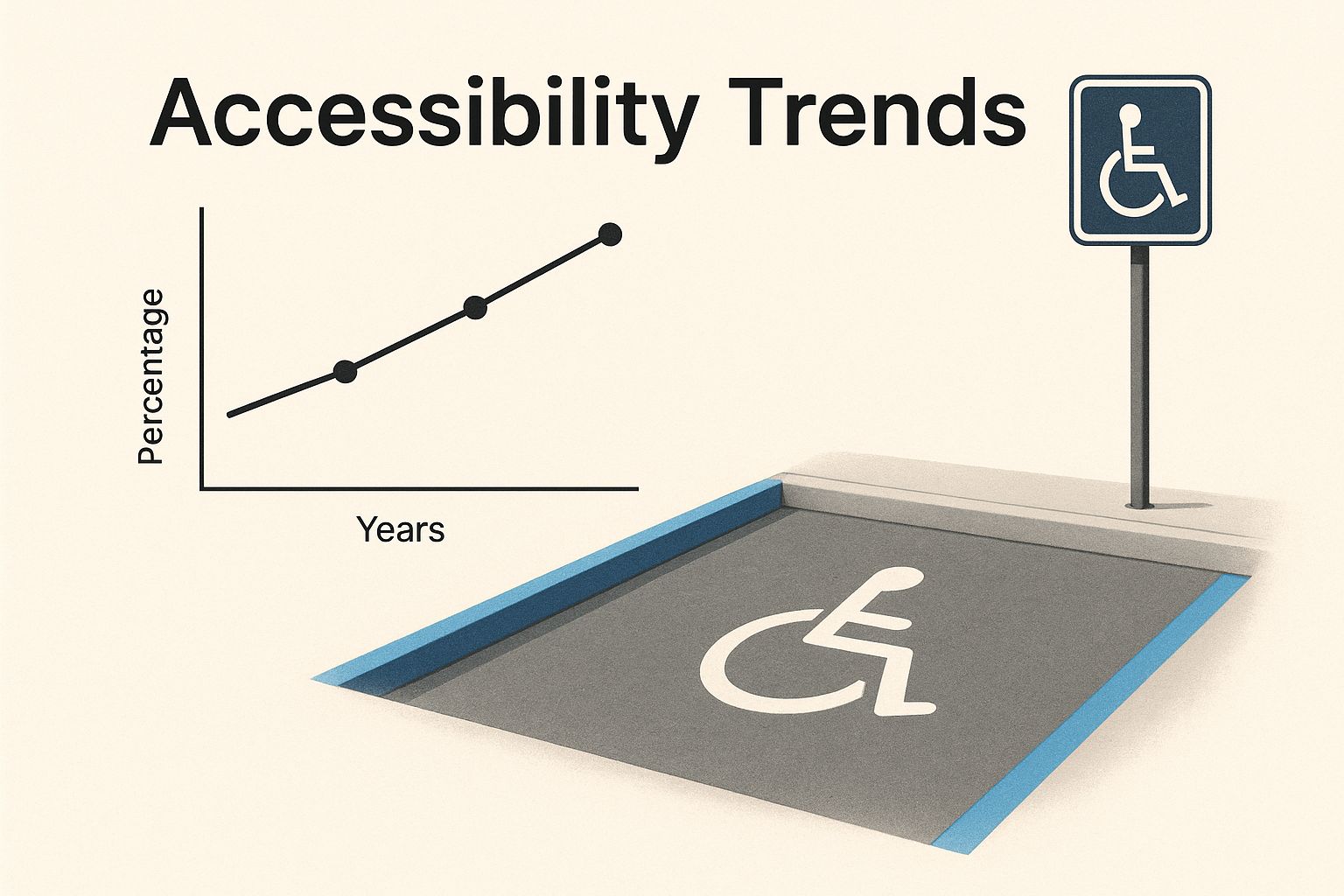
As you can see, a legal and safe accessible parking spot is a mix of clear signs, specific pavement markings, and enough space.
How Many Accessible Spaces Are Needed?
Property owners often ask, "How many handicap spots do I need?" The good news is the ADA doesn't make you guess. It gives a clear formula based on the total number of parking spaces in your lot.
The 2010 ADA Standards for Accessible Design lay out specific rules. For example, a small lot with 1 to 25 total spots must have at least one accessible space. A larger lot with 301 to 400 spaces needs at least eight. The number goes up from there, making sure there are enough spots for the size of the property.
Getting this right when building is very important. Proper layout, grading, and pavement markings often need professional planning, much like the work needed to install good storm drainage systems in Monterey and Santa Cruz County.
Standard Spaces vs. Van-Accessible Spaces
It's important to know that not all accessible parking spots are the same. The ADA makes a key difference between standard accessible spaces and van-accessible spaces. This difference matters a lot to many people.
- A standard accessible space must be at least 96 inches (8 feet) wide.
- It must be next to a striped access aisle that is at least 60 inches (5 feet) wide. This aisle is a no-parking zone. It gives someone the room they need to use a wheelchair or walker.
Key Takeaway: The striped access aisle is just as important as the parking space itself. It is a lifeline, not just extra space. Parking in or blocking an access aisle is illegal and can stop someone from getting into or out of their vehicle.
- A van-accessible space is made for vehicles with ramps or lifts.
- These spots need a much wider access aisle of at least 96 inches (8 feet). That extra three feet of room is absolutely needed for the side-mounted lifts on many accessible vans.
A Clear Breakdown of ADA Requirements
To help you see these rules, we've made a simple table. It shows the minimum number of accessible spaces required by federal law. A key rule to remember is that one of every six accessible spaces must be a van-accessible spot.
ADA Required Minimum Number of Accessible Parking Spaces
This table shows the ADA's rules for accessible parking based on the total number of spots in a lot.
| Total Parking Spaces in Lot | Required Minimum Accessible Spaces | Required Van-Accessible Spaces |
|---|---|---|
| 1 to 25 | 1 | At least 1 (must be van-accessible) |
| 26 to 50 | 2 | At least 1 |
| 51 to 75 | 3 | At least 1 |
| 76 to 100 | 4 | At least 1 |
| 101 to 150 | 5 | At least 1 |
| 151 to 200 | 6 | At least 1 |
| 201 to 300 | 7 | At least 2 |
| 301 to 400 | 8 | At least 2 |
| 401 to 500 | 9 | At least 2 |
| 501 to 1,000 | 2% of total spaces | 1 in every 6 must be van-accessible |
As you can see, the number of spots grows as the parking lot gets bigger. This makes sure there are enough spaces available.
Understanding the "Safe Harbor" Rule
What about older buildings that were built before the newest ADA rules were made? This is where the "safe harbor" rule helps. It means that if a property's parking lot already followed the older 1991 ADA rules, the owner does not have to change it just to meet the new 2010 rules.
But this protection does not last forever. If the business changes the parking lot in any way—like repainting the lines, repaving it, or changing the layout—it loses that safe harbor protection. Then, the whole lot must be updated to meet the current ADA rules.
How State and Local Laws Affect Parking Rules
The federal Americans with Disabilities Act (ADA) sets the basic rules for accessible parking, but that's not the end of the story. It's best to think of the ADA as the national minimum—a starting point that every state must meet. From there, states, counties, and cities can add their own rules to make these spaces even safer and more useful.
This means the rules for handicap parking spaces can be different when you cross a state line. One state might require taller signs or wider aisles than the federal rules. That’s why you must always check local laws. They have the final say when it comes to fines and punishments.
Why Local Rules Matter More in Real Life
The ADA is a federal law, but it’s the local police officer who writes a ticket. They enforce state and city laws every day. So, while the federal government sets the "what," state and local laws explain the "how" and the "how much" for any rule breaking.
For example, one state might give you a $250 fine for parking illegally. The state next door might give you a $500 ticket for doing the exact same thing.
Local rules also cover other details, like:
- The exact design of parking permits and license plates.
- The words required on signs, such as "Violators Subject to Fine."
- How property owners must keep spaces clear of snow, shopping carts, or trash.
This allows the rules to fit the needs of the area while still protecting the rights the ADA guarantees. It is a partnership between different levels of government, all working to keep parking accessible.
A Real-World Example from New York State
Let’s look at New York to see how this works. The state has its own specific laws that add to the federal ADA rules. This adds another layer of detail that drivers and property owners must follow.
In New York, handicap spaces must be at least eight feet wide. They must have clearly marked access aisles painted with diagonal stripes. The signs must be between five and seven feet high to be easily seen. Of course, a car needs a valid permit or plate to park there.
If you break these rules, the fines are high: from $250 to $500.
Important Takeaway: The state and city fines are the ones that really count. Those fines are almost always higher and faster than anything at the federal level. This makes them the real tool for making sure people follow the rules.
New York is a perfect example of a state taking the federal plan and adding its own rules for size, signs, and—most importantly—fines. For property owners, this means that just meeting ADA rules might not be enough. Getting it right takes the same kind of careful attention to local detail that a utility trenching contractor in Monterey County needs when working on important projects.
The Consequences of Breaking Local Rules
Ignoring state or local parking laws will cost you. The fines are set high for a reason. They send a clear message that blocking accessible spots is a serious issue. It’s not just about parking without a permit, either. Local laws often cover other things people forget about.
For example, many city rules also outlaw:
- Blocking an access aisle: Even if your car is not in the blue space, parking on those striped lines is just as illegal.
- Using someone else's permit: The permit belongs to the person with the disability, and they must be in the vehicle.
- Using an expired permit: Just like your driver's license, these permits have expiration dates.
How these rules are enforced also changes from place to place. Some cities have special parking teams or even volunteers looking for violations. The bottom line is, your chances of getting caught are higher than you might think. Following these local rules is part of being a responsible driver and keeps these vital spots open for those who need them.
The Role of Signs and Pavement Markings
A handicap parking spot is not official until it has the right signs and markings. The specific signs and paint required by law are what turn a patch of asphalt into a legal, accessible space. Together, these things clearly show the rules for everyone.
Think of the signs and paint as the official language of the parking lot. Bright blue and white colors and the well-known wheelchair symbol send a clear message: this space is for people with valid permits. This is the first defense against people using the spots incorrectly and is a key tool for police.
The International Symbol of Access
The most recognized sign is the International Symbol of Access—the familiar white wheelchair logo on a blue background. This symbol is understood everywhere and immediately shows that a space is for people with disabilities. Using it is not just a suggestion; it's a legal requirement.
The ADA has strict rules for the signs with this symbol. They must be high enough to be seen from a driver's seat, even if another car is parked in the space. Usually, the bottom of the sign must be at least 60 inches from the ground.
Understanding Pavement Markings and Access Aisles
Pavement markings do more than just outline the parking spot. Blue paint for the space and white for the wheelchair symbol create a strong visual that stands out. But the most important markings are the diagonal white or blue stripes next to the space.
These stripes mark the access aisle, which is a strict no-parking zone. It's best to think of it as a personal ramp to the sidewalk. This aisle provides the clear space someone might need to:
- Use a wheelchair lift: Many vans have side lifts that need several feet of clear space to work.
- Open doors fully: People using walkers often need to swing their car doors wide open.
- Move safely: The aisle creates a safe path away from moving cars in the lot.
Blocking this aisle is just as illegal as parking in the space itself because it can trap someone in their vehicle. Keeping these stripes clear is a key part of overall parking lot maintenance and safety.
A key takeaway is that the access aisle is a part of the accessible space. A parking spot without a clear access aisle is not truly accessible and is useless for many drivers with disabilities.
Bringing It All Together for Enforcement
For a space to be legal, both the signs and the pavement markings have to be there and be kept in good shape. A faded symbol on the ground or a missing sign just creates confusion and makes it hard for officers to write tickets.
Property owners are responsible for making sure these signs and markings are in good condition. That means keeping signs clear of things like bushes or snow and making sure the painted lines are always easy to see. This mix of clear signs and markings creates a system that protects these important spaces for those who need them.
Using Your Parking Permit in Other Countries
A disability does not stop at a country's border. Luckily, efforts to make places accessible don't either. If you have a handicap parking permit from your home country, you might be surprised to learn it could be valid thousands of miles away. This can make traveling to other countries much easier.
This is possible because of official agreements between countries. These agreements create a system where one country agrees to honor the parking permits from another.
The Start of International Recognition
The idea for this system started decades ago. A major global effort began in 1978 with a decision by the European Conference of Ministers of Transport (ECMT). This decision set a simple rule: member countries would give visiting drivers with disabilities the same parking rights as their own citizens.
This agreement was expanded in 1997 to include other countries like the United States, Canada, and Australia. This means a US-issued handicap permit is often accepted across Europe, and a European "Blue Badge" is often accepted in the United States. It's a great example of countries working together to help travelers.
Key Insight: This system works because each country respects the disability verification process of the others. It trusts that if you have a real permit from home, you should be allowed to use accessible parking in other countries.
Practical Tips for Traveling Abroad
Even with these international agreements, the rules for handicap parking spaces can be different from one city to another. A little bit of research before you travel can save you a lot of stress and a costly parking ticket.
Before you travel, it's always smart to:
- Check Local Rules: Do a quick online search for parking rules in the place you are visiting. Try searching for terms like "Blue Badge parking rules" for the UK or "disabled parking" for the specific country.
- Print Information: It can be helpful to print a short explanation of the agreement from an official tourism or government website. If a local officer does not know about your permit, having this paper can help explain things.
- Display Your Permit Clearly: Just like at home, always hang your permit from your rearview mirror or place it on your dashboard where it can be seen. Make sure the expiration date and symbol are easy to read.
Always Check Before You Park
While the international agreement is strong, it may not always be followed perfectly at the local level. Never assume the rules are the same as what you're used to back home.
For example, some cities might have zones where only local permits are good, or there could be different time limits. Signs and curb markings can also have different meanings. Managing this type of system requires special knowledge, much like the expertise needed for complex underground utility services.
The most important rule is to always double-check. Look for signs that explain the local rules. If you're staying at a hotel, ask the staff for help. A few extra minutes of checking can make sure your trip stays smooth and fun.
How to Report Parking Violations
Clear rules for handicap parking are great, but they only work if they are followed. It’s upsetting to see a car without a permit in an accessible spot or blocking the striped access aisle. That one car can stop someone from safely getting where they need to go.
Knowing the right way to report these problems is the best way to support accessibility without having to argue with someone.
The most common violations are easy to see. A car parked in a spot without a valid permit is the biggest one. Another serious issue is when a driver parks on the striped access aisle next to a space. That aisle is there for a reason, and blocking it can make it impossible for someone using a wheelchair ramp to get in or out of their vehicle.
A Step-by-Step Guide to Reporting
If you see a violation, the goal is to report it safely and correctly to the right people. It's a simple process that keeps you out of a difficult situation. Taking a minute to get the key details makes it much easier for police or the property manager to do something.
Here’s what to do:
-
Do Not Confront the Driver: Your safety comes first. Never get into an argument with the driver. It’s better to let the police handle it—that’s their job.
-
Gather Key Information: Write down the important details. You’ll need the vehicle's license plate number, make, model, and color. Be sure to note the exact location, including the name and address of the business.
-
Take a Photo (If Safe): A picture is powerful proof. If you can do it without being noticed, snap a quick photo showing the vehicle in the space. Try to get both the license plate and the lack of a permit in the picture.
Who to Contact with Your Report
Once you have the information, you just need to know who to call. It depends on whether it's public or private property, but one phone call is almost always the right move.
The best first step is to call the non-emergency number for the local police or sheriff's department. They handle parking rules and can give tickets on public streets and in private parking lots, like at a grocery store or mall.
If the violation is in a private lot, you can also report it to the business owner or property manager. They are legally required to keep their accessible spaces open for those who need them. A professional company that provides parking lot striping and marking in Monterey and Santa Cruz County can help businesses make sure their lots are legal and clearly marked, which helps police enforce the rules.
By taking a few moments to report a violation, you’re doing more than just pointing out a problem. You’re helping to make sure these important spaces stay open for the people who need them.
Common Questions About Handicap Parking
Even when you know the basics, the specific rules for handicap parking spaces can be tricky. Let's clear up some of the most common questions with simple answers.
Here's a common situation: Can someone park in an accessible spot if the person with the disability stays in the car while a friend runs into the store? The answer is yes. The rule is that the person the permit was issued to must be with the vehicle, either as the driver or a passenger.
Another question comes up when a parking lot is full. What if all the handicap spots are taken? In some states, if all accessible spaces are full, a car with a valid permit may be allowed to park at an angle and take up two standard spots. But this is not a rule everywhere—you must check your local laws first.
Questions About Permit Use and Enforcement
People often ask if they can lend their permit to a family member or friend. The answer here is a firm no. The permit is issued to a specific person for their use only. Letting someone else use it is fraud and can lead to big fines and losing the permit.
The most important thing to remember is that the permit belongs to the person, not the car. Misusing a permit, even if you mean well, hurts the whole system designed to help those who truly need accessible parking.
What about a spot with blue paint on the ground but no sign? Can you park there? In most places, for a ticket to be valid, the space must have a properly mounted, permanent sign. Pavement markings alone are often not enough to make the space legally reserved.
Finally, what should you do if your permit is about to expire? Always start the renewal process with your state's DMV well before it expires. Using an expired permit is the same as having no permit at all and can get you a big fine.
Making sure your parking lot meets all state and federal rules requires professional help. For ADA-compliant paving and marking on the Central Coast, trust Coastal Pipeline Inc. Contact us today to ensure your property is safe and accessible for everyone.