When you think about fixing your pavement, it's easy to imagine a massive bill. But keeping your asphalt in top shape in Monterey County doesn't have to drain your budget. In fact, it's surprisingly affordable.
The secret is to be smart about it. Small, timely repairs are your best defense against the high cost of a full replacement. This keeps your property safe and looking sharp without a huge financial hit. And the good news? Our local pricing makes this approach even more affordable compared to other parts of the country.
Why Smart Asphalt Repair Is Surprisingly Affordable
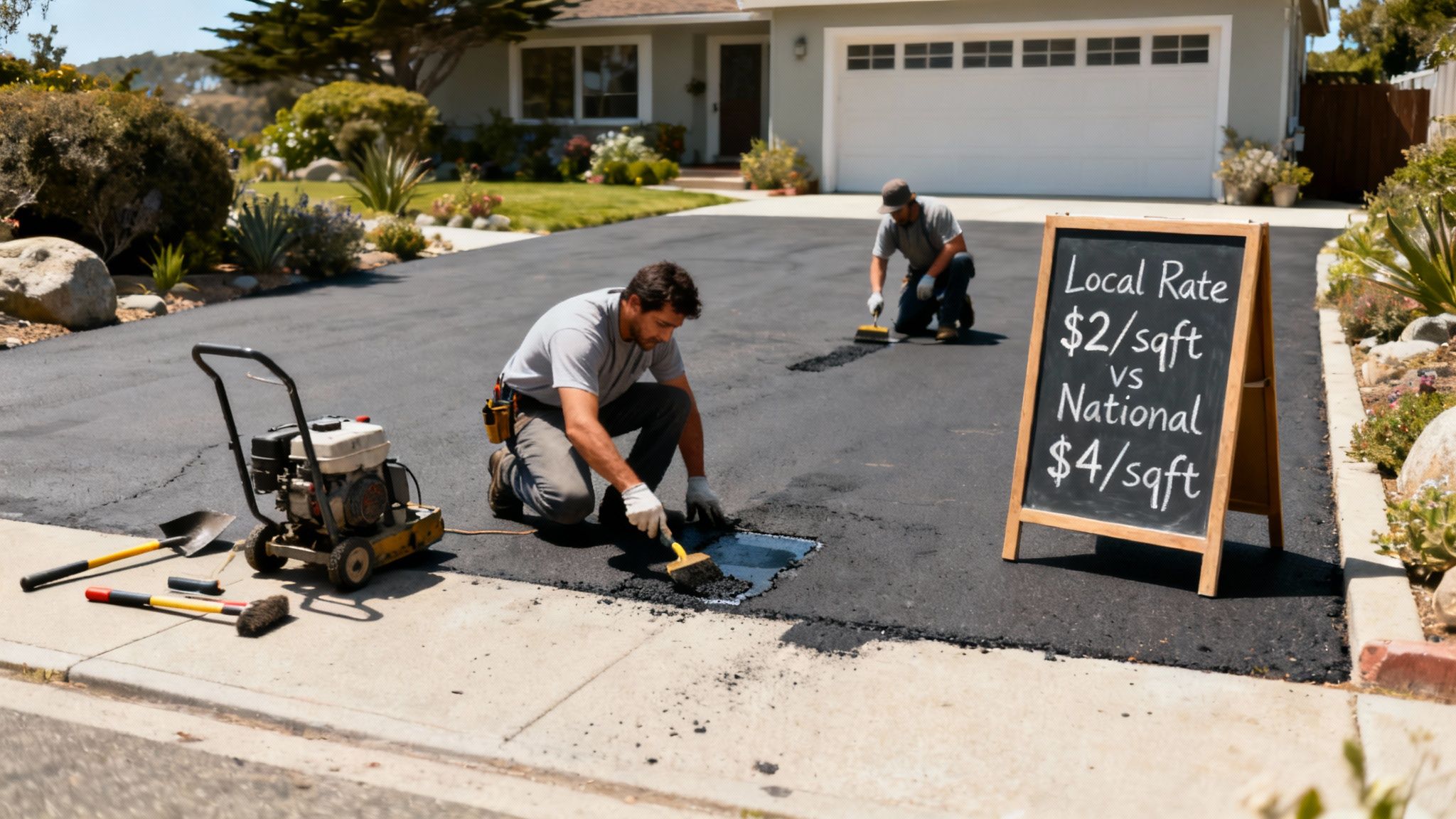
I’ve talked with countless property managers—from schools and business parks to HOAs—who put off asphalt maintenance because they expect a huge invoice. The key is to stop thinking about "replacement" and start focusing on smart, targeted "repairs."
Think of it this way: fixing a few cracks or a small pothole today is a minor cost. But leaving it alone lets water seep in, ruin the foundation, and create a massive problem that will cost ten times as much to fix later.
We have a real advantage here in Monterey County. Our mild coastal climate is much kinder to asphalt than the harsh winters that damage pavement elsewhere. This means that quick repairs and preventative steps like sealcoating actually work better and last longer, giving you more for your money.
Taking Advantage of Local Pricing
The competitive market right here in our community also helps keep costs down. Let's look at the numbers.
On average, a typical asphalt repair project in Monterey County will run you between $424 and $464. Now, compare that to the national average, which can be as high as $4,022. The difference is massive.
This quick comparison really shows the savings available for property managers in our area.
Monterey County vs. National Asphalt Repair Cost Snapshot
| Repair Type | Average Cost in Monterey County | National Average Cost |
|---|---|---|
| Pothole Patching | $150 – $400 | $500 – $1,000 |
| Crack Sealing | $0.75 – $1.50 per linear ft | $1.00 – $3.00 per linear ft |
| Sealcoating | $0.20 – $0.45 per sq ft | $0.25 – $0.70 per sq ft |
These numbers make it clear: regular maintenance isn't just a good idea here—it's a smart financial decision.
By catching problems early, you’re not just saving on the repair. You’re also delaying the need for a full, disruptive, and costly repaving project by years. That means less downtime for your school, business, or community.
The secret to affordable pavement management isn't finding the cheapest one-time fix; it's using a consistent strategy of small, targeted repairs that protect the long-term value of your property.
For a broader perspective, looking into effective cost reduction strategies can also provide some valuable insights that apply well beyond just pavement.
Choosing the Right Repair for Maximum Value
Not all pavement damage is the same, so a one-size-fits-all repair strategy doesn't work. The best way to get a cost-effective asphalt repair in Monterey County is choosing the right method for the problem. For property managers at schools, HOAs, and businesses, matching the repair to the damage means you stop overpaying for work you don’t need.
The goal is to get more life out of your existing pavement without breaking the bank or causing a huge mess. Let’s walk through three of the most effective techniques we use at Coastal Pipeline Inc. (CPI) to make that happen.
Efficient Patching for Contained Damage
Do you have a pothole or a small area of crumbling, "alligatored" asphalt? A simple patch is often the most direct and sensible solution. The process is straightforward: we cut out the damaged section, check that the foundation is solid, and fill it with fresh, hot-mix asphalt.
This is the perfect fix for isolated problems that haven't started to spread. It’s quick, strong, and an affordable way to get rid of a safety hazard before it grows into a bigger headache. By focusing the repair only on the bad spot, we keep material costs and work time to a minimum.
Sealcoating for Proactive Protection
Sealcoating isn't really a "repair"—it's a powerful preventative step that offers amazing long-term value. Think of it as sunscreen for your asphalt. A quality sealant shields the surface from what destroys it: UV rays, water, and chemical spills from cars.
Getting on a regular sealcoating schedule every few years is one of the smartest financial decisions you can make for your property.
- It extends pavement life: We've seen sealcoating double the lifespan of an asphalt surface.
- It saves serious money: A local Monterey County business recently saved an estimated $15,000 in future repaving costs by starting a sealcoating and crack-filling plan.
- It looks great: A fresh, dark sealcoat instantly gives your property a clean and professional look.
If you're trying to decide between small fixes or a major project, we have a guide that can help. You can learn more about whether driveway paving or crack repair is the right choice for your situation.
Infrared Repair for Seamless Results
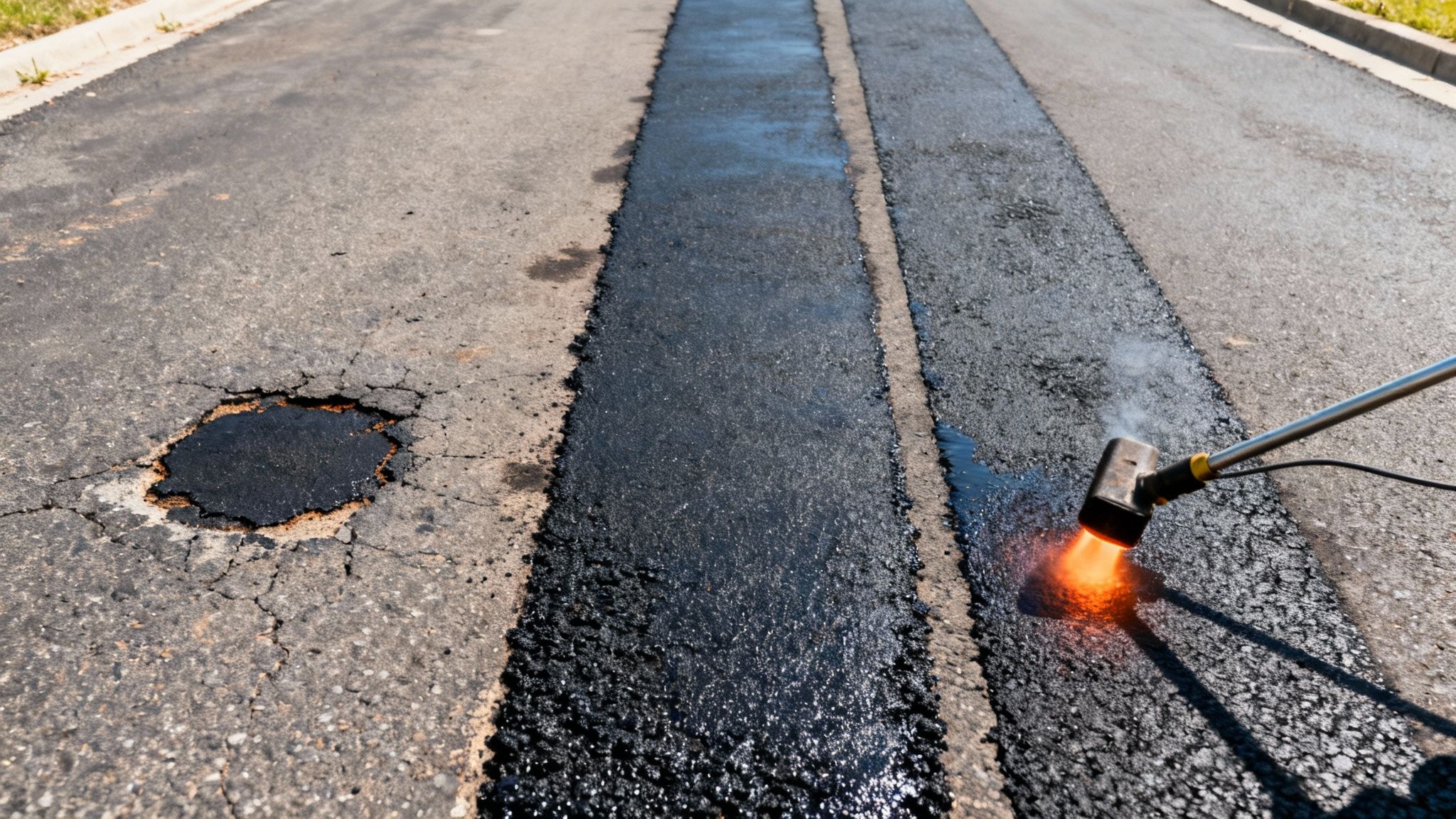
For issues like potholes, surface cracks, or bumpy seams, infrared asphalt repair is a game-changer. This technology uses special heaters to soften the existing asphalt around the damaged area. Then, we mix in a small amount of new asphalt and blend it right into the heated pavement.
The magic of this process is that it creates a seamless patch. There are no "cold joints" or seams, which are the weakest part of a traditional patch and where water often gets in to cause future problems.
Infrared repair is also very efficient. For example, a school in Salinas had us fix several potholes using this method. We finished the entire job in one afternoon, saving them 40% compared to a traditional cut-and-replace quote. Better yet, the parking lot was safe and ready for student drop-off the next morning. It reduces waste, cuts repair time, and delivers a durable fix.
How Targeted Repairs Extend Pavement Life
It’s easy to look at a small crack in your parking lot and think, "I'll get to it later." But with asphalt, small problems can quickly turn into major headaches. The smartest approach to cost-effective asphalt repair in Monterey County is to fix issues while they're still small.
Think of your pavement's surface as a shield. Even one unsealed crack is a weak spot. Rain gets in and works its way down to the foundation. Once that foundation gets wet, it weakens and can no longer support the weight above it. That’s when you start seeing potholes and large cracks.
Suddenly, a problem that could have been fixed in an hour with sealant has become a major, expensive repair.
Minimizing Disruption for Local Properties
We know that for our clients—whether it's a busy school in Salinas, a quiet HOA in Monterey, or a business in Seaside—downtime is a big problem. Shutting down a parking lot for a week costs money and frustrates everyone. This is where efficient, targeted repairs make all the difference.
We understand that. That's why techniques like infrared repair and smart patching are so valuable. For instance, we can patch several potholes for a school over a single weekend, so the lot is safe and ready for traffic on Monday morning. For an HOA, we can seal cracks one section at a time, keeping daily disruptions for residents to a minimum.
An hour of targeted repair today truly prevents a week of closure tomorrow. Acting early isn't just about saving money; it's about keeping your business or community running smoothly.
The Power of Proactive Maintenance
When you act early, you control the maintenance schedule and the budget. You aren't reacting to a sudden pavement problem that forces you to act. A simple crack-filling program can add years to your asphalt's life, delaying the massive expense of a full repaving project.
This strategy works especially well here. The need for asphalt repairs is always shaped by the local climate and traffic. Here in Monterey County, our mild weather is a big advantage—asphalt breaks down more slowly than in places with harsh winters.
- A single sealcoat application can last two to three years.
- Applying two coats can extend that protection to three to five years.
This makes sealcoating a powerful, long-term investment. You can learn more about how climate impacts asphalt repair costs and see how our local conditions play a role.
This forward-thinking approach changes pavement care from a surprise expense to a planned part of your property management. It ensures your property stays safe, accessible, and professional-looking all year long.
Real Savings from Monterey County Projects
Talking about smart repairs is one thing, but seeing how they work in the real world is what really matters. We’ve seen firsthand how a targeted approach to asphalt repair in Monterey County can make a huge financial difference for property owners.
These aren't just theories. They're real projects for clients right here in our community, saving them thousands of dollars and adding years to the life of their pavement.
The Local Business Park That Avoided a Full Repave
A while ago, we got a call from a business park manager in Seaside. He was looking at a huge quote for a complete parking lot replacement and thought it was his only option. His lot was in bad shape—potholes, large cracks, and a worn-out look.
Instead of tearing everything out, we created a plan that focused on the root problems. We used our infrared asphalt repair equipment to patch the potholes seamlessly, bonding the new asphalt to the old for a permanent fix. After that, a fresh layer of high-quality sealcoat made the whole surface look new again.
The result? The business park avoided the high cost and disruption of a full repaving project. Our targeted repair and sealcoating plan saved them an incredible 40% off the original replacement quote. We also had them back in business after just one weekend of work, minimizing downtime.
The HOA That Got Ahead of Its Budget Problems
Another great example is an HOA in Monterey that was struggling with its budget. They were always playing catch-up, spending money to fix potholes only after they became a problem for residents. It was an expensive and endless cycle.
The solution was simple: we helped them switch from reacting to problems to preventing them.
- First, we fixed the immediate issues: We filled every existing crack to stop water from causing more damage.
- Then, we set up a long-term schedule: A routine sealcoat application every three years was put on the calendar.
That one change completely turned their finances around. The HOA cut its annual asphalt maintenance budget by over 30%. Better yet, they've likely added five to seven years to their pavement's lifespan, pushing the need for a massive and costly repaving project far down the road.
Cost Savings Analysis: Local Project Examples
This table shows the real financial benefits our clients saw by choosing smart repairs over a total replacement.
| Client Type (e.g., School, HOA) | Problem | Cost of Full Repave (Estimate) | Cost of Targeted Repair Plan | Total Savings |
|---|---|---|---|---|
| Local Business | Widespread Potholes & Cracking | $55,000 | $33,000 | $22,000 (40%) |
| HOA Community | Recurring Potholes, No Plan | $90,000 | $63,000 (over 3 years) | $27,000 (30%) |
As you can see, these projects prove that targeted repairs are not just a temporary fix. They're a smart financial strategy that delivers major savings, reduces disruption, and protects your property for years to come.
Your Guide to a Smooth Repair Project
Managing an asphalt project is less stressful when you have a good plan. When you know what to look for and what to ask, you can guide the process with confidence. This helps ensure you get quality work without disrupting your home or business.
It all starts with a simple walk-through. Just take a look at your pavement. Are you seeing spiderweb-like cracks? Has the rich, black surface faded to a dull gray? These are early signs that your asphalt needs some attention.
Before you call a contractor, do a little prep work. It'll make getting a quote faster and more accurate. Pace off the area that needs work to get a rough size. Then, use your phone to take a few clear photos of the worst spots. Giving this info to a contractor helps them understand the job from the start.
Key Questions for Any Contractor
To find a good partner who is focused on cost-effective asphalt repair in Monterey County, you need to ask more than just the price. These questions will tell you a lot about their experience and quality.
- What repair method do you recommend and why? A professional won't just give you one option. They should explain why a certain method, like infrared repair versus a simple patch, is the right choice for your problem.
- How will you minimize disruption to our property? This is very important for businesses, schools, and HOAs. Ask about their plan for managing traffic, their work hours, and how long they expect the job to take.
- Can you explain the long-term benefits of this repair? You're not looking for a quick fix. You want to extend the life of your pavement. They should be able to clearly explain how their work will prevent bigger, more expensive problems later on.
This infographic breaks down how a smart approach—from inspection to repair—adds up to big savings and a longer-lasting surface.
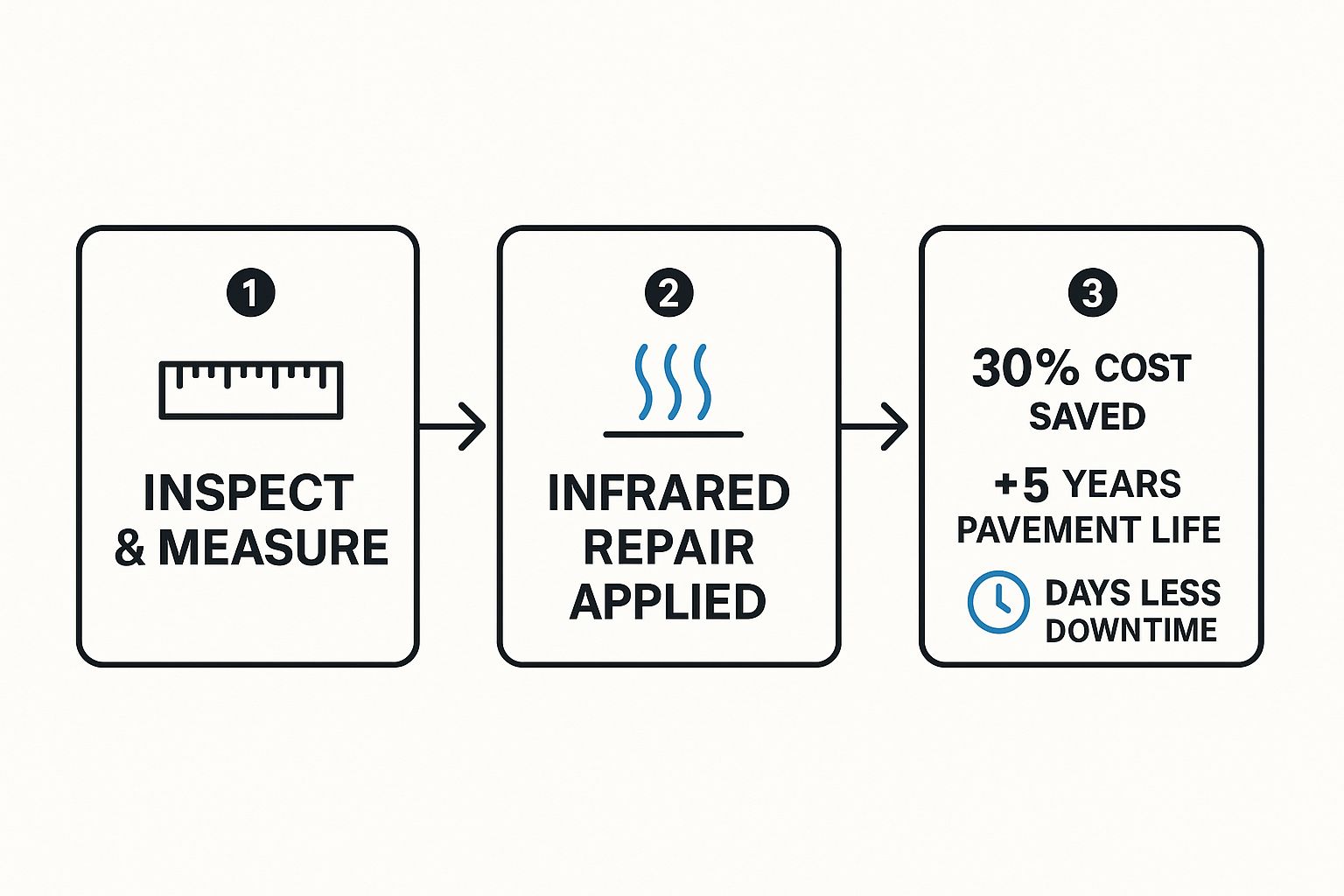
As you can see, choosing a modern method like infrared repair isn't just about a better-looking patch. It means lower costs, less downtime for your property, and a pavement that lasts for years longer.
Understanding costs helps you budget smartly. Across the country, asphalt repair prices can range from $0.25 to $15 per square foot, depending on the job. Minor crack filling might just be a few hundred dollars, but bigger patches will cost more. The key lesson is that small, early repairs are always cheaper than waiting for things to fall apart.
Having a clear, proactive plan turns asphalt maintenance from a surprise expense into a manageable investment. By checking your property and asking the right questions, you take control of the situation.
For a project that stays on time and on budget, using tools for efficient job and cost tracking can make a world of difference. Don't forget that timing is also everything—weather plays a huge role in how well asphalt cures. To make sure you're scheduling your project for success, check out our guide on the ideal asphalt paving temperature requirements.
Answering Your Top Asphalt Repair Questions
Even with a good plan, a few questions always come up. That's completely normal. To help you feel confident, here are some simple answers to the questions we hear most from property owners in Monterey County. My goal is to clear up any confusion and show you that smart, affordable maintenance is possible.
How Often Should I Really Be Sealcoating My Lot?
Here's some good news: our mild coastal climate means you don't need to sealcoat every single year. A professional, high-quality sealcoat application will easily last you 3 to 5 years. We just don't get the harsh freeze-thaw cycles that destroy pavement in other parts of the country.
I always tell my clients to do a quick walk-through each spring to look for signs of wear, but you can confidently budget for resealing every few years. It's the most effective way to protect your investment from the sun and rain—the two things that eventually lead to cracks and potholes.
Is Infrared Repair Actually Better Than a Traditional Patch?
In many cases, yes. Infrared repair is a modern approach where we use special equipment to heat the existing asphalt around a pothole. This lets us seamlessly blend new asphalt into the old pavement.
The result is a permanent, watertight bond with no weak spots. Those seams are the biggest weakness in a traditional "cut and patch" repair, creating a perfect entry point for water to get in and cause the same problem all over again. While a classic patch still works, infrared is often faster, cleaner, and gives you a much stronger fix that prevents future headaches.
Pro Tip: If your budget is tight, put every penny you can toward filling and sealing cracks. Unsealed cracks are like an open invitation for water to get under your pavement and wreck the foundation. Ignoring them is what leads to those massive, budget-busting repairs down the road.
What’s the Single Most Important Repair to Make on a Tight Budget?
Crack sealing. No question. It gives you the biggest return on your maintenance dollar.
This is a fairly low-cost task that has a huge impact. You’re preventing water from getting into the foundation, which is the root cause of almost all major pavement failures like potholes and "alligator" cracking. Think of it as preventative medicine for your parking lot—you’re stopping major damage before it starts. If you want to dive deeper into repair costs, our guide on understanding the true cost of an asphalt driveway is a great resource.
Ready to make a smart, affordable investment in your property? Coastal Pipeline Inc. is here to provide a clear plan that extends the life of your pavement and fits your budget. Get your free, no-obligation quote today!