Before you dig, the most important work on your project happens underground. For any good contractor, finding buried utilities is not just a task to check off a list. It is the foundation of a safe, successful, and profitable job. If you skip this step, you are asking for trouble.
Your Most Critical First Step
Here at Coastal Pipeline, our certified utility locating and trenching operations start with one simple rule: know what’s below before you dig.
Whether we’re working in Monterey, Santa Cruz, or San Benito County, that rule never changes. The network of pipes and cables under the ground is more complex than most people think. One wrong move with a digging machine can cause problems that last for weeks or even months.
The High Stakes of Getting It Wrong
Let's be clear: hitting a utility line is a huge and expensive problem. Hundreds of thousands of accidents are reported every year in the U.S. These cost billions in repairs, project downtime, and fines. Finding utilities correctly is not just about avoiding a headache; it’s about protecting your entire business.
A single accidental strike can cause a lot of problems:
- Severe Crew Injuries: Hitting a high-pressure gas line or a high-voltage electrical cable is a worst-case scenario that can be deadly.
- Budget-Breaking Damages: The cost to fix a cut fiber optic cable or a major water main can wipe out your profit.
- Project-Killing Delays: A utility strike means all work stops. Then come investigations, emergency repairs, and scheduling problems that can derail your entire project.
The table below shows why this process is so important. There is no room for error when so much is at risk.
Why Accurate Utility Location is Non-Negotiable
| Area of Impact | Risk of Inaccurate Locating | Benefit of Proper Locating |
|---|---|---|
| Crew Safety | Major injuries or death from gas explosions or electric shock. | A safe work area where your team goes home every day. |
| Financial Health | High repair costs, big fines, and rising insurance costs. | Projects stay on budget without surprise expenses that hurt profits. |
| Project Timeline | Work stops right away, leading to long investigations and big delays. | Smooth progress that keeps the project on schedule. |
| Public Services | Widespread outages of water, power, gas, or internet for the community. | Uninterrupted service for nearby homes and businesses. |
| Reputation | Damage to your company's good name and possible legal trouble. | Building a name as a reliable, safety-focused contractor. |
Taking the time to do it right is a core business practice. It protects your people, your profits, and your reputation.
Combining High-Tech Tools with Old-School Know-How
Modern tools like Ground Penetrating Radar (GPR) and electromagnetic locators have made a big difference, but they are not a perfect solution. Technology is only as good as the person using it. That’s where experience is key.
Our approach at Coastal Pipeline is to combine modern detection methods with the hands-on expertise that comes from years in the field. We use GPR to get a clear picture of what’s underground, but we never just trust the paint marks on the ground. You can get a better sense of what we're looking for by reading our guide to the different types of underground utilities.
"Technology gives you the map, but careful excavation provides the proof. I can’t tell you how many times we’ve been on a job site in Salinas where the first marks were off by a foot or two. A quick pothole to visually confirm a gas line's depth prevented what could have been a serious incident. That’s why we never rely on marks alone."
In this guide, we'll share the proven methods we use every day to protect our team and our business. We will show you the real-world best practices from our work across the Central Coast. A safety-first mindset and following the rules are the keys to a successful contracting business.
Your Pre-Excavation Planning Checklist
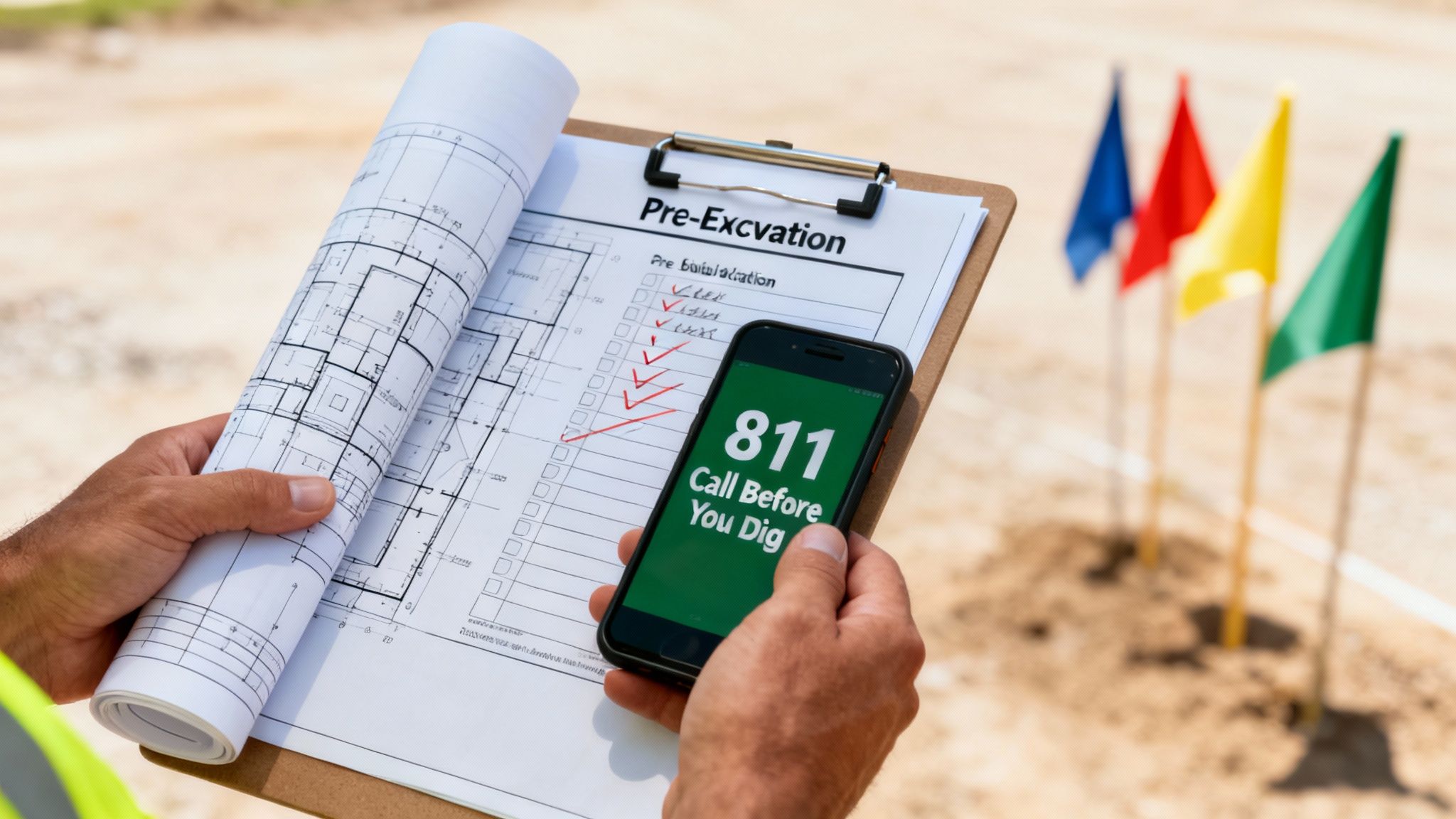
Success on a job site starts long before the digging machine arrives. It begins with careful planning. A good pre-digging process is your best defense against surprises that can ruin your timeline and budget. It’s like mapping out the hidden world under your feet before you start digging.
To do it right, you need a system. This is not just about checking boxes. It is about having a disciplined mindset. There's a reason people stress the importance of using checklists for critical operations—it improves safety and consistency. For us, that means carefully reviewing every plan, permit, and utility mark.
Start with the 811 'Call Before You Dig' Mandate
First, every single dig, big or small, starts with a call to 811. This is a free service required by law. It gets public utility companies to come to your site and mark their lines with flags or paint. It's the first step for any digging project.
But here’s a lesson from our years of certified operations at Coastal Pipeline: making the call is just the start. You have to know what the marks mean and, more importantly, what they don't mean. Remember, 811 only covers public utilities. These are the lines the service providers own up to the meter.
A common—and dangerous—mistake is thinking the site is clear after the public locators leave. Private lines like the power line to a garage, sprinkler systems, or fuel lines from a propane tank are your responsibility. They won’t be marked by the 811 service.
Navigating Local Protocols in Monterey, Santa Cruz, and San Benito
Working here on California's Central Coast means following local rules. Monterey, Santa Cruz, and San Benito counties each have their own permit process and utility coordination protocols you must know.
- Monterey County: You will often find farm irrigation lines and complex city water systems, especially in places like Salinas. Utility coordination protocols require you to work closely with both city and agricultural water districts.
- Santa Cruz County: The mix of coastal and mountain areas creates complicated utility layouts. You need to be in close contact with the Public Works department to understand property lines and access rights.
- San Benito County: This area has a mix of old towns and new developments. This means you will need to find old, sometimes poorly documented utility maps while also checking plans for new lines.
For any project in this region, getting the right permits from the local government is a must. This has to happen at the same time you submit your 811 ticket to make sure you are following all rules before any dirt is moved.
Case Example: Building a Complete Site Picture
Let's say you're about to start work on a new commercial building in Salinas. You did the right thing and called 811. Now you have marks for the public gas, water, and telecom lines along the street. But what about the property itself?
This is where your professional work comes in. A complete checklist goes much deeper:
- Dig Up Historical Plans: Go to the city planning department and ask for old site plans. These can be very helpful, showing abandoned lines or pipes that won’t be on any modern map.
- Talk to the Utility Owners: Go beyond the field locator. Talking with an engineer at the local utility can often give you more detailed maps and information that the person marking the ground might not have.
- Bring in a Private Locator: The only sure way to find everything else is to hire a private utility locating service to scan the whole property. This is how you find those private electrical, water, or sewer lines that 811 doesn’t cover. Our team at Coastal Pipeline provides complete https://coastalpipelineinc.com/underground-utility-services/ that fill this important safety gap.
When you combine public markings from 811, old records, and a private scan, you are no longer working with a rough guess. You’re working with a clear picture of what is under the ground. This is the difference between hoping you’re safe and knowing you are. It’s how you dig with confidence.
Choosing the Right Detection Methods
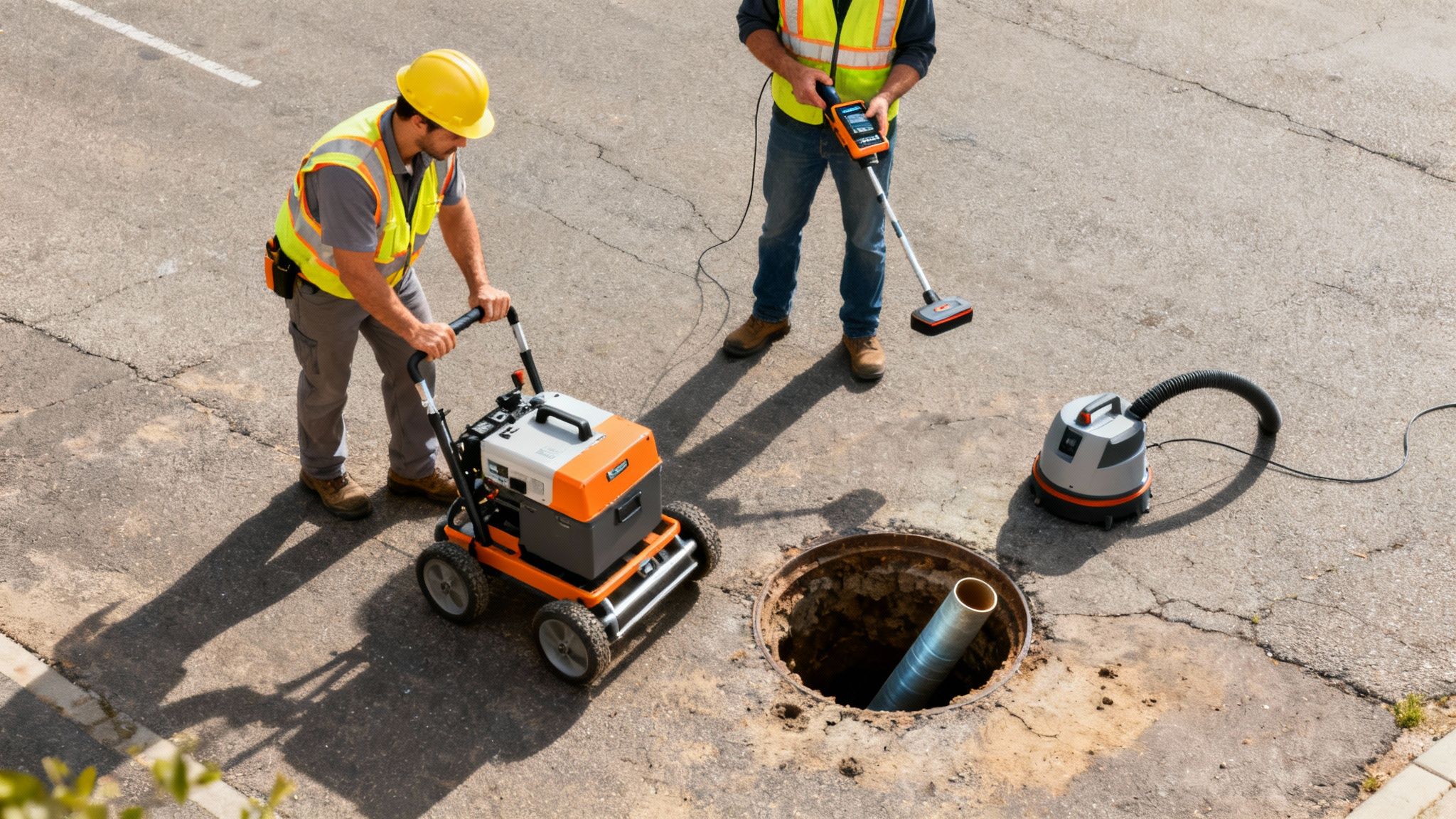
Once you have the plans and the public utility marks are on the ground, it's time to bring in the tools. Knowing which detection method to use—and when—is what makes an operation professional and safe, not a risky guess. At Coastal Pipeline, our certified crews have learned that the best approach is always a mix of modern detection methods and proven, traditional excavation expertise.
Relying on just one method can lead to trouble. Instead, we use a combination of high-tech locators and careful, physical checks to get the full picture. This makes sure we're not just finding most of the utilities, but all of them. Each tool has its purpose, and you have to know its strengths.
Modern Tools for a Modern Job Site
Today's technology gives us a great advantage. It lets us see under the surface without digging. The two most effective tools we use are Electromagnetic (EM) locators and Ground Penetrating Radar (GPR).
Electromagnetic (EM) Locators are the main tool for finding metal pipes and cables. An EM locator sends out a signal that creates a field around a metal line. The receiver then picks up that field. This lets us trace the utility's path very accurately.
But its biggest strength is also its biggest weakness: it only finds materials that conduct electricity. It's great for locating gas lines, water mains, and power cables. But it will completely miss things like PVC sewer lines or fiber optic cables that don't have a metal tracer wire.
Ground Penetrating Radar (GPR) is what we use to find those other things. It works like a fish finder for the ground. It sends radio waves into the earth and reads the "echoes" that bounce back. This lets it find both metal and non-metal objects. This makes it essential for finding plastic pipes, concrete structures, and even old, filled-in trenches.
On a recent project in Santa Cruz County, our crew used GPR to locate a series of old, non-metallic irrigation lines that didn't appear on any city maps. An EM locator would have missed them entirely, but the GPR painted a clear picture. This real job-site case prevented a messy and costly utility strike, showing the importance of code compliance and safety.
While GPR is very useful, it's not perfect. Its performance can be affected by soil conditions like heavy clay or a lot of moisture, which can limit the signal. You can learn more about how technology is transforming underground utility projects and making job sites safer.
Choosing the right tool for the job is important, as each has its own uses and limits.
Choosing the Right Utility Detection Method
| Method | Best For Detecting | Key Advantage | Limitation |
|---|---|---|---|
| EM Locator | Metal pipes and cables (gas, water, electric). | Very accurate for tracing the path of known metal lines. | Cannot find non-metal materials like plastic or clay pipe. |
| Ground Penetrating Radar (GPR) | Non-metal utilities (PVC, fiber optics), buried structures, and soil changes. | Can find a wide range of objects under the ground. | Less effective in clay, wet, or rocky soils. |
| Vacuum Excavation | Physically checking the exact location, depth, and type of any utility. | The safest method for uncovering sensitive lines without damage. | Slower and more costly than remote tools; requires removing debris. |
| Hand Digging (Potholing) | Visual confirmation in small spaces or when heavy equipment cannot be used. | Precise and controlled; allows for a gentle touch around utilities. | Takes a lot of work and can be slow; risk of tool damage to the utility. |
The only way to be completely accurate and safe on site is to use a mix of these methods.
When Technology Meets the Trench
As powerful as these tools are, they only give you a map of what's likely underground. They provide a location and an estimated depth. But they can't tell you for certain what a utility is or its exact position.
That's why the final, and most important, step is to physically check through careful digging. This is where traditional excavation expertise cannot be replaced. We call it potholing or daylighting. It’s the only way to be 100% sure of a utility’s location, depth, material, and size.
There are two main ways to do this safely:
- Vacuum Excavation: This is by far the safest and most precise method. It uses high-pressure air or water to loosen the soil, and a powerful vacuum then removes the dirt. This gently uncovers the utility without any risk of damage from a metal bucket. It is our preferred method around sensitive lines like gas or fiber.
- Hand Digging: Sometimes, good old-fashioned shovels are the best way. Careful hand digging allows for a gentle touch. It is great for checking utilities in tight spaces or areas where heavy equipment can't go.
A Real-World Example from the Field
On a commercial project in Monterey, the 811 marks showed a major gas line running next to our planned trench. Our EM locator confirmed its path, but the GPR showed a second, unknown object a few feet away and a little deeper.
Instead of taking a chance, we stopped everything and used a hydro-vacuum excavator to create a small test hole. This real job-site case taught us a critical lesson: the marked gas line was right where it was supposed to be, but the second object was an old, abandoned water main that wasn't on any plans. If we had just trusted the paint and started digging, our excavator could have easily hit the unmarked pipe, causing a flood and major project delays.
This experience shows our core belief: technology provides the map, but careful digging provides the proof.
Implementing On-Site Safety and Compliance
Once the plans are done and the paint is on the ground, the real work begins—and so does the real risk. Moving from a plan on paper to digging in the dirt requires a strong focus on crew safety and following the rules. Here at Coastal Pipeline, our certified trenching operations are built on a safety-first culture. This culture connects the plan to the reality of an open trench.
Every experienced contractor knows those colored lines on the ground are an important guide, but they are never a guarantee. They give you the approximate location of a utility. The true test of a professional crew is how they work around these marks. They must respect what the marks represent while also understanding their limits.
Respecting the Tolerance Zone
State laws and industry best practices create a tolerance zone around marked utilities. This is your safety buffer, a space usually measuring 18 to 24 inches on each side of the marks. Within this zone, heavy machinery is not allowed until you've visually confirmed exactly where that utility is.
Think of this as a "no-go" area for your excavator bucket. Inside this buffer, the only digging allowed is careful and non-destructive—like using a shovel or a vacuum excavator. Following this one rule is probably the single most effective way to prevent a utility strike.
Real-World Case Study: Unclear Markings in Santa Cruz
We had a project in a Santa Cruz County neighborhood not long ago, installing a new sewer line. The 811 marks showed a gas line running next to our planned trench, but the paint was faded and unclear as it got near some old trees.
Instead of taking a chance, our site foreman immediately followed our safety protocol.
- Stop All Work: The excavator was shut down. The whole crew gathered to discuss the situation. No one made any assumptions.
- Re-Verify with Hydro-Excavation: We brought in a vacuum excavation truck to "pothole" the line. This means carefully exposing it at several points along its suspected path. This method uses pressurized water to gently wash away the soil, revealing the pipe without any risk of damage.
- Communicate and Confirm: We found that the gas line was actually several inches closer to our trench than the old marks suggested. Our foreman called the local utility owner to confirm the pipe’s material and pressure. He documented the entire process.
This simple, step-by-step approach turned a potentially dangerous situation into a routine safety check. This real job-site case emphasizes a core value at Coastal Pipeline: every team member has the power to stop work if something feels unsafe. This culture is the foundation of a safe operation and ensures code compliance. For a deeper dive, check out our essential guide on construction site safety tips.
The most important tool on any job site isn't the excavator; it's the crew's willingness to stop and ask questions. That pause to verify the gas line in Santa Cruz didn't just prevent a utility strike—it reinforced our commitment to sending everyone home safely.
Meeting OSHA Trenching Requirements
Besides respecting tolerance zones, every dig must meet OSHA standards for trenching and excavation safety. These aren't just suggestions; they're federal laws designed to prevent deadly trench collapses.
A few key OSHA requirements to follow:
- Protective Systems: Any trench deeper than five feet must have protection against collapse. This can mean sloping the soil back, using supports, or using a trench shield (trench box).
- Access and Egress: For trenches four feet or deeper, you need a safe way for workers to get in and out, like a ladder or ramp. That exit must be within 25 feet of every worker in the trench.
- Daily Inspections: A "competent person" must inspect the trench daily and before every shift starts. They look for problems like cracks or water seeping in that could signal a collapse.
Following these rules isn’t just about avoiding fines; it’s about knowing that gravity is powerful. A single cubic yard of soil can weigh as much as a small car, and a collapsing trench wall is very dangerous. Sticking to these standards is a key part of our daily work to protect our most valuable asset—our people.
Making sure you have the right insurance is also a big part of this. For contractors, it's important to know the difference between policy types, especially when it comes to being responsible for damages. You can learn more by understanding professional liability insurance for contractors and how it compares to general liability.
Your On-the-Ground Contractor Workflow
A successful dig is all about having a solid, repeatable process. This is not just a checklist you go through; it’s a mindset that keeps your crew safe and the project on track. For our teams here at Coastal Pipeline, this is the exact approach we use to stay compliant, protect our people, and maintain our reputation for getting the job done right across Monterey, Santa Cruz, and San Benito Counties.
A smart workflow is a mix of high-tech gear and old-school digging sense. You have to know which tool to use for the job. More importantly, you need to know when to put the technology down and trust what you can see with your own eyes.
From the First Call to the Final Check
The real work starts long before the excavator bucket ever hits the ground. Each step in the process builds on the last. This gives you a complete, accurate picture of what’s hiding just under the surface.
This simple flow chart gives a great visual of the core steps: mark, verify, and then excavate.
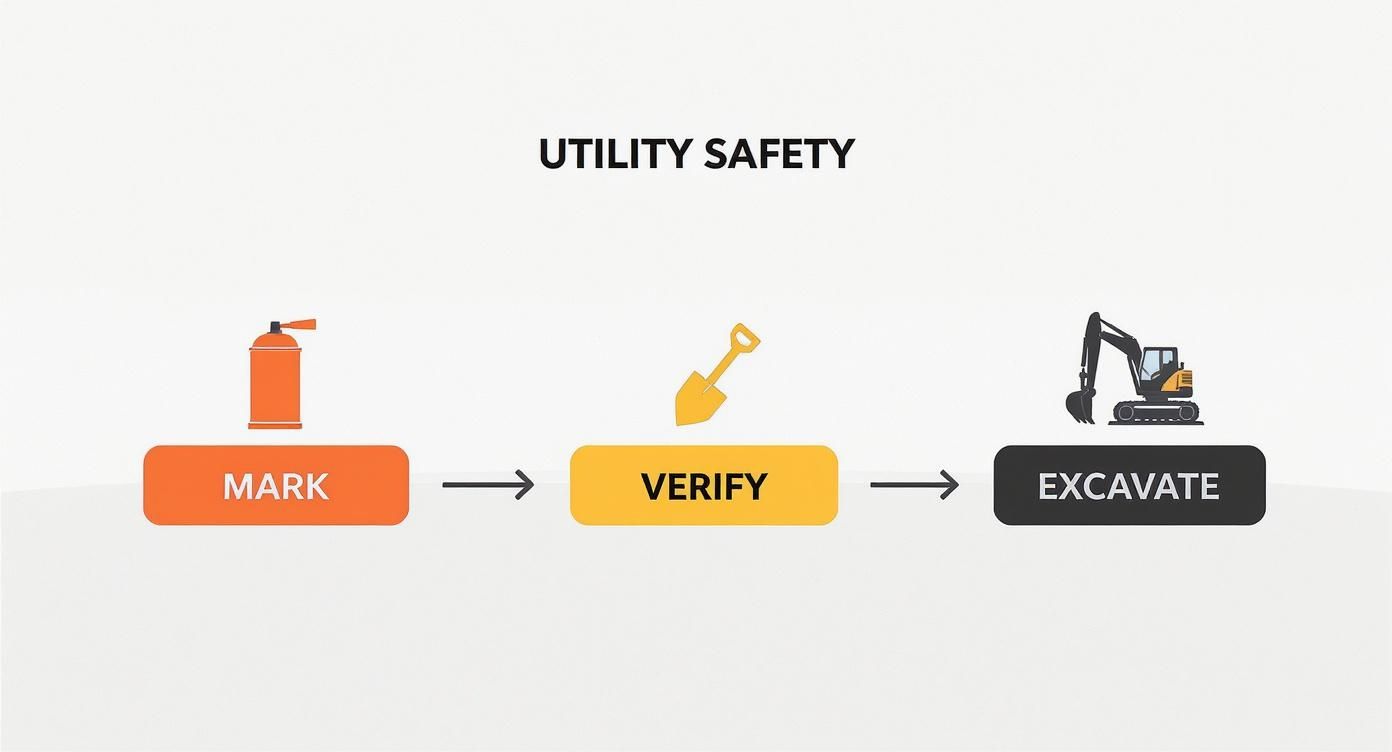
Remember, the paint on the ground is just the starting point. Getting visual confirmation is the only way to be 100% certain before you start digging.
The Operational Playbook
Here’s a breakdown of how to structure your operations for your next project. This is not a theory; it's the field-tested process we use every day, reflecting best practices from our certified utility locating operations.
- Do Your Homework First: The first step is always the required 811 call to get the public utilities marked. While you’re waiting, start getting local records and any permits you’ll need. This is especially important since requirements can vary between Monterey, Santa Cruz, and San Benito County.
- Bring in the Private Locators: Never assume 811 marks everything. You must hire a private locating service to find all the lines that 811 misses—like electrical feeds to sheds, old septic systems, or irrigation pipes. You can’t start work without a complete site picture.
- Sweep the Site Yourself: Once the marks are down, it’s time for your own tech sweep. Use a combination of an Electromagnetic (EM) locator and Ground Penetrating Radar (GPR). This modern detection method lets you confirm the public marks and find any unrecorded lines, whether they're metal or not.
- Establish Your Tolerance Zone: This is a key visual sign for your entire crew. Mark out the legally required tolerance zone—usually 18 to 24 inches on each side of the marked utility. This area becomes a strict "no-go" zone for any heavy machinery.
- Get Eyes on the Utility (Potholing): This is the final check. You must physically expose the utility to confirm its location and depth. Use a non-destructive method like vacuum excavation or just careful hand digging within the tolerance zone. There’s no substitute for seeing it with your own eyes. This marries modern tech with traditional excavation expertise.
- Excavate with Confidence: With all utilities visually confirmed, you can finally start the main digging. Make sure to keep a safe distance from the exposed lines and always watch the trench wall stability. Follow every OSHA guideline for support and access.
True expertise isn't just knowing how to run the equipment. It's having the discipline to stop, double-check, and question what you're seeing. We've avoided many potential disasters simply by trusting our process instead of making assumptions.
This commitment to a thorough process is backed by an industry that’s getting smarter and safer. The global utility locator market was valued at around USD 950 million and is on track to hit nearly USD 1.42 billion by 2030. A huge reason for this, especially in North America, is the push for stricter rules and the use of better tech like GPR and EMI. You can read more about the growth of the utility locator market.
Following a workflow like this does more than just keep you out of trouble. It creates a safer job site and builds a reputation for being a professional. Properly planning for what you can't see, especially when it comes to underground utility trenching for electrical lines, is what separates the experts from everyone else.
Your Questions Answered: A Field Guide to Utility Locating
Even with the best plan, questions always come up on the job site. That's a good thing—it shows your crew is thinking about getting it right and keeping everyone safe. Having worked on countless projects across Monterey, Santa Cruz, and San Benito Counties, we've heard just about every question there is.
Here are the simple answers to some of the most common ones we get.
What's the Single Biggest Mistake You See Contractors Make?
The most dangerous mistake is treating the 811 paint marks as being 100% accurate. Calling 811 is the law and a very important first step. But those marks are just an educated guess of a utility's general path. They do not tell you the depth of the line.
Your professional duty doesn't end with a phone call. You have to physically confirm the exact location, how big the line is, and how deep it is within the legal "tolerance zone." This zone is usually about 18 to 24 inches on either side of the marks.
The only way to be certain is by carefully exposing the utility. We call this "potholing" or "daylighting." It's typically done with non-destructive methods like vacuum excavation or careful hand digging. Simply trusting the paint on the ground is a big gamble that can lead to major utility strikes, service outages, and dangerous situations.
How Do We Find Private Utilities That 811 Won't Mark?
This is a big blind spot for a lot of crews. The 811 service is only responsible for public utilities—the main lines that run from the street to your property's meter. Everything on the other side of that meter is considered private, and it's up to the property owner to find it.
There can be a surprising amount of private lines buried out of sight:
- Power lines to a detached garage, workshop, or well pump.
- Gas or water lines feeding a pool heater or an outdoor BBQ.
- The entire network of an irrigation system.
- Septic lines and their drain fields.
- Data or communication cables connecting buildings on a large property.
To find these, you need to bring in a private utility locating service. These specialists use a different set of tools, like Ground Penetrating Radar (GPR) and Electromagnetic (EM) locators, to find everything else. They can spot plastic pipes, old abandoned lines, and other things that the public service would never even look for. For true site safety, every dig needs two steps: call 811 for public lines, then hire a private locator for the rest.
What's the Protocol If We Find an Unmarked Line?
Digging up a line you weren't expecting is a stop-everything-now moment. Your crew's safety is the only thing that matters.
The very first thing you do is stop all digging. Don't try to poke it, move it, or figure out what it is on your own. Get everyone out of the area and keep a safe distance. The rule is simple: treat every unmarked line like it’s live and dangerous.
Next, get your site supervisor involved right away. They need to call 811 again to report an unmarked line. You should also contact the property owner and the local utility providers to let them know what you've found. Nobody should touch that part of the site until a qualified professional has identified the line and given the official all-clear.
Is There a Standard Depth for Buried Utilities?
No, and that’s why you can't make assumptions. Local codes might offer general guidelines, but the real-world depth of a utility can be very different. So many things can change it over time:
- Age: Older lines were often buried before today's rules existed.
- Grading Changes: Years of landscaping, erosion, or new construction can add or remove soil, changing how deep a line is.
- Obstacles: Installers may have put a line shallower or deeper than usual to get around big rocks, tree roots, or another utility.
As a general rule, high-risk lines like gas and electric are usually buried deeper—maybe 24 to 36 inches. Communication lines like fiber or cable can be much shallower, sometimes only 12 to 18 inches down. But again, these are just averages. Never bet your safety on a guess; you have to see it to know for sure.
We Used GPR, So Why Do We Still Need to Pothole?
Ground Penetrating Radar (GPR) is a fantastic tool. It gives us a great view under the ground and can spot things other locators can't, like plastic pipes or concrete structures.
But here's the key thing to understand: GPR shows you a change in the ground. It doesn't positively identify what that change is.
A GPR scan might show you a clear target three feet down. But it can't tell you if that's a live sewer line, an old forgotten drain pipe, or just a really big rock. Potholing is what turns that digital image into hard proof. By carefully digging down and physically exposing the target, you confirm what it is, its size, its condition, and its exact depth. It’s the final step that removes all guesswork before the heavy equipment starts working.
At Coastal Pipeline Inc., we know that a safe, successful project starts with careful planning, the right technology, and a strong commitment to doing things by the book. If you're planning work in Monterey, Santa Cruz, or San Benito County, our certified team is here to make sure your project is built on solid ground.
Contact us today to discuss your underground utility and excavation needs.