
Yes, it's often completely normal for a new water main to cost over $20,000. That number can feel like a shock, but it accurately reflects a complex project that goes far beyond simple digging and plumbing.
Why a High Water Main Quote Is Often Realistic
Seeing a quote for $20,000 or more for an underground pipe can cause serious sticker shock. Most people expect a bill of a few thousand dollars. When the estimate comes back five or ten times that, it’s easy to feel like you’re being overcharged—especially for work that will be buried and out of sight.
That reaction is understandable, but it comes from a common misstep: assuming that underground line replacement is just about digging a hole and dropping in a pipe. The reality is that it’s much closer to a small-scale engineering project, loaded with required steps and hidden costs.
What the Data Shows
Let's look at the numbers. Industry data helps put these figures into perspective. According to national cost estimators, a standard trenched water line replacement averages anywhere from $50 to $200 per linear foot. If you have a typical 100-foot run from the street to your house, you can see how that adds up fast.
Underground utility work is expensive because it requires permits, traffic control, trench safety measures, official inspections, and complete surface restoration. On top of that, recent labor shortages and inflation have driven up costs. Many property owners don't realize that the depth of the main, local soil conditions, and strict municipal code requirements heavily affect the final price. You can dive deeper into national water line replacement costs to see how different regions compare.
It's More Than Just a Pipe
A professional, legitimate quote covers a lot more than just the pipe and the crew's time. It's built on critical safety and regulatory requirements that protect you, your property, and the public. These often-invisible costs are non-negotiable for a professional contractor.
Here’s a quick look at what’s really involved:
- Engineered Layouts: We're not just digging a line. The new main must be mapped to meet strict municipal codes for depth, grade, and material type.
- Permits and Inspections: This involves official city or county fees and the time spent coordinating with inspectors to ensure everything is up to code.
- Trench Safety Protocols: Open trenches are incredibly dangerous. Proper shoring and safety measures are required by law to prevent a collapse.
- Traffic and Pedestrian Control: If any work happens near a street or sidewalk, a formal plan is needed to safely manage the flow of cars and people.
- Full Surface Restoration: The job isn't done until your driveway, sidewalk, and landscaping are put back exactly as they were.
To give you a clearer picture, this table breaks down the main factors that push a water main project into the five-figure range.
Why Water Main Quotes Can Exceed $20,000
| Cost Driver | How It Impacts Your Project | Typical Price Impact |
|---|---|---|
| Excavation & Trenching | The deeper and longer the trench, the higher the cost. Hitting rock or unstable soil adds significant time and equipment needs. | $4,000 – $10,000+ |
| Traffic & Pedestrian Control | Working in a public right-of-way requires permits, flaggers, signage, and barriers, which are legally mandated for safety. | $2,000 – $7,000+ |
| Paving & Surface Restoration | Restoring asphalt, concrete, and landscaping to their original condition is a specialized, multi-step process. | $3,000 – $8,000+ |
| Permits & Inspections | Municipal fees and the administrative time to coordinate with city officials are part of every legitimate project. | $1,000 – $4,000 |
| Specialized Labor (Prevailing Wage) | Public works projects often require "prevailing wage" labor rates, which are significantly higher than standard residential wages. | Can increase labor costs by 50% or more. |
As you can see, the pipe itself is often one of the smallest parts of the total cost. The majority of the expense comes from the complex work required to get to the pipe and restore everything afterward safely and legally.
At Coastal Pipeline, we believe in transparent estimates that break down every single one of these components. We’ve worked with homeowners and developers across Santa Cruz, Monterey, and San Benito Counties, and our focus is always on ensuring your installation is safe, compliant, and built to last for decades—with no surprises or hidden fees.
Deconstructing That Water Main Installation Quote
When a quote for over $20,000 lands in your inbox, that big number at the bottom can be a shock. But a professional estimate isn't just a price tag—it’s a comprehensive plan for a complex construction project. Understanding what goes into that total is the first step toward seeing its real value and making a confident decision.
The biggest misstep people make is thinking the job is just digging a trench and laying some pipe. This leads to unfair comparisons between a licensed, insured general engineering contractor and a handyman service that offers a tempting low price. But that lower price almost always comes from cutting critical corners on safety, permits, and quality that will cost you more down the road.
A legitimate quote from an experienced contractor is designed to protect you by including every necessary step from start to finish.
This visual breaks down how the per-foot costs for a pretty standard job can quickly add up to a five-figure total.
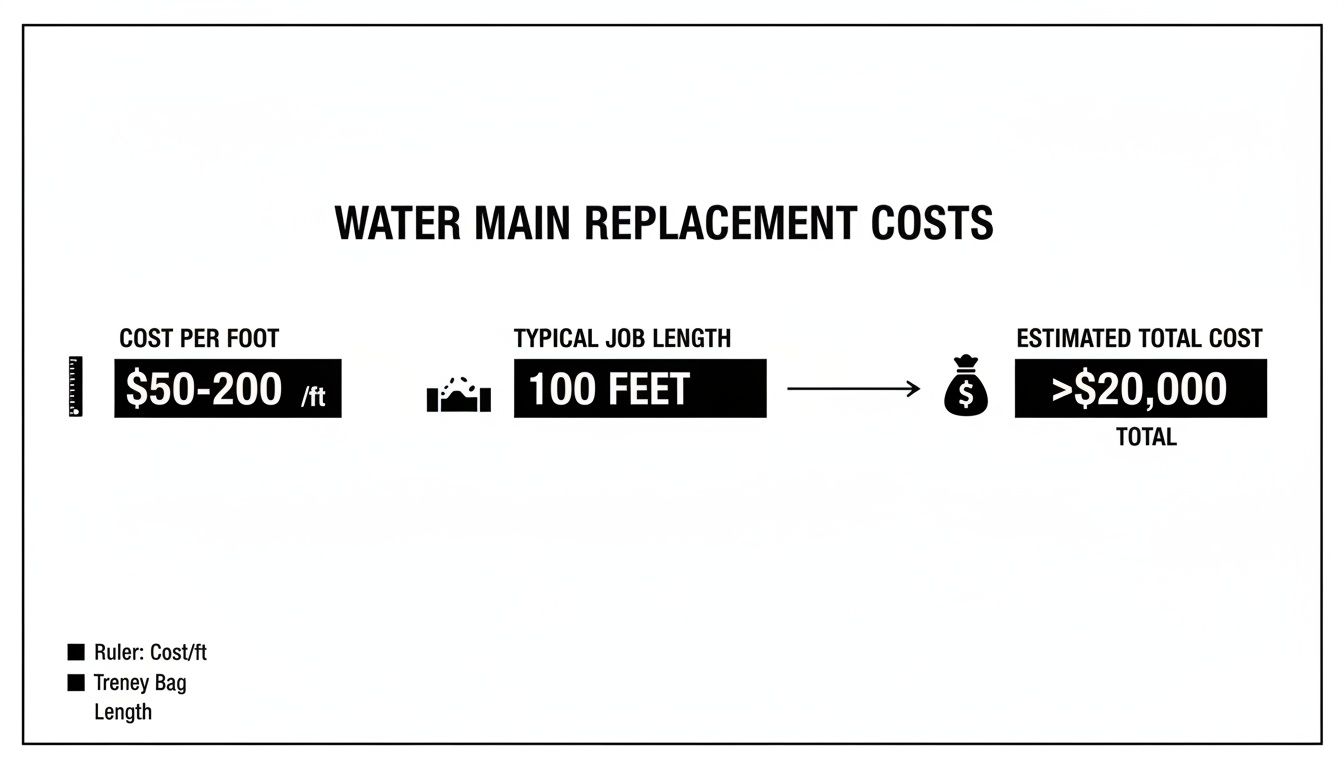
As you can see, even a moderate per-foot cost multiplies fast over the length of the project, easily pushing the final price well into that $20,000+ range.
Understanding the Line Items
A transparent, professional quote should always be itemized, showing you exactly where your money is going. Instead of one lump sum, you should ask for a detailed scope of work that breaks the project into clear components. This is the only way you can accurately compare different bids and really understand the value each contractor is providing.
Here’s what you should expect to see on a professional estimate:
- Materials: This isn't just the pipe itself (whether it’s durable Ductile Iron or flexible HDPE), but also all the necessary fittings, valves, thrust blocks, and proper backfill material.
- Labor and Equipment: This is the cost for the skilled crew operating the heavy machinery needed for excavation, pipe installation, and managing the site safely.
- Excavation and Trench Safety: Safely digging the trench is a huge part of the job. This line item includes vital safety measures like shoring to prevent collapse, which is a non-negotiable legal requirement to protect workers.
- Permits and Inspection Fees: Every city and county charges fees for the necessary permits and requires official inspections to ensure the work meets public safety and engineering standards.
The Hidden Costs That Drive Up the Price
Beyond the obvious, several other factors contribute significantly to the total cost. Historical data confirms that major water main jobs often surpass $20,000 in markets like ours, driven by rising labor, material, and regulatory demands. In fact, comprehensive water main assemblies can average $180–$300 per foot in high-seismic zones. For a 150-foot project, that alone can total $27,000–$45,000.
When you look at national statistics, it’s clear that 55% of water mains over 100 feet exceed $20,000, especially after you factor in permit fees (which can add 10–20%) and a necessary contingency for surprises. It’s also important to remember how documents like bids and contracts are processed in the industry; you can explore some relevant construction use cases to see the bigger picture.
Here’s a look at the major components that contribute to the final bill.
Itemized Cost Breakdown for a Typical Project
This table illustrates the percentage contribution of each major component to the total project cost, helping you visualize where the money goes.
| Cost Component | Description of Work Involved | Estimated % of Total Cost |
|---|---|---|
| Excavation & Trenching | Digging the trench, soil removal, and implementing legally required safety measures like shoring to prevent cave-ins. | 30% – 40% |
| Materials & Equipment | The pipe itself, all fittings, valves, backfill materials, and rental/operation costs for heavy machinery like excavators. | 20% – 30% |
| Labor & Prevailing Wage | Wages for the skilled crew, including operators, pipefitters, and laborers, often dictated by local prevailing wage laws. | 15% – 25% |
| Surface Restoration | Repaving asphalt, repairing concrete sidewalks or driveways, and restoring landscaping to its original condition. | 10% – 20% |
| Permits & Traffic Control | Municipal permit fees, inspection costs, and the implementation of a traffic control plan with signs, flaggers, and barriers. | 5% – 15% |
| Tie-Ins & Testing | The complex work of connecting the new main to the city system and the property, followed by pressure testing and disinfection. | 5% – 10% |
As you can see, the actual pipe is only one piece of a much larger puzzle. The physical labor of digging and the painstaking work of putting everything back together are what really drive the cost.
Don't Forget These Critical Steps
Other crucial—and often overlooked—costs that must be included are:
- Traffic and Pedestrian Control: If the work is anywhere near a road or sidewalk, a formal traffic control plan with flaggers, signs, and barriers is required by law. This is about public safety, pure and simple.
- Utility Tie-Ins: This is delicate work. Connecting the new main to the city’s system and your property’s plumbing requires serious precision and coordination with municipal inspectors.
- Testing and Disinfection: Before a new water main can be put into service, it has to be pressure tested for leaks and thoroughly flushed and disinfected to ensure the water is safe to drink.
- Full Surface Restoration: The final step is restoring everything to the way it was before the project started. This includes repaving asphalt, repairing concrete sidewalks, and fixing any lawns or landscaping that were disturbed.
At Coastal Pipeline, we've built our reputation on providing transparent estimates that clearly break down every line item—labor, materials, permitting, and restoration. We’ve worked with homeowners and developers all over Santa Cruz, Monterey, and San Benito Counties to install water mains that last for decades, and we do it without vague scopes or hidden fees. We believe our job is to help you understand the full scope of the work so you can feel completely confident in your investment.
What's Really Driving Up the Cost? Unseen Factors in Water Main Installation
Ever wonder why you and your neighbor might get wildly different quotes for what looks like the same water main job? It’s a common point of confusion for property owners. The truth is, what you see on the surface is just a tiny fraction of the story.
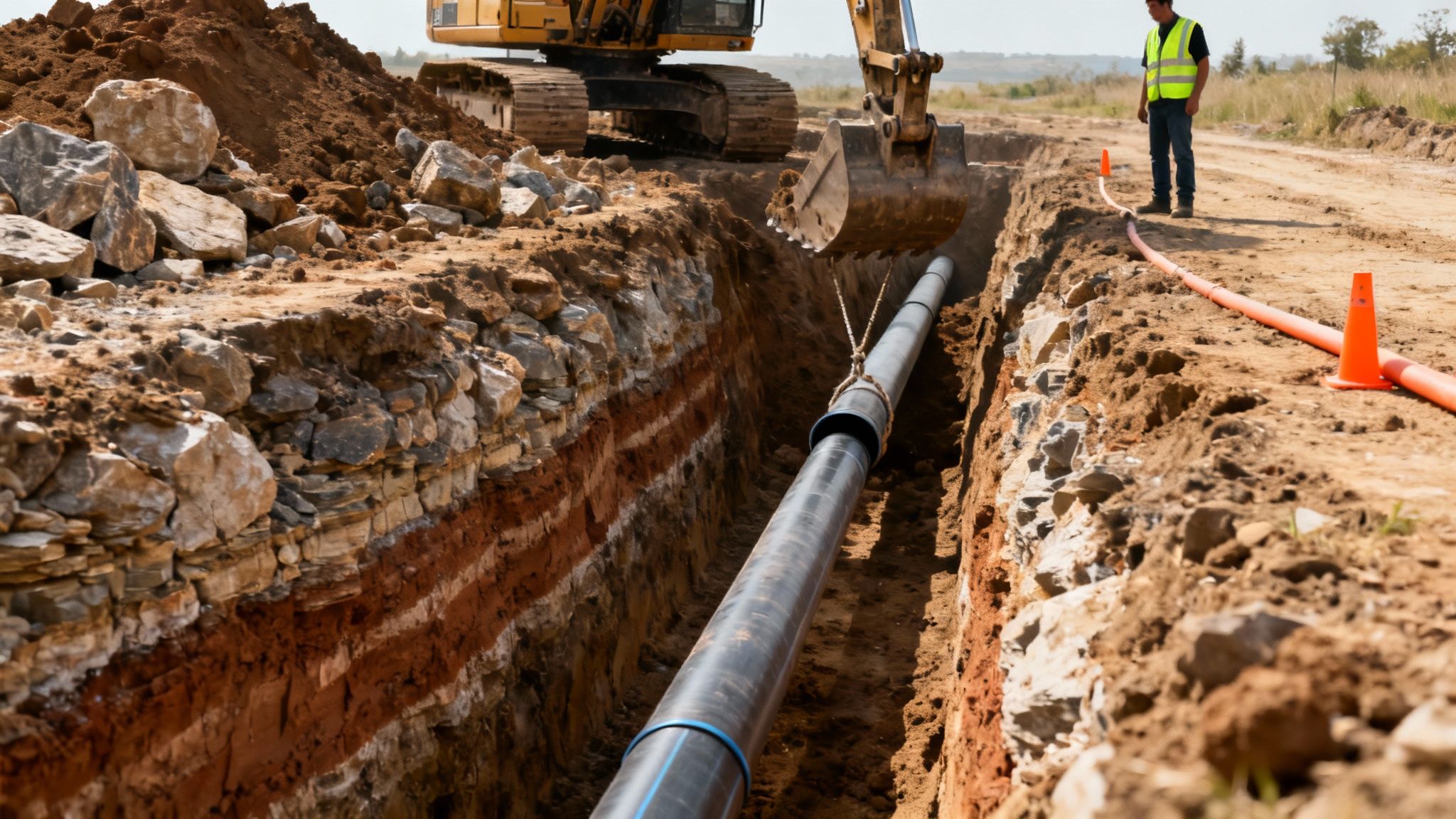
The real cost drivers are lurking underground. A common misstep is assuming that underground line replacement is just about digging a hole and dropping in a pipe. This leads to unfair comparisons between licensed general contractors who follow every rule and unpermitted handyman-style services that cut corners.
Beyond just the pipe and the labor, professionals have to account for serious workplace safety risks in utilities (electric, gas, water). These are the hidden factors that can quickly inflate a seemingly simple project.
Unseen Site Conditions
The specific conditions on your property are, without a doubt, the biggest wildcard in any quote. A job that looks straightforward can turn into a major headache once the digging starts. These are the kinds of problems no one can see coming.
Here are a few common site conditions that can add thousands to your bill:
- Tough Ground Conditions: You might think soft, sandy soil would be easy, but it’s a nightmare for trench stability. It collapses easily, meaning crews have to install expensive trench shoring to keep everyone safe. On the flip side, hitting a layer of dense clay or, worse, solid rock, can bring the job to a grinding halt. That requires bringing in heavy-duty equipment like hydraulic breakers, which aren't cheap.
- Required Pipe Depth: Local codes set the rules here, and they often require water mains to be buried pretty deep—sometimes four or five feet down. A deeper trench means more digging, more extensive safety systems, more dirt to haul away, and more backfill to bring in. All of that adds up.
- Tight Site Access: Can a full-sized excavator even get to the work area? Things like narrow side yards, fences, mature trees, or retaining walls can block access for heavy machinery. When that happens, the crew is forced to use smaller, less efficient equipment or—in a worst-case scenario—dig by hand. That's slow, back-breaking work, and it costs a lot more in labor.
Key Takeaway: The final price tag for a water main is dictated by what's underground. Rock formations, soil stability, and tricky access are invisible from the surface but can have a massive impact on the budget.
Navigating a Maze of Buried Utilities
The ground beneath your feet is probably more crowded than you think. It's crisscrossed with a network of other essential services, and your new water main has to be carefully threaded through all of them without causing a catastrophe.
A professional crew has to work around existing gas lines, sewer laterals, storm drains, and conduits for power and communications. The first, most critical step is figuring out exactly where everything is. We cover this in detail in our guide on how to locate underground utilities.
Every single utility that crosses the path of the new water line is a conflict point. Each one has to be carefully exposed by hand-digging to avoid a dangerous—and incredibly expensive—accident.
Navigating Central Coast Installation Challenges
If you own property in Santa Cruz, Monterey, or San Benito Counties, you know our local landscape is anything but standard. A quote for a new water main that seems high compared to national averages often makes perfect sense once you factor in the unique challenges we face here on the Central Coast. This is exactly where a seasoned local contractor proves their worth over a company that treats every job the same.
Working here means wrestling with a huge range of soil types, from loose coastal sand to the hard, dense clay you find further inland. Each one demands a different strategy for excavation and shoring to prevent dangerous trench collapses and ensure the new line has a stable, lasting foundation.
Meeting Strict Local and State Codes
On top of the tricky soil, our entire region is governed by some of the strictest seismic safety and environmental codes in the country. These aren't just suggestions; they’re rules that dictate the exact materials we can use, how deep the trench must be, and the specific techniques required to secure the pipeline against ground movement. Getting this right is the difference between a project that’s on time and on budget, and one that spirals out of control.
A common misstep is assuming that underground line replacement is just about digging a hole and dropping in a pipe. This leads to unfair comparisons between licensed general contractors and unpermitted handyman-style services.
The numbers from our area back this up. For example, public works data shows that 82% of water projects in Monterey ended up costing over $22,000 when you include all the necessary prep work and paving. It's a similar story in Santa Cruz County, where 62% of bids topped $20,000 thanks to urban markups, mandatory erosion control, and extra costs for things like backflow certification. These figures help normalize what a complete, compliant, and long-lasting job actually costs around here.
Why Local Expertise Matters
A contractor who has spent years working on the Central Coast has an instinct for these things. We know the permitting maze in Monterey is a different beast than in San Benito County. We anticipate the need for specialized erosion control when working near sensitive coastal zones. This kind of deep local knowledge is what prevents expensive surprises and frustrating delays.
Our experience preparing for local weather is also critical. You can read more about how we handle storm drain and utility upgrades for heavy rain.
We’ve worked with homeowners, commercial developers, and municipalities across Santa Cruz, Monterey, and San Benito Counties to safely install water mains that last for decades—without hidden fees or vague scopes.
The High Cost of Cutting Corners
When a quote for a new water main comes in over $20,000, it’s natural to feel a bit of sticker shock. The temptation to find a cheaper alternative is strong. But here lies the single most expensive mistake you can make: assuming the job is just about digging a trench and laying some pipe.
This mindset pits a qualified, licensed general engineering contractor against a low-cost handyman service, and that’s a dangerous and unfair comparison.
At first glance, it seems logical. It’s just a pipe, right? How hard can it be? The problem is that a rock-bottom price almost always means crucial, non-negotiable steps are being ignored. We're not talking about small details—we're talking about legally required permits, safety protocols, and inspections that protect you, your property, and the public.
A cheap bid is cheap for a reason. It cuts corners you can't see, but the risks are very real and can be financially catastrophic.
The Aftermath of a Botched Job
Opting for an unlicensed or unpermitted contractor to save a few thousand dollars often backfires in spectacular fashion. Instead of a professional installation, you can inherit a project riddled with problems that end up costing far more to fix than you ever "saved."
Here’s what you’re really risking with a lowball offer:
- Serious Safety Hazards: An unsecured trench is a death trap waiting to collapse. Even worse, an uninformed digger could strike an unmarked gas or electrical line with deadly consequences.
- City Fines and Stop-Work Orders: The moment a city inspector spots unpermitted work, they will shut your project down on the spot. You'll be left with a giant hole in the ground and some hefty fines to pay.
- Failed Inspections and Complete Redos: A job that doesn't follow code won't just fail an inspection—it will have to be completely redone. That means paying a second contractor to dig up the brand-new pipe and install it correctly.
- Long-Term Liability: If that improperly installed main fails and causes a sinkhole or floods your neighbor's property, guess who's on the hook? You could be held financially responsible for all the damages.
The Real Value Behind a Professional Quote
In sharp contrast, a professional quote that exceeds $20,000 isn't just a high price tag; it reflects the true value of getting the job done right the first time. It's built on a detailed scope of work that guarantees safety, quality, and compliance from start to finish. This includes everything from engineered plans and trench shoring to pressure testing and complete surface restoration.
When you hire a licensed contractor, you're not just paying for a pipe in the ground. You are investing in peace of mind. You're buying the confidence that the work is safe, legal, and built to last for decades without failing.
At Coastal Pipeline, our estimates break down every single component, from labor and materials to permits and restoration. While unexpected issues can arise on any complex underground project, our professional approach to construction change order management ensures any adjustments are handled clearly and fairly.
We've partnered with homeowners, businesses, and municipalities across Santa Cruz, Monterey, and San Benito Counties to deliver safe, durable water infrastructure. We don’t do hidden fees or vague promises—just professional work you can count on.
How to Get a Fair and Transparent Quote
When a quote for over $20,000 lands in your inbox, it's easy to feel a little winded. That initial sticker shock is completely normal, but your next move is crucial: you need to understand exactly what you’re paying for. Any professional contractor worth their salt will do more than just give you a single number—they'll provide a clear, detailed breakdown of the entire job.
The key is to understand what goes into the price. You should always ask for a detailed scope of work—not just a lump sum. This lets you see the breakdown of engineered layouts, utility tie-ins, permit fees, trenching safety protocols, pressure testing, and full restoration.

What to Look for in an Estimate
The best way to protect yourself and make sure you’re getting a fair price is to insist on a detailed scope of work. A transparent quote should itemize every major cost component, so you can see precisely where every dollar is going.
Your estimate should have clear line items for things like:
- Engineered Layouts and Utility Tie-ins: The specific plan for connecting your new line to the municipal system.
- Permit and Inspection Fees: The actual costs required by your city or county to do the job legally.
- Trenching and Safety Protocols: Details on the excavation work and any legally required safety measures, like trench shoring.
- Pressure Testing and Disinfection: The final steps that prove the line is safe, clean, and leak-free before it's put into service.
- Full Surface Restoration: A clear plan for putting everything back the way it was, from asphalt and concrete to landscaping.
A lump-sum bid without these details is a huge red flag. A true professional is proud to show you the work involved; someone cutting corners will try to hide it behind a single number.
At Coastal Pipeline, we provide transparent estimates that break down labor, material, permitting, and surface restoration. We also help clients understand financing options and prevent cost surprises by planning ahead. We’ve worked with countless homeowners, developers, and municipalities across Santa Cruz, Monterey, and San Benito Counties to install water mains that are built to last for decades—without any hidden fees. Our comprehensive approach to underground utility services gives you a clear plan and total peace of mind.
Common Questions About Water Main Costs
When a quote for over $20,000 lands in your inbox, it’s bound to raise a few questions. Let's tackle some of the most common ones head-on so you can understand what's behind the numbers.
"Can't I Just Dig the Trench Myself?"
It's a tempting thought, especially when trying to save money. How hard can it be to dig a hole and lay some pipe? In reality, replacing a water main is a whole lot more complex—and for good reason.
This isn't a simple DIY project. For starters, all water main work legally has to be handled by a licensed and insured contractor. You're tying into a public utility system, which requires specialized knowledge, specific safety equipment like trench shoring, and the ability to pass rigorous municipal inspections. It's a job that untrained individuals simply can't do safely or legally.
The sticker shock is real, we get it. But that professional quote reflects the full, true cost of doing the job right. It covers everything from permits and traffic control to trench safety and complete site restoration—all the critical pieces a handyman or DIY approach would miss.
"What Am I Actually Paying For?"
To really understand the cost, you have to look past the pipe itself. A lump-sum estimate doesn't tell you the whole story, which is why you should always insist on a detailed scope of work.
A professional, transparent estimate from a company like Coastal Pipeline will always break down the costs. You should see specific line items for things like:
- Engineered plans and coordinating the utility tie-ins
- All the fees for permits and the time spent managing inspections
- Trenching safety systems, such as shoring to prevent collapse
- Proper pressure testing and disinfection of the new line
- Full restoration of the surface, whether it's paving, concrete, or landscaping
This level of detail isn't just about showing you where the money goes; it's about making sure there are no surprises down the road. We’ve worked with homeowners, developers, and entire cities across Santa Cruz, Monterey, and San Benito Counties to install water mains built to last for decades—all without unexpected fees or corner-cutting.
Ready for a transparent and professional estimate for your project? Contact Coastal Pipeline Inc. today to get a detailed quote that explains every cost, ensuring your project is done right from the start. Learn more at https://coastalpipelineinc.com.