When you pay for a new commercial parking lot, you expect a smooth, strong surface that will last. Most paving contractors offer a simple, one-size-fits-all service: they grade the ground, lay down asphalt, and paint lines. It sounds simple, but this basic approach is exactly what most paving contractors get wrong about commercial parking lots. They treat it like a topcoat, not like an important piece of your property's infrastructure.
A modern parking lot has to do more than just hold cars. It needs to handle rainwater properly, meet strict ADA rules for slopes, and be ready for future needs like electric vehicle (EV) charging stations. The standard "grade, pave, stripe" method often misses these key details. Contractors often don't plan for future conduit runs for EV chargers and lighting. They also don't always offer phased work to keep a business open. This leads to expensive and messy tear-outs later on. With EV charging demand rising fast—over 1.2 million public ports are expected by 2030—and ADA rules getting stricter, this lack of planning is a big problem.
This guide explains the most common and costly mistakes contractors make. We'll show you how planning your parking lot like a piece of infrastructure from the start protects your money, ensures you follow the law, and prepares your property for the future. For business owners planning projects in Santa Cruz, Monterey, or San Benito County, understanding these points is the first step to a smarter, more durable parking lot.
1. Inadequate Drainage Design and Subsurface Preparation
One of the biggest mistakes paving contractors make is not focusing on drainage and the ground underneath the asphalt. Many just care about the blacktop you can see, following a simple "grade, pave, stripe" plan. This ignores the most important part of a parking lot's life: what’s under the surface.
When water can't drain away, it becomes the pavement's worst enemy. Without a good drainage system and a solid base, water sits on the surface and soaks into the ground below. This weakens the foundation, causing cracks, potholes, and "alligator" cracking. The result is often a full, expensive replacement years before it should be needed.
Why Proper Preparation is Non-Negotiable
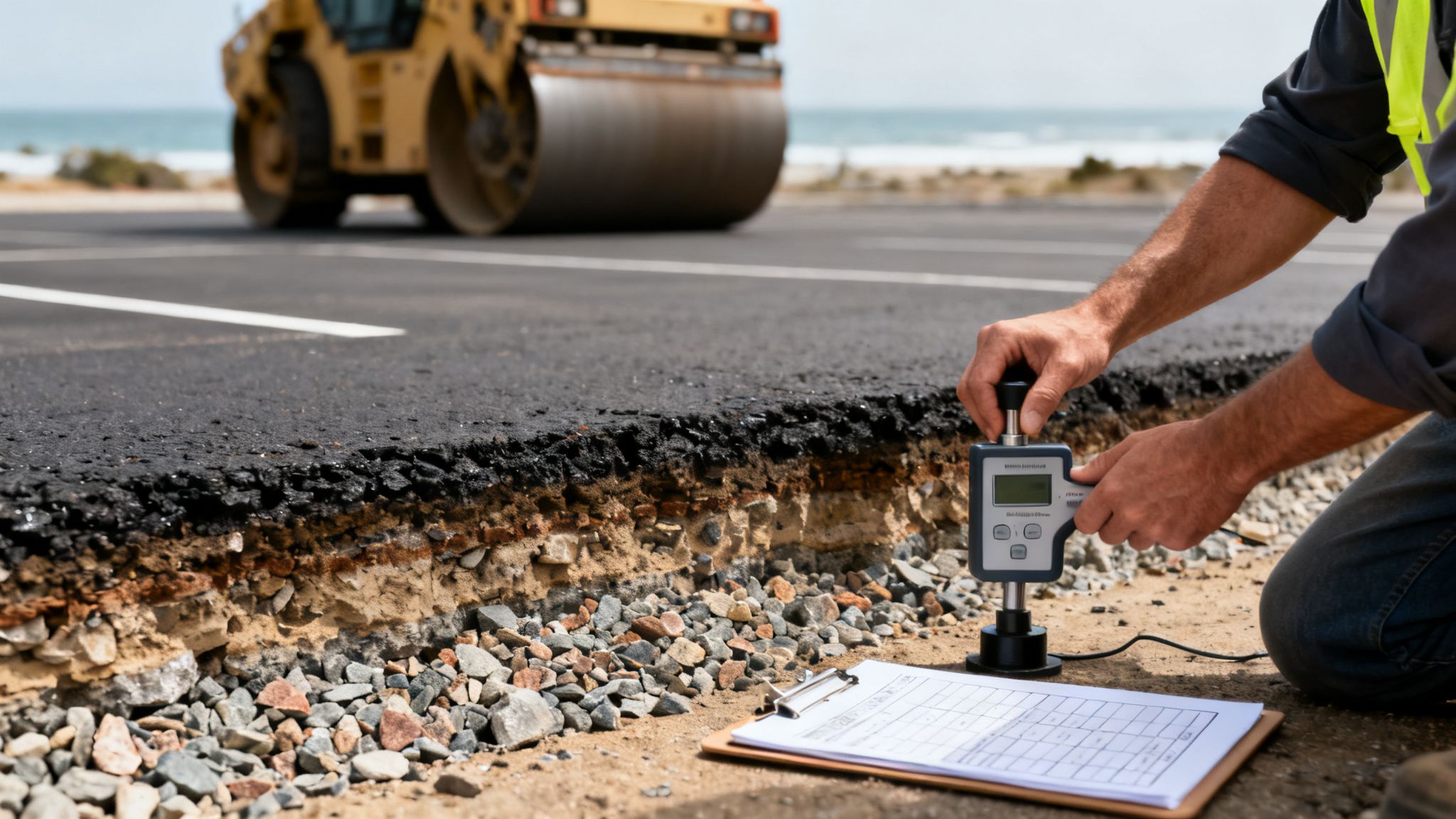
A commercial parking lot is a key part of your property’s infrastructure, not just a surface. Its strength depends on a well-packed base of gravel and a smart drainage plan. This is especially true in coastal California, where rain and different soil types can quickly ruin a poorly built lot.
An expert contractor, like Coastal Pipeline, makes sure that important underground work like storm drains and utility conduits are installed before any asphalt is laid. This smart sequencing prevents future problems and protects the property owner’s investment. Planning paving like infrastructure, not just a surface, avoids costly tear-outs later and ensures compliance from day one. To learn more about how these systems are designed, you can find helpful details in this guide to mastering storm water drainage system design.
Actionable Best Practices for Subsurface Success
To avoid this common problem, property owners should hire a contractor who focuses on the foundation. Here are key steps to get a long-lasting parking lot:
- Conduct Geotechnical Testing: Start with soil tests to understand the ground conditions. This helps design the right base.
- Specify a Robust Base: Require a gravel base layer that is at least 4 to 6 inches thick. Make sure it is packed down to at least 95% of its maximum density.
- Plan Drainage Intelligently: Include catch basins, sloped areas, and proper slopes (usually 1-2%) in the first grading plan, not as an afterthought.
- Verify Before Paving: Use survey tools to check that slopes are correct before the asphalt is put down.
- Keep Meticulous Records: Keep all reports from the compaction tests. This information is important for any future warranty claims.
2. Inadequate Base Layer Preparation and Compaction Verification
Another big area where many paving contractors fail is in preparing and checking the gravel base layer. Rushing this step or not meeting proper compaction standards is a shortcut that leads to early failure. A commercial parking lot isn't just a layer of asphalt; it's a system designed to spread out the weight of heavy vehicles. Its strength comes from a well-packed gravel base.
This foundation, usually 4 to 8 inches thick, is what stops the asphalt from sinking, rutting, and cracking after just a few years. Contractors who skip or do a poor job on compaction testing are often trying to save time and money, but the property owner pays the price later. The lot might look good at first but will start to fail long before it should.

Why Proper Preparation is Non-Negotiable
A strong base is the backbone of a lasting parking lot. It provides the support needed to handle daily traffic, heavy trucks, and the weather. Proper compaction locks the gravel particles together, creating a dense, stable platform that resists damage and keeps water out. Skipping this step is one of the main reasons commercial parking lots fail too soon.
For example, many lots fail within 5 to 7 years because their base was only packed to 85-90% of its maximum density instead of the needed 95% or more. In contrast, lots where compaction was carefully tested can easily last 15 to 20 years with normal maintenance. Treating the base like a simple layer of rock instead of an engineered foundation is a mistake that guarantees expensive repairs in the future.
Actionable Best Practices for Subsurface Success
Property owners must hire a contractor who not only builds a proper base but also proves its strength through testing. Here are the key steps to ensure a strong and lasting foundation:
- Specify Standards in the Contract: State in the contract that all gravel base layers must be compacted to a minimum of 95% relative compaction before any work starts.
- Hire Independent Testing: Hire a separate engineering firm to perform compaction tests. This ensures the results are fair and not influenced by the paving contractor.
- Document Everything: Require detailed reports for every test. These reports should show the test location, moisture level, density, and a clear pass or fail result.
- Test at Regular Intervals: Conduct density tests often, about one test for every 500 to 1,000 square feet, to ensure quality across the whole parking lot.
- Enforce a Redo Clause: The contract should clearly state that the contractor must fix any areas that fail compaction tests at no extra cost to the owner.
3. Ignoring Existing Utility Conflicts and Underground Infrastructure
One of the most dangerous and expensive mistakes paving contractors make is digging without knowing what's underground. Many contractors focus only on the paving and forget to check for underground utilities like sewer, water, electrical, and gas lines. This creates huge risks, turning a simple paving job into an emergency with costly repairs and serious safety dangers.
Commercial parking lots are often built over complex networks of pipes and wires. A contractor who skips the step of locating utilities is gambling with the owner's money and schedule. Hitting just one sewer line can stop a project for weeks and add thousands of dollars in unplanned repair costs.
Why Proactive Utility Coordination is Essential
A parking lot is more than just asphalt; it’s the final layer over a site’s entire infrastructure. An expert contractor understands this and makes finding and working around utilities a top priority from the start. This proactive approach prevents accidents and also allows for planning for the future. For example, by laying empty pipes (conduits) for future EV chargers before paving, you avoid having to cut into the new asphalt later.
Expert contractors like Coastal Pipeline coordinate all this pre-work before paving starts. This smart thinking not only avoids disaster but also makes the project run smoothly. To better understand how these hidden systems affect your lot, you can explore insights on how subsurface utility conditions impact pavement performance.
Actionable Best practices for Utility Conflict Avoidance
Property owners can avoid this common mistake by hiring contractors who prove they are serious about checking what’s underground. Insist on the following steps to protect your property:
- Initiate Early Locating: The contractor must contact 811 (call-before-you-dig) at least 2-3 weeks before any digging is planned.
- Secure Utility Maps: Get maps and drawings from all relevant city, county, and private utility companies.
- Utilize Advanced Technology: For complex sites, hire a specialist to perform a ground-penetrating radar (GPR) survey to find unmarked utilities.
- Conduct a Pre-Construction Meeting: Hold a meeting on-site with everyone involved, including utility company staff, to review the marked locations.
- Maintain Clear Markings: Make sure all utilities are clearly marked with paint and flags, and record their locations.
- Document Everything: Keep all utility locating tickets, reports, and permits on-site during the project.
4. Overlooking ADA Compliance and Accessibility Requirements
A major failure for many paving contractors is treating Americans with Disabilities Act (ADA) compliance as a last-minute task. They often focus on laying smooth asphalt but don't engineer the exact slopes and dimensions required by law. This mistake turns a new parking lot into a legal and financial problem for the property owner.
Being non-compliant isn't just about paint. It’s about the physical construction of the lot. If accessible parking spots, access aisles, and connecting paths have the wrong slopes, the whole area may be considered unusable for people with disabilities. This often leads to failed inspections, fines, and the need for expensive repairs.
Why Meticulous ADA Planning is Mandatory
ADA compliance is a strict federal rule that cannot be ignored. A contractor who gets this wrong puts the property owner at risk for lawsuits and forces them to pay for the same work twice. For example, fixing a non-compliant accessible spot isn't just repainting lines. It often means grinding down or repaving entire sections to fix slopes, which can cost thousands of dollars.
Expert contractors address ADA slope requirements from the very beginning. By making sure every slope and dimension is planned before paving starts, they remove the risk of future problems. This protects the owner’s investment and ensures the property is safe and accessible for everyone from day one. To understand the details, you can read this guide on creating an ADA-compliant parking lot.
Actionable Best Practices for Guaranteed Compliance
To avoid the common mistakes of ADA non-compliance, property owners must work with a contractor who is an expert in accessible design. Here are the key steps to make sure your parking lot meets all legal rules:
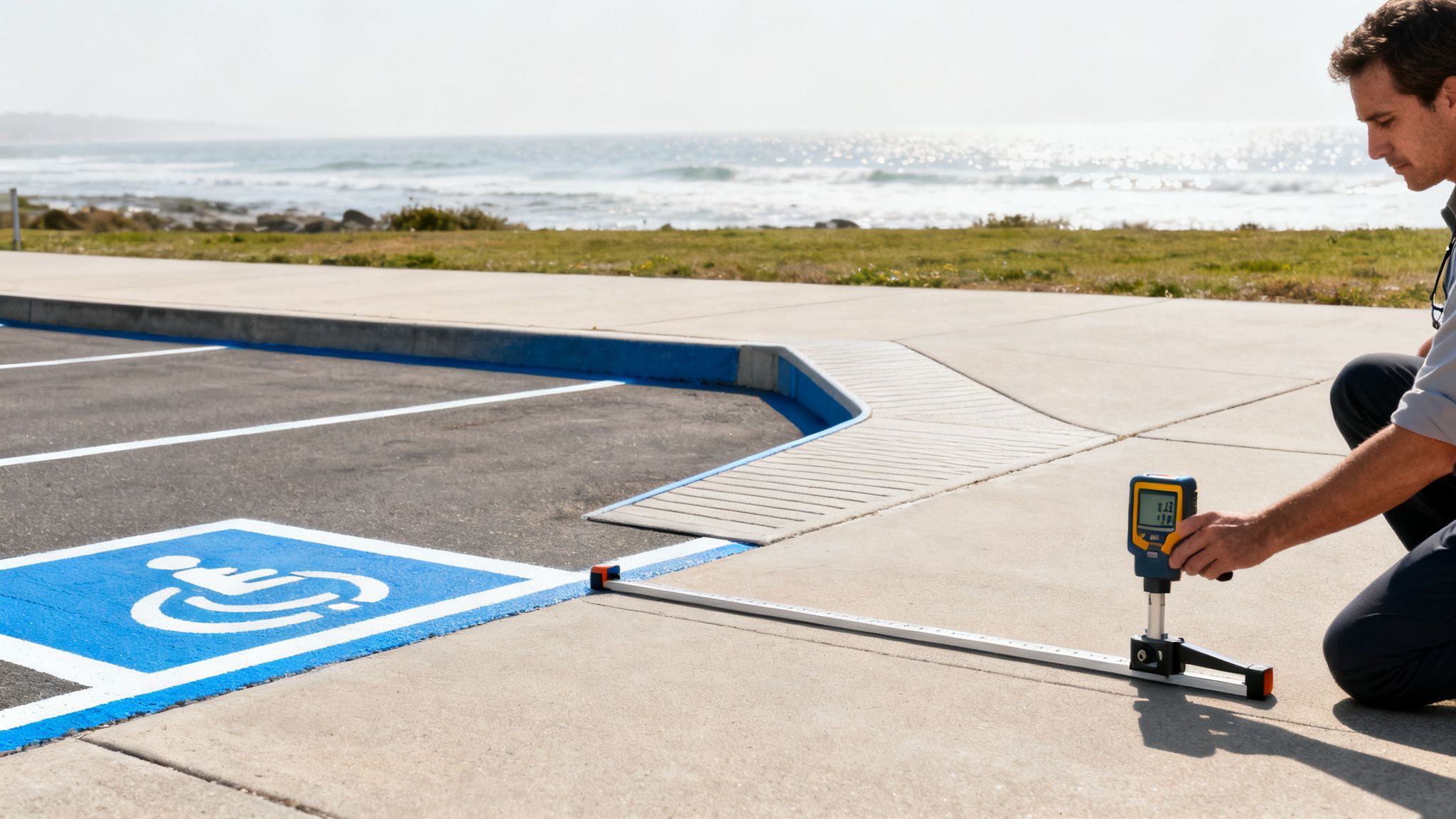
- Reference the 2010 ADA Standards: Make sure the contractor’s plan uses the current ADA Standards for Accessible Design, which set exact rules for slopes (a maximum of 2.083% in any direction for accessible spaces).
- Verify Layout Pre-Paving: Before paving, walk the site to confirm the marked-out dimensions for accessible spaces and access aisles are correct.
- Use Precision Grading Tools: The contractor must use laser levels and digital slope gauges during grading and paving to constantly check that all surfaces meet the rules.
- Document Everything: Ask for photos and survey data that confirm all critical slope and dimension measurements.
- Ensure Proper Connectivity: Check that there is a clear, accessible path connecting the parking spaces to the main building entrance.
5. Insufficient Pavement Quality Specifications and Material Control
A common shortcut that leads to early failure is using a generic, one-size-fits-all asphalt mix. Many contractors treat asphalt like a simple product, ignoring the science that determines how well it performs. They don't choose the right materials for the job, leading to a surface that can't handle the local weather and traffic.
This mistake is one of the most damaging things paving contractors get wrong about commercial parking lots. When a contractor uses a low-quality mix without proper checks, they are basically building a parking lot that is designed to fail. The result is a lot that starts to show problems like cracking and crumbling within just 5 to 7 years, less than half its potential life.
Why Material Science Matters for Pavement Longevity
Not all asphalt is the same. The "recipe," or mix design, must be created for its specific use. This includes the quality of the gravel and sand, and most importantly, the type of liquid asphalt binder that holds it all together. For coastal California, with its moisture, changing temperatures, and strong sun, using the right binder is essential.
For example, many contractors use a generic binder that is not suited for the coastal climate and often fails within 7-10 years. A well-planned project would require a better binder, like a PG 64-10, which is made to resist sun and water damage, providing a reliable surface for 15 years or more. Skipping this important detail is a sure way to waste your investment.
Actionable Best Practices for Material Quality Assurance
To make sure your pavement investment is protected, property owners must demand strict material rules and checks. Insist that your contractor follows a quality control plan.
- Specify the Right Binder: For coastal California projects, require a PG 64-10 or higher-grade binder and ask for special additives to improve water resistance.
- Request the Mix Design: Ask for the official mix design report from the asphalt supplier to check its contents.
- Conduct Plant and Field Testing: Require quality control testing at the plant and on the job site to check for proper density.
- Monitor Placement Temperatures: The temperature of the asphalt when it's being laid is critical. You can learn more about this in these asphalt paving temperature requirements.
- Document Everything: Keep a complete file of all material reports, test results, and quality control logs for future use.
6. Failure to Coordinate with Municipal Inspections and Permitting
A common and disruptive mistake is when paving contractors ignore the important role of working with the city or county. They may see permits and inspections as simple paperwork rather than key parts of the project. This shortsighted view often leads to stop-work orders, expensive rework, and long delays.
The truth is that commercial parking lots are regulated projects. They need a series of approvals from officials at different stages, from grading to the final surface. When a contractor fails to schedule these inspections or get the right permits, they put the entire project at risk. This is a clear sign of what most paving contractors get wrong about commercial parking lots; they fail to manage the project’s paperwork and rules.
Why Proactive Coordination is Non-Negotiable
A commercial parking lot must meet specific local codes for grading, drainage, and accessibility. City inspectors are responsible for checking this. For instance, a project that started without the right grading permits faced a three-week stop-work order and had to pay for expensive rework to meet city rules. These problems can be completely avoided with good planning.
Contractors like Coastal Pipeline know that working smoothly with local governments in counties like Monterey, Santa Cruz, and San Benito is key. By scheduling inspections ahead of time and making sure all plans are approved, they prevent delays and ensure the final product is fully compliant. This turns the relationship with inspectors into a partnership, ensuring a smooth process from start to finish.
Actionable Best Practices for Municipal Compliance
To avoid the costly trap of non-compliance, property owners must demand a contractor who has a proven process for handling city requirements. Here are the key steps for a smoothly run and fully approved project:
- Secure All Permits First: Get all necessary permits (grading, building, etc.) before any equipment shows up on-site.
- Schedule Inspections in Advance: Request inspections with the city at least one week ahead of time for key milestones.
- Maintain On-Site Documentation: Keep copies of all permits, approved plans, and inspection records on the job site at all times.
- Address Inspector Feedback Immediately: If an inspector finds a problem, all work should stop until it is fixed and re-inspected.
- Obtain Final Certification: Make sure the contractor gets a final sign-off and provides paperwork showing the project is complete. This is needed to close out permits and avoid future problems.
7. Poor Sealing, Maintenance Planning, and Lifecycle Cost Management
One of the biggest signs that separates a simple paving contractor from a long-term partner is the failure to plan for the parking lot's future. Many contractors see the final stripe as the end of the job. They get paid and leave property owners without a plan to protect their new investment. This "pave and abandon" approach ignores the fact that asphalt needs regular care to last its full life.
Without a maintenance plan, a new parking lot is left open to its main enemies: sun, water, and air. These things break down the asphalt binder, making the surface brittle and likely to crack. What starts as a small problem can quickly turn into major damage, turning a simple maintenance task into an expensive repair job.
Why Proactive Maintenance is Non-Negotiable
A commercial parking lot is a big investment, and how long it lasts is directly connected to a regular maintenance plan. Just like a car, it needs regular service. The most important service is the first seal coat, which should be applied 6 to 12 months after paving. This first seal coat replaces important oils and creates a protective barrier.
When this key first step is missed, the pavement's lifespan can be cut in half. Commercial lots that get regular seal coating and crack sealing often last more than 15 to 20 years. In contrast, ignored lots often need a complete repaving in as little as 7 to 10 years, at three to five times the cost of the maintenance that was skipped. For more on extending pavement life, explore our guide on commercial parking lot maintenance.
Actionable Best Practices for Lifecycle Success
To avoid early failure and get the most from your paving investment, property owners must insist on a contractor who provides a clear maintenance plan. Here are key steps to ensure a long-lasting parking lot:
- Demand a Written Maintenance Plan: When the project is done, your contractor should give you a written schedule for seal coating, crack filling, and inspections.
- Prioritize the First Seal Coat: Schedule the first seal coat for 6 to 12 months after paving to lock in the pavement's strength.
- Establish a Regular Cadence: Plan to seal coat every 2 to 3 years and fix any cracks or potholes within a month.
- Document Everything: Keep a detailed log of all maintenance, including dates, materials used, and photos.
- Conduct Annual Assessments: Do a yearly walk-through to find and fix any new problems before they get bigger.
- Request a Lifecycle Cost Analysis: A good contractor can show you a 15- to 20-year cost plan, proving how regular maintenance saves a lot of money over time.
8. Inadequate Weather and Seasonal Condition Management
A common but serious mistake among paving contractors is not managing weather conditions properly. Many push to finish a job on time, ignoring how temperature and moisture affect asphalt quality. Paving in wet, very hot, or cold conditions damages the material, leading to poor compaction and early failure.
This is one of the key things paving contractors get wrong about commercial parking lots, especially in places with changing weather. When asphalt is laid outside its best temperature range (usually 70°F to 90°F), it doesn't pack down correctly. Laying it on a wet base traps water underneath, which weakens the foundation and leads to quick damage like cracking and potholes.
Why Weather Isn't Just a Scheduling Nuisance
Ignoring Mother Nature is a recipe for a failed project. In coastal California, the difference between a parking lot that lasts 20 years and one that fails in five often comes down to timing. The winter months from December to February bring rain and cool weather that are bad for paving. On the other hand, projects scheduled from late May through September benefit from the ideal dry and warm weather needed for the best results.
A contractor who paves in poor conditions is not saving the client time or money; they are delivering a weak product. True professionals know that a weather delay is always better than a pavement failure and will plan for extra days in their schedules.
Actionable Best Practices for Weather-Ready Paving
Property owners must insist that their contractor respects weather rules. A well-planned project is a strong one. Here are the key steps:
- Schedule for Success: Plan major paving work during the region's best weather window (May-September in coastal California).
- Monitor Forecasts Diligently: Watch 10 to 14-day forecasts. Postpone paving if temperatures are expected to drop below 50°F or if rain is predicted within 48 hours.
- Protect the Foundation: If rain is coming during the prep phase, use tarps to keep the gravel base dry.
- Ensure Proper Cure Time: After paving, let the asphalt cure for at least 7 days before opening it to traffic so it has time to harden.
- Prioritize Quality Over Speed: A good contractor will delay work when conditions are not right. Waiting a little longer is better than having to repave the entire lot.
8-Point Comparison: Paving Contractor Mistakes
| Issue / Title | 🔄 Implementation Complexity | ⚡ Resource Requirements | ⭐ Expected Outcomes | 📊 Ideal Use Cases | 💡 Key Advantages & Tips |
|---|---|---|---|---|---|
| Inadequate Drainage Design and Subsurface Preparation | High — requires engineered grading, geotech and utility coordination | Grading analysis, catch basins, swales, compaction testing, coordination with utilities | Prevents pooling and base failure; +10–15+ years lifespan when done | New commercial lots in coastal/rain-prone areas or sites with poor soils | Conduct soil borings, specify 4–6"+ aggregate base, integrate catch basins into grading plan, document compaction |
| Inadequate Base Layer Preparation and Compaction Verification | Moderate–High — methodical testing and rework if failing | Nuclear density gauges, calibrated rollers, trained operators, testing lab | Reduces rutting/settlement; measurable quality records; longer service life | High-traffic lots, heavy-load areas, projects requiring warranty defense | Specify 95–98% Proctor, independent testing (1 per 500–1000 sq ft), require retest/redo on failures |
| Ignoring Existing Utility Conflicts and Underground Infrastructure | Moderate — requires pre-construction surveys and stakeholder meetings | Call-before-you-dig (811), GPR surveys, utility maps, coordination time | Avoids utility strikes, delays and costly emergency repairs | Urban/infill sites or properties with complex underground networks | Initiate 811 2–3 weeks out, obtain utility maps, mark utilities, hold precon utility meeting and keep records |
| Overlooking ADA Compliance and Accessibility Requirements | Moderate — precision design and verification required | ADA-certified designer, laser/slope gauges, detailed layout and signage | Ensures legal compliance, reduces liability and remediation costs | Public-facing commercial lots, retail, medical facilities | Reference 2010 ADA Standards, verify slopes/dimensions before paving, document measurements and inspections |
| Insufficient Pavement Quality Specifications and Material Control | Moderate — requires supplier coordination and QA testing | PG binder selection (PG64-10 for coastal CA), lab mix design, plant sampling, additives | Significantly extended durability (15–20+ years) and moisture/UV resistance | Coastal climates, high UV/moisture exposure, long-life pavement projects | Specify PG 64-10, require Marshall/Superpave mix, plant QC sampling, use anti-strip agents and monitor temps |
| Failure to Coordinate with Municipal Inspections and Permitting | Moderate — administrative lead times and staged inspections | Permit applications, SWPPP, inspection scheduling, as-built documentation | Ensures code compliance and timely final sign-off; prevents rework | Any permitted project; counties with strict permitting (Monterey, Santa Cruz, San Benito) | Obtain permits before mobilization, schedule inspections early, maintain permit and inspection records on site |
| Poor Sealing, Maintenance Planning, and Lifecycle Cost Management | Low–Moderate — ongoing program and owner engagement | Seal coat materials, crack seal supplies, maintenance scheduling tools | Extends life to 15–20+ years; reduces lifecycle cost 30–50% with regular maintenance | Owner-managed properties, long-term asset portfolios, multi-tenant sites | Provide written maintenance plan, first seal 6–12 months post-pave, seal every 2–3 years, document activities |
| Inadequate Weather and Seasonal Condition Management | Moderate — requires flexible scheduling and protections | Weather forecasting, tarps/protection, contingency days, flexible crews | Better compaction/bonding; fewer moisture-related failures; improved longevity | Coastal CA projects with variable seasons; winter-rain windows | Monitor 10–14 day forecasts, avoid paving <50°F or with rain <48 hrs, schedule May–Sep, allow 7-day cure before traffic |
Pave Smarter: The Future of Your Parking Lot Is Built from the Ground Up
The lesson from learning what most paving contractors get wrong is clear: a successful project is decided long before the first paving machine arrives. The difference between a parking lot that cracks in a few years and one that lasts for decades isn't just the asphalt. It's about planning ahead and treating the parking lot as a vital part of your property’s infrastructure, not just a topcoat.
We’ve seen how small mistakes can lead to big failures. From poor drainage that ruins the foundation to weak compaction that guarantees early cracks, the base is everything. Ignoring underground pipes creates expensive problems, while overlooking exact ADA slope rules creates legal risks. The common "grade, pave, stripe" method is too simple for today's needs.
From Surface-Level Thinking to Integrated Infrastructure
The biggest takeaway is to shift from a surface-level mindset to an integrated one. A parking lot is a system. It handles water, supports traffic, provides safe access, and now, it even powers our cars. This is where many contractors fail. They see only asphalt, while an expert partner sees a connected system of drains, utilities, accessibility, and future-readiness.
This expert approach delivers real benefits:
- Future-Proofing for Technology: Demand for electric vehicle (EV) charging is growing fast. A contractor who doesn't plan for underground conduits before paving is setting you up for an expensive tear-out of your new lot later.
- Compliance and Safety: ADA rules for businesses are getting stricter. A contractor who treats accessible routes and slopes as an afterthought is exposing your business to lawsuits. True compliance is built from the ground up, not just painted on.
- Operational Continuity: Standard paving can shut down a business. An expert partner understands the need for phased work, including nights and weekends, to cause minimal disruption and keep your business running.
Your Parking Lot as a Long-Term Asset
Ultimately, the main reason most paving contractors get it wrong is their failure to see the big picture. They offer a short-term fix that creates long-term problems. The right approach turns your parking lot from a constant headache into a durable, compliant, and valuable asset. It's about investing in the foundation, from subsurface prep to utility coordination, to ensure a long life and prevent costly repairs. For insights into comprehensive approaches to infrastructure development that avoid common mistakes, consider the expertise discussed by the Energy Specialists company (LSE Vinci Constructions), involved in industrial and tertiary works. This mindset of integrated, intelligent planning is the key to building infrastructure that lasts. Choosing a contractor isn't just about the lowest price; it's about picking a partner who will protect your investment for years to come.
Don't let your next project fall victim to common paving mistakes. Coastal Pipeline Inc. specializes in the integrated approach, expertly managing underground utilities, drainage, and ADA compliance before paving begins to build parking lots that are assets, not liabilities. If you are planning a project in Santa Cruz, Monterey, or San Benito County, visit Coastal Pipeline Inc. to partner with a team that builds it right from the ground up.