
The number of handicap parking spaces you need isn’t a single number. It depends on how many total spots your parking lot has. A good rule of thumb is to have at least one accessible space for every 25 total spots, and the number goes up from there.
Why Accessible Parking Is More Than Just a Sign
Have you ever wondered why some parking spots are reserved? It's not just to be nice. It's about giving everyone fair access and freedom. These spaces are required by law under the Americans with Disabilities Act (ADA). This law makes sure people with disabilities can be a full part of public life.
Think of an accessible parking space as a bridge. For someone who has trouble moving, that special spot is the only way to get from their car to your front door. Without it, simple trips like going to the doctor, the store, or dinner with friends can become impossible. These spaces make sure everyone has a fair chance to use the same services.
The Foundation of Fair Access
The main idea behind these rules is simple: the number of required spots isn't chosen at random. It's based on the total size of a parking lot to make sure enough spots are available for the people who visit. The bigger your lot, the more accessible spaces you need. This system stops it from being a free-for-all where people who need the spots most can't find one.
Understanding this idea is the first step to following the rules. Before we look at charts and numbers, it’s important to know the "why." These rules exist for a few key reasons:
- To Ensure Equal Opportunity: They give people with disabilities the same chance to visit businesses and public places as everyone else.
- To Promote Independence: Accessible parking helps people manage their daily lives without having to ask others for help.
- To Follow the Law: Following ADA rules protects businesses from big fines and lawsuits. A first-time fine can be as high as $75,000.
When you look at it this way, the detailed rules for handicap parking spaces that control their design and location start to make more sense. This helps you figure out exactly how many spots your property needs.
Calculating Your Required Number of Accessible Spaces
Figuring out how many accessible parking spaces your property needs might sound hard, but it’s actually pretty simple. The Americans with Disabilities Act (ADA) uses a clear formula: the number of accessible spots you need is based on the total number of parking spaces in your lot or garage.
Think of it like a recipe. The total number of parking spaces is your main ingredient. The ADA gives you a chart that tells you exactly how many of those spots must be accessible. As your lot gets bigger, you'll need more accessible spots.
This picture helps explain how the number of required spots grows with the size of a parking lot.
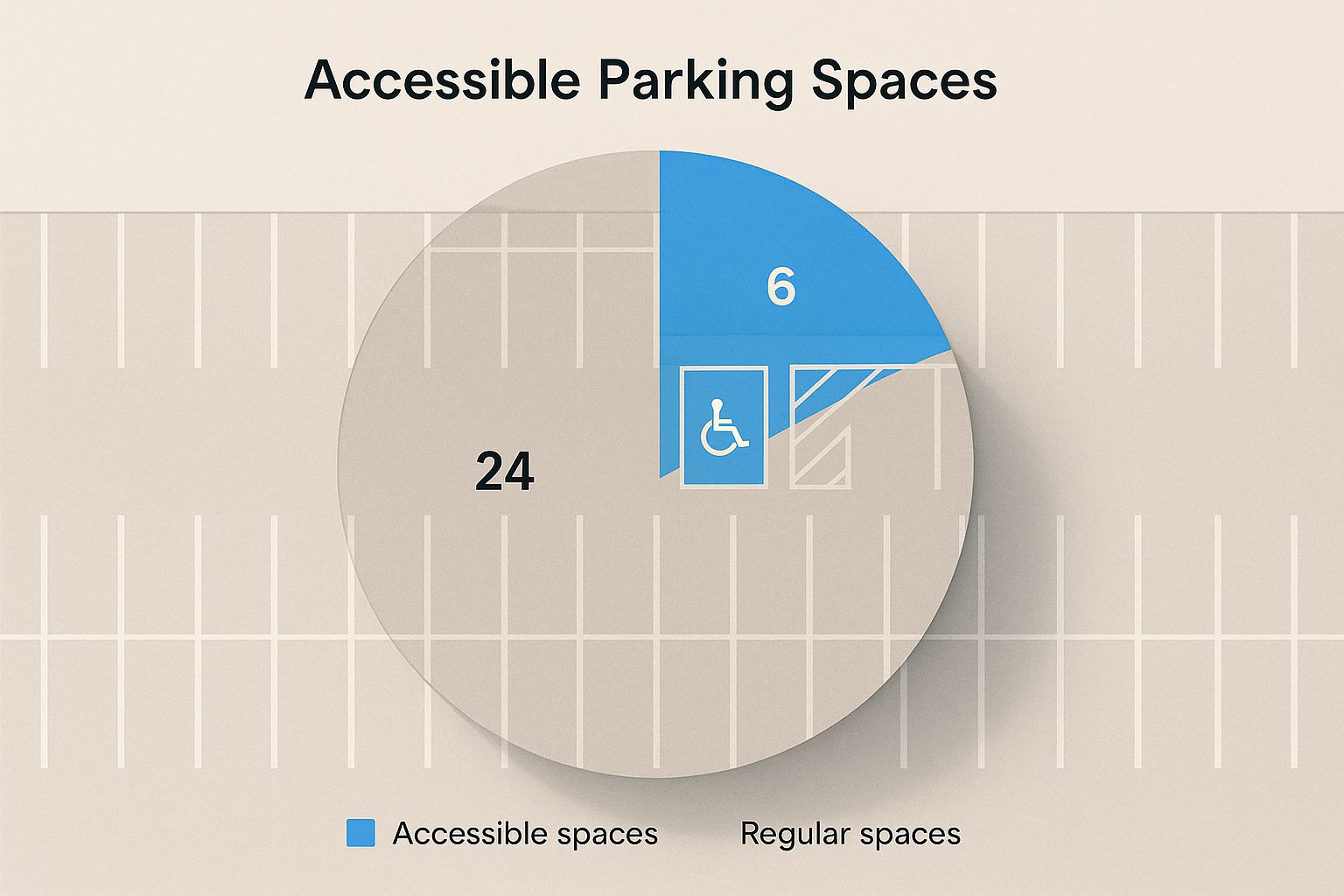
As you can see, the numbers change to make sure there's fair access, whether you have a small lot or a huge parking garage.
The ADA Minimum Requirements Chart
To get the exact numbers for your property, just find where your lot fits on the official ADA chart. This table makes it easy.
Here is the official breakdown of the minimum number of accessible spaces you need.
ADA Required Minimum Number of Accessible Parking Spaces
| Total Parking Spaces in Lot | Required Minimum Accessible Spaces |
|---|---|
| 1 to 25 | 1 |
| 26 to 50 | 2 |
| 51 to 75 | 3 |
| 76 to 100 | 4 |
| 101 to 150 | 5 |
| 151 to 200 | 6 |
| 201 to 300 | 7 |
| 301 to 400 | 8 |
| 401 to 500 | 9 |
| 501 to 1,000 | 2% of total spaces |
| 1,001 and over | 20 spaces, plus 1 for each 100 over 1,000 |
Let’s look at a couple of quick examples. Say you own a small shop with a parking lot that has 40 spaces. Looking at the chart, your lot is in the "26 to 50" group. This means you need to have at least two accessible parking spaces.
Now, imagine a bigger place, like a shopping center with 450 total spaces. That lot is in the "401 to 500" range, so it must have at least nine accessible parking spaces.
Don't Forget Van-Accessible Spaces
Getting the total number right is the first step, but there’s one more important detail: van-accessible spaces. These spots are wider and are made for vehicles with ramps or lifts.
The rule is that for every six accessible spots, at least one must be van-accessible. We'll talk more about the design of these spaces later.
These ADA rules are the standard across the U.S. But it's interesting to see how other countries handle it. For example, Australia requires one accessible space for every 50 regular spots. In the U.S., a lot that size would need two spots. This shows that while the goal of access is the same everywhere, the exact rules can be different.
Getting these numbers right is the first step to following the law. If you want to learn more, check out our complete guide on the rules for handicap parking spaces. Having the right number of spots makes sure your property is both welcoming and legal.
Understanding Van-Accessible Parking Spaces
Many people think all accessible parking spots are the same. A standard accessible space is a bit wider than a normal one. But some drivers and passengers need a lot more room to get in and out of their vehicles safely. This is where van-accessible parking spaces come in. They are very important for making a property truly open to everyone.
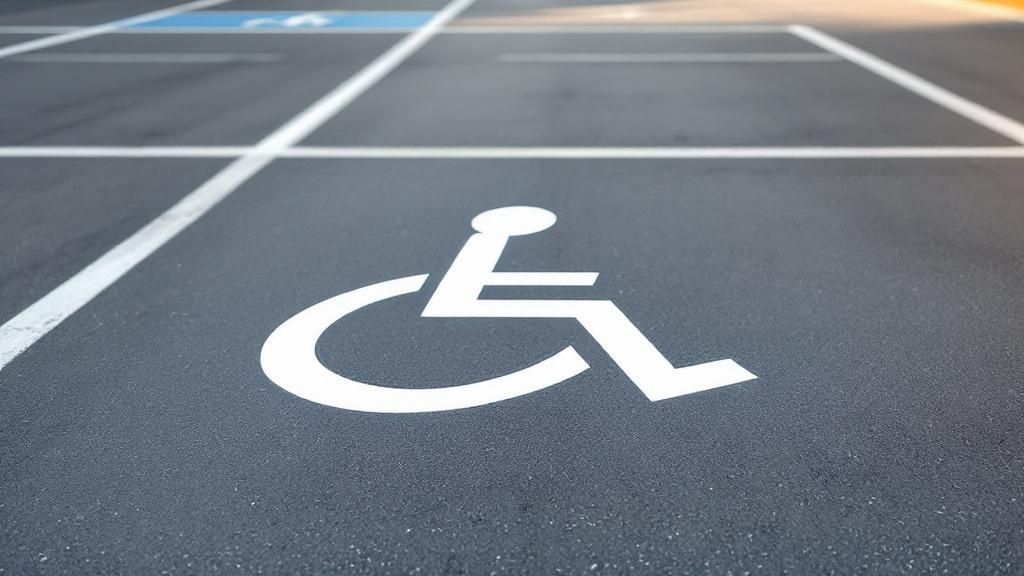
These spots are made for vehicles with side-mounted ramps or lifts. These are needed for many people who use wheelchairs or scooters. Without that extra space, a ramp can't open all the way. This can trap a person inside their own vehicle.
The One-in-Six Rule for Van Accessibility
Luckily, the ADA has a simple rule for figuring out how many van-accessible spaces you need. It’s called the one-in-six rule.
For every six accessible parking spaces required in your lot, at least one must be a van-accessible space.
This is a firm rule. It doesn't matter if you have a tiny lot with only a few accessible spots or a huge parking garage. If you need anywhere from one to six accessible spaces, at least one of them must be van-accessible. If you need seven, then at least two must be van-accessible, and so on.
Why Is That Extra Space So Important?
Think about the last time you tried to open your car door in a tight parking spot. You probably had to squeeze out. Now, imagine trying to do that while using a ramp and moving a wheelchair. The problem gets much bigger.
A standard accessible spot needs an access aisle that's at least 60 inches wide. But a van-accessible space needs a much wider access aisle of at least 96 inches (that's eight feet). This isn't just for comfort. It's the smallest amount of space needed for a ramp or lift to work safely and for someone to get their wheelchair onto the pavement.
Here’s a simple way to see the difference:
- Standard Accessible Space: Built for people who can get in and out of their car with a little extra door space.
- Van-Accessible Space: Made for vehicles with ramps or lifts that need a lot of side room to work.
Getting this right isn't just about following a rule. By using the one-in-six rule correctly, you give real, independent access to all your visitors. This makes sure they can arrive and leave safely and with dignity.
Special Parking Rules for Medical Facilities
The standard rules for accessible parking work for most businesses, like stores and office buildings. But for medical buildings, the rules are much stricter, and for a good reason. Places like hospitals and physical therapy centers have more visitors with mobility problems. So, the rules have to change to meet their needs.
Think of it this way: a bookstore and a physical therapy clinic might both have a 100-space parking lot. But they serve very different groups of people. The clinic will have more visitors who need accessible parking just to get in the door. The ADA knows this and sets a higher standard for medical centers to make sure patients can get care easily.

Higher Requirements for Patient and Visitor Parking
For some types of medical centers, the standard parking chart is just the start. These buildings must have a much higher percentage of accessible spaces for their patients and visitors.
The rules are split into two main groups:
- Hospital Outpatient Facilities: At least 10% of parking spaces for patients and visitors must be accessible.
- Rehabilitation and Physical Therapy Centers: At least 20% of patient and visitor parking must be accessible.
That’s a big jump from the normal rules. For example, hospital outpatient centers must make at least 10% of their patient and visitor parking accessible. Rehab centers and physical therapy clinics need even more. They must have 20% of their spots be accessible to help patients with major mobility problems.
Key Takeaway: The type of building changes how many handicap parking spaces are required. Medical properties must plan for a much higher number of accessible spots than a typical business.
Putting the Medical Rules into Practice
Let's see how this works in a real situation. Imagine two different businesses, and each has a 100-space parking lot.
- Example 1: A Bookstore: A bookstore with 100 parking spaces is in the "76 to 100" group on the standard ADA chart. Based on that, it would only need 4 accessible parking spaces.
- Example 2: A Physical Therapy Clinic: A physical therapy clinic also has 100 spaces, but they're all for patients. Because it's a rehab center, it must make 20% of those spaces accessible. That means it needs 20 accessible parking spaces—five times as many as the bookstore.
This comparison shows why the type of business matters so much. For people who work in paving and construction, knowing these special rules is key to keeping clients in line with the law. If you need a review of the basic rules for all properties, our guide on the general rules for handicap parking spaces gives a full overview.
How Location and Design Impact Compliance
Knowing how many handicap parking spaces you need is just the first part. If those spots are in the wrong place or designed badly, your property still won't follow the Americans with Disabilities Act (ADA). True access is about more than just having the right number of spots. It’s about creating a safe and direct path for everyone.
Think of it like this: having a ticket to a big game is great, but it’s no good if you can’t find a clear path to your seat. The accessible parking space is the ticket. But its location and design are the clear path that a person with a disability needs to get into your building.
The Shortest Accessible Route Rule
When it comes to location, the most important rule is the shortest accessible route. You cannot ignore this rule. It means your accessible parking spots must be as close as possible to the building's main accessible entrance.
You can't just put them in a far corner of the lot because it's easier. They need to be in the best spots to reduce how far someone with a mobility challenge has to travel. And if your building has more than one accessible entrance, the spots should be spread out to give easy access to each one.
Getting the Design Details Right
Besides where you put the spaces, how you design them is just as important. Every detail must meet certain standards to follow the law and work well. If even one of these details is off, the space can't do its job.
Here are the key design parts you must get right:
- Correct Size: A standard accessible car space must be at least 96 inches wide. This provides the room needed for car doors to open fully without hitting the car next to it.
- Clear Access Aisle: Every accessible spot must have an access aisle next to it. This is the striped area right beside the spot. This aisle needs to be at least 60 inches wide and clearly marked to stop other cars from parking there.
- Stable and Level Surface: The parking space and access aisle must be on a firm, stable, and mostly flat surface. The slope can't be more than a 1:48 ratio (about a 2% grade) in any direction. This makes sure a wheelchair can move safely without tipping or rolling away.
Proper signs are not optional. Every accessible space must be marked with a sign that includes the International Symbol of Access. These signs need to be high enough for a driver to see and placed so they are not blocked by a parked van.
Finally, never forget that the access aisle is just as important as the parking spot itself. It must connect directly to an accessible path, like a sidewalk with a curb ramp, that leads straight to the building entrance. This creates a smooth and safe journey from the car to the front door, which is the whole point of the ADA.
Checking for Stricter State and Local Rules
It’s easy to think that if you follow the federal Americans with Disabilities Act (ADA), you’re all set. But that’s a common and expensive mistake. The ADA is just the starting point—the minimum you have to do.
Think of the ADA as the floor, not the ceiling. Many states, counties, and cities have their own accessibility codes that require more than the federal rules. If you ignore them, you could face big fines and legal problems, even if you followed every ADA rule. A local inspector won’t care that your lot meets federal rules if it breaks a city rule.
California: A Prime Example
California is a perfect example of why you have to look beyond the ADA. The state’s own rules, in the California Building Code (CBC), add several extra requirements. While the ADA covers basics like space counts, the CBC goes into the small details of design and signs.
For example, a project in California must consider:
- Specific Paint Colors: The CBC often requires the accessibility symbol to be painted in a specific blue on a white background. The ADA does not require this.
- Unique Signage: State law requires extra words on accessible parking signs, like "Minimum Fine $250," which is not part of the federal code.
- Towing Warnings: Signs in California must also include information about towing cars that are not allowed to park there.
These may seem like small details, but they can cause you to fail an inspection. A contractor who only knows the federal ADA rules would get it wrong in California every time. This would cause project delays and cost more money.
The most important thing to remember is this: you must follow the strictest rule, whether it’s from the city, the state, or the federal government.
This is why it’s so important to work with a local contractor who knows these local rules well. We know the specific rules for Monterey, Santa Cruz, and San Benito Counties and can make sure your project follows the law from day one.
To get a full picture of the basic requirements, you can read our detailed guide covering the general rules for handicap parking spaces.
Common Questions About Accessible Parking Rules
Figuring out the details of accessible parking often leads to a few common questions. Getting the right answers is key to making sure your property is both welcoming and follows the law. Here are a few of the most common issues property owners face.
What Happens If My Business Is Not Compliant?
Not meeting ADA standards is a serious financial risk. The results aren't just a small penalty. You can face federal fines, private lawsuits from people, and even local fines.
A first-time federal fine alone can cost up to $75,000. On top of the fines, not following the rules can hurt your business's name and lead to expensive legal fights. Knowing how many handicap parking spaces are required is the first step to avoiding these problems.
Do I Need Accessible Spots in an Employee Lot?
Yes, you do. The rules don't just apply to customer parking. If you have a parking lot just for your staff, you must include accessible spaces. You use the same charts to figure out how many you need. This makes sure every employee has the same safe, direct access to their workplace.
Can Any Car Use a Van-Accessible Spot?
Yes, technically. Any car with a valid disability placard or license plate can legally park in any accessible space, including one marked "van-accessible." However, it is polite to leave those spots for the people who really need them.
The extra-wide access aisle next to a van-accessible spot is not just for looks. It's needed for wheelchair lifts and ramps to work. By choosing a standard accessible spot when possible, drivers can help make sure people who need that extra room can find a space that works for them.
Understanding these common situations is important. For more information on spot design, location, and more, check out our complete guide on the rules for handicap parking spaces.
At Coastal Pipeline Inc., we make sure your paving projects meet all federal, state, and local ADA requirements right from the start. Contact us today to get your commercial lot compliant and accessible. Visit us at https://coastalpipelineinc.com.