
Putting in a new sewer line isn't a one-day job. It's a carefully sequenced process that you have to get right the first time. The whole project really comes down to four main parts: planning and getting permits, digging the trench and prepping the base, laying the pipe itself, and then backfilling and getting the final sign-off.
Getting a handle on how to install a sewer line means you need to master each step. Above all, you've got to ensure the pipe has a steady, continuous downward slope. If you don't, gravity won't be on your side, and you'll be dealing with clogs and backups for years.
Your Sewer Line Installation Project Blueprint
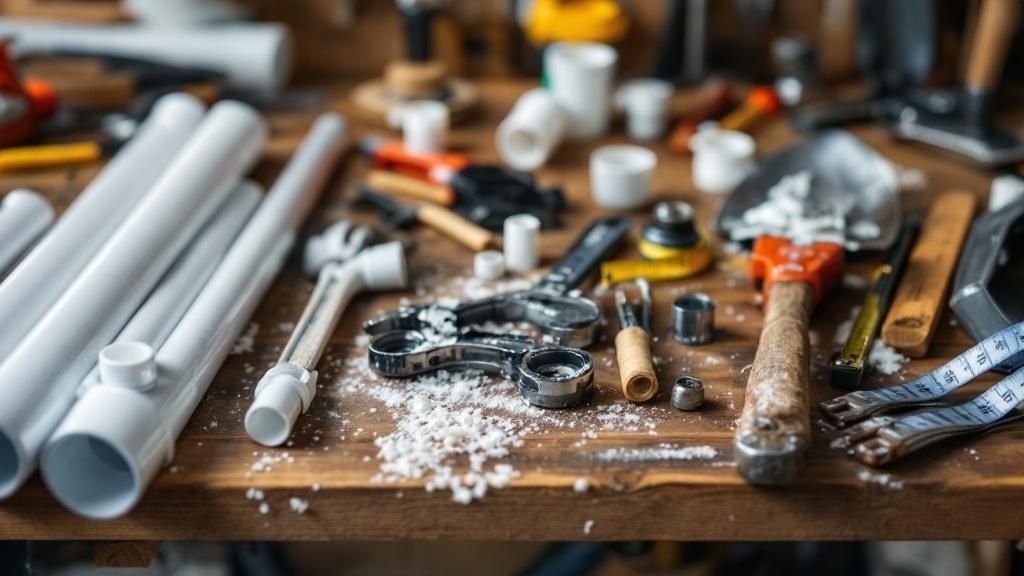
Before you even think about picking up a shovel, a solid sewer line project starts with a detailed plan. This isn't just about digging a ditch from point A to point B. It's a calculated process that guarantees your new system is safe, up to code, and built to last. Think of this as your roadmap from start to finish.
This is a major construction project, and it's a lot more involved than just connecting a few pipes. It's big business, too—the global market for sewer line services was valued at around $3.5 billion in 2024 and is only expected to climb. This shows just how critical these systems are for both new construction and replacing aging infrastructure. You can learn more about these market trends to see the bigger industry picture.
Let's break down the entire process into manageable phases. Understanding this sequence is key to a successful project.
Sewer Line Installation Project Phases
The table below outlines the typical flow of a sewer line installation, from the initial paperwork to the final inspection. Each phase builds on the one before it, so paying close attention to detail at every step is crucial for a durable, long-lasting system.
| Phase | Key Activities | Primary Goal |
|---|---|---|
| Planning & Permitting | Site mapping, calling 811 for utility locates, slope calculation, submitting plans to the city. | To create a code-compliant, safe, and efficient plan and secure all necessary legal approvals before work begins. |
| Excavation & Bedding | Digging the trench to precise depth and width, installing safety shoring, laying a gravel or sand bed. | To create a stable, safe, and properly graded trench that will support and protect the sewer pipe. |
| Pipe Laying & Testing | Placing pipe sections on the bed, joining them with solvent cement, installing cleanouts, pressure testing the line. | To install a leak-proof sewer line that maintains the correct slope for gravity-fed drainage. |
| Backfilling & Final Hookup | Filling the trench in compacted layers, connecting to the house and city main, final city inspection. | To protect the new pipe, restore the site, and ensure the entire system is fully operational and approved. |
As you can see, it's a methodical process. Rushing or skipping steps will only lead to headaches, expensive repairs, or serious safety issues down the line.
Critical Takeaway: The single most important technical detail is getting the slope, or "grade," perfect. For most residential sewer lines, you need a minimum downward slope of a quarter-inch for every foot of pipe. This is the magic number that ensures gravity can pull everything—liquids and solids—away from your house without a hitch.
Planning Your Project and Selecting Materials

Every successful sewer line job I've ever been on started the same way: with meticulous planning. This happens long before a shovel ever hits the dirt, and it's the only way to guarantee the project is safe, up to code, and built to last. Believe me, skipping this step is the fastest route to blown budgets, legal headaches, and a system that's just bound to fail.
The very first thing to do is map it out. Get a piece of paper and sketch your property, marking exactly where the sewer line exits the house (we call this the "stub-out") and where it needs to connect at the street or septic tank. This simple drawing becomes your project blueprint.
Next, and this is a big one, you have to find out what’s already buried in your yard. It’s not just a good idea—it's the law. Before you even think about digging, call 811. It’s a free national service, and they'll send crews from the local utility companies to mark where their gas, electric, and water lines are. It prevents a project from turning into a disaster.
Calculating the Critical Slope
Gravity is the engine that drives a sewer line, which makes getting the slope right the single most important part of the entire job. I can't tell you how many failures I've seen that come down to an improper grade.
- Too little slope? Solids will just sit in the pipe, leading to one clog after another.
- Too much slope? The water zips right past the solids, leaving them behind to build up and cause a major blockage.
The gold standard for residential sewer lines is a drop of one-quarter inch for every one foot of pipe. So, if you have a 40-foot run, the pipe needs to be 10 inches lower at the end than where it started. We use a laser level or a builder's level to map this out perfectly along the trench path before we start digging.
Expert Tip: Always, and I mean always, plan your slope starting from the lowest point—the city connection or septic tank—and work your way back to the house. This ensures you have enough fall to work with and don't dig yourself into a corner where the pipe ends up too high to connect.
Navigating the local permit office is another must-do task upfront. Every city and county has its own rulebook, and you need that permit in hand before you start. Give your local building department a call and ask for their checklist. It usually involves submitting your site plan and paying a fee. Don't skip this, or you could face big fines and be forced to tear out everything you’ve installed. For more complex jobs, our crews are pros at handling the entire process, including permit coordination for all sewer line services and installation.
Choosing the Right Sewer Pipe Material
The type of pipe you pick directly affects how the installation goes, what it costs, and how long it will last. This isn't a small decision; the global market for sewer pipe was valued at around $9.6 billion in 2021, which shows just how critical this infrastructure is.
Your local building code is the ultimate authority here, so always check what’s approved in your area before buying anything. Let's break down the common choices.
Pipe Material Comparison
| Pipe Material | Pros | Cons | Best For |
|---|---|---|---|
| PVC (Polyvinyl Chloride) | Affordable, lightweight, and has a smooth interior for great flow. It's easy to find and resists chemicals and corrosion. | Can get brittle in extreme cold or from sun exposure. Joints need both primer and cement. | The go-to for most modern residential sewer lines. It hits the sweet spot for cost and reliability. |
| ABS (Acrylonitrile Butadiene Styrene) | Tougher than PVC and holds up better in the cold. The joints are simpler, with a one-step process (no primer). | Costs more than PVC and can be harder to find. It's also not as resistant to some chemicals. | Great for projects in colder climates or anywhere you need a more durable pipe, as long as local codes allow it. |
| Cast Iron | Extremely durable, very quiet (you won't hear water running through it), and fire-resistant. | It's incredibly heavy, a real pain to cut and handle, expensive, and can rust over many, many years. | Mostly used in commercial buildings or for pipes that run through living spaces where noise is a major concern. |
For the vast majority of residential projects we see, Schedule 40 PVC is the standard. It simply offers the best combination of durability, cost, and ease of installation, making it the top choice for both contractors and homeowners.
Excavating the Trench and Preparing the Pipe Bed
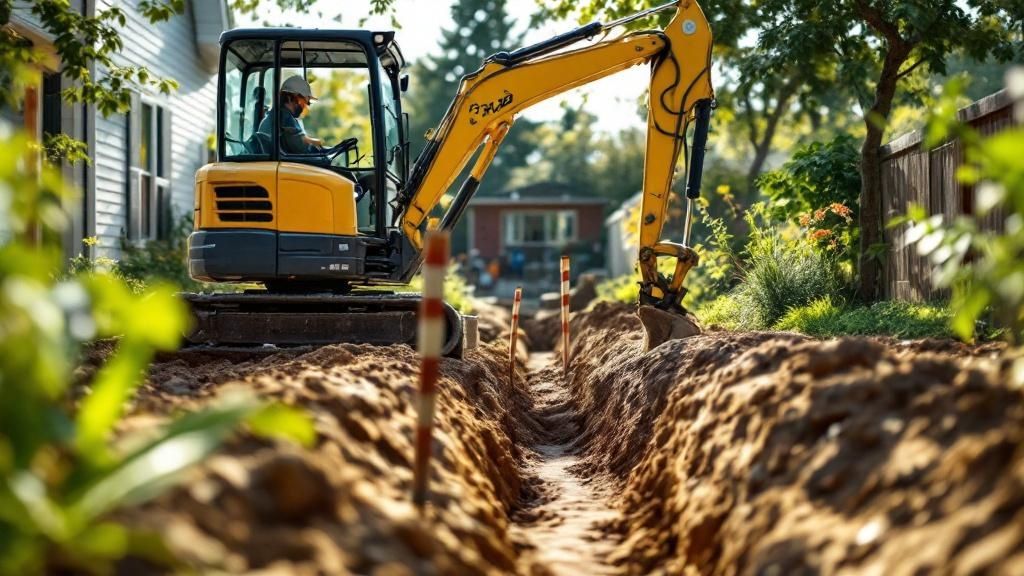
With your permits approved and a solid plan in hand, you're ready for the most satisfying part of the job: breaking ground. This is where your project moves from paper to reality, but it demands precision and a serious focus on safety. The quality of your trench has a direct impact on how well your sewer line performs for years to come.
First, you have to decide how you'll move all that dirt. For a very short, shallow run in soft soil, you could dig it by hand with a trenching spade, but be warned—it's incredibly tough work. For most projects, renting a mini-excavator is the only practical way to go. It turns days of back-breaking labor into a few hours and gives you far more control over the trench's depth and width.
Never operated heavy machinery? Don't be intimidated. Rental companies give you the rundown, and modern mini-excavators have intuitive joystick controls. It’s a good idea to spend some time practicing in an open area before you start digging the real thing.
Ensuring Trench Safety and Stability
Let's be clear: excavation is statistically one of the most dangerous parts of any construction job. The weight of soil is immense, and trench walls can collapse without any warning. This isn't just a risk; it's a massive legal and safety liability.
That’s why any trench deeper than five feet must be properly secured according to OSHA (Occupational Safety and Health Administration) standards. You have two main options to prevent a cave-in:
- Shoring: This means installing a support system, like a trench box or hydraulic shores, to physically hold the walls in place. Trench boxes are big metal shields you lower into the trench, creating a safe work zone inside.
- Sloping: This involves angling the trench walls back at a safe incline so they're less likely to collapse on their own. The exact angle you need depends on your soil type—looser soil needs a much more gradual slope.
For a DIY job, sloping is often the easiest route if you have the space. But if your trench is running close to a foundation, driveway, or property line, a trench box is non-negotiable. You can't risk undermining those structures. For a look at the professional standards we adhere to, you can learn more about certified excavation and land clearing services.
Critical Safety Reminder: One cubic yard of soil can weigh as much as a small car. A trench collapse can be fatal, and there's often no time to react. Always put safety ahead of speed when digging.
Preparing the Perfect Pipe Bed
Once the trench is dug to the right depth—making sure you've accounted for the pipe diameter and your bedding material—it's time to prepare the bottom. You can't just drop the sewer pipe onto the native soil. The bottom of a trench is rarely smooth or evenly compacted.
If you lay a pipe directly on that uneven surface, you'll create high spots and low spots. Over time, those low spots (we call them "bellies") will collect standing water and solids. This leads to chronic clogs that are a nightmare to fix without digging the whole line up again.
To stop this from ever happening, you have to create a uniform foundation known as the pipe bed. It's all about adding a layer of granular material to the bottom of the trench.
Bedding Material and Compaction
The best materials for a pipe bed are sand or pea gravel. Personally, I prefer pea gravel—the small, rounded 3/8-inch stones. It’s easy to work with and gives you fantastic, stable support once it's compacted down.
Here's the process for getting that bed just right:
- Add the Material: Start by placing a layer of your bedding material, aiming for at least 2 to 4 inches deep along the entire trench.
- Level and Grade: Use a good, stiff rake to spread the material evenly. You need to make sure it perfectly matches the quarter-inch-per-foot slope you figured out in your plan.
- Compact the Bed: Now, grab a hand tamper and firmly compact the pea gravel or sand. This step is absolutely crucial. It prevents the ground from settling later, which would completely ruin your pipe's slope.
A properly prepared bed cradles the pipe, providing continuous support along its entire length and protecting it from shifting soil. Take your time here. The perfect grade you set now is the foundation for a trouble-free sewer system that will last for decades.
Laying and Connecting the Sewer Pipe
With a perfectly graded trench and a solid pipe bed, you're now at the heart of the installation. This is where your sewer line physically comes together. Precision is everything here—every joint you create has to be permanent and 100% leak-proof. Take your time, double-check your work, and you'll build a system that will last for decades.
Start by carefully lowering the pipe sections into the trench. You can't just drop them in, as that could mess up the smooth, compacted bed you just worked so hard to create. Always place the pipes with the "bell" end—the wider, flared part—facing uphill, back towards the house. This lets the spigot (or plain) end of the next pipe slide right in, pointing in the direction of the flow.
Before you even touch the cement, do a quick "dry fit." Just slide the spigot end into the bell end to make sure they fit correctly and your alignment is perfect. It's a simple, two-second check that can save you from a massive headache down the line.
Creating Permanent Solvent Weld Joints
For PVC or ABS pipes, the connection isn't just glue; it's a chemical process known as a solvent weld. The solvent literally melts the surface of the plastic on both pieces, fusing them into one continuous, solid piece of pipe as it cures. It creates an incredibly strong bond, but your technique has to be spot on.
I always tell my crew to get everything laid out and ready before they open the cans of primer and cement. You have a very short window to work once you start, so there's no time to be fumbling for tools.
Here’s the breakdown for a perfect solvent weld every time:
- Clean and Deburr: First, wipe the inside of the bell and the outside of the spigot with a clean, dry rag. Get rid of any dirt, dust, or moisture. Then, use a deburring tool or even a sharp utility knife to shave off any rough plastic burrs left over from cutting the pipe.
- Apply Primer (for PVC): Grab the dauber from the can and apply a liberal coat of purple primer to both surfaces you're joining. The primer cleans the plastic on a chemical level and starts softening it up for the weld. Don't be shy with it.
- Apply Cement: Right after priming, apply a smooth, even layer of the appropriate solvent cement to both the spigot end and the inside of the bell.
- Join and Hold: Push the spigot firmly into the bell with a slight quarter-turn twist. That little twist is key—it spreads the cement evenly and ensures full coverage. You have to hold that joint together firmly for at least 30 seconds. The chemical reaction actually creates pressure that can push the pipe back out.
A common rookie mistake is not holding the joint securely for the full 30 seconds. The cement sets incredibly fast. If that pipe backs out even a fraction of an inch, the weld is compromised and it's almost guaranteed to leak under pressure.
This graphic really simplifies the core process of positioning, joining, and verifying your work.
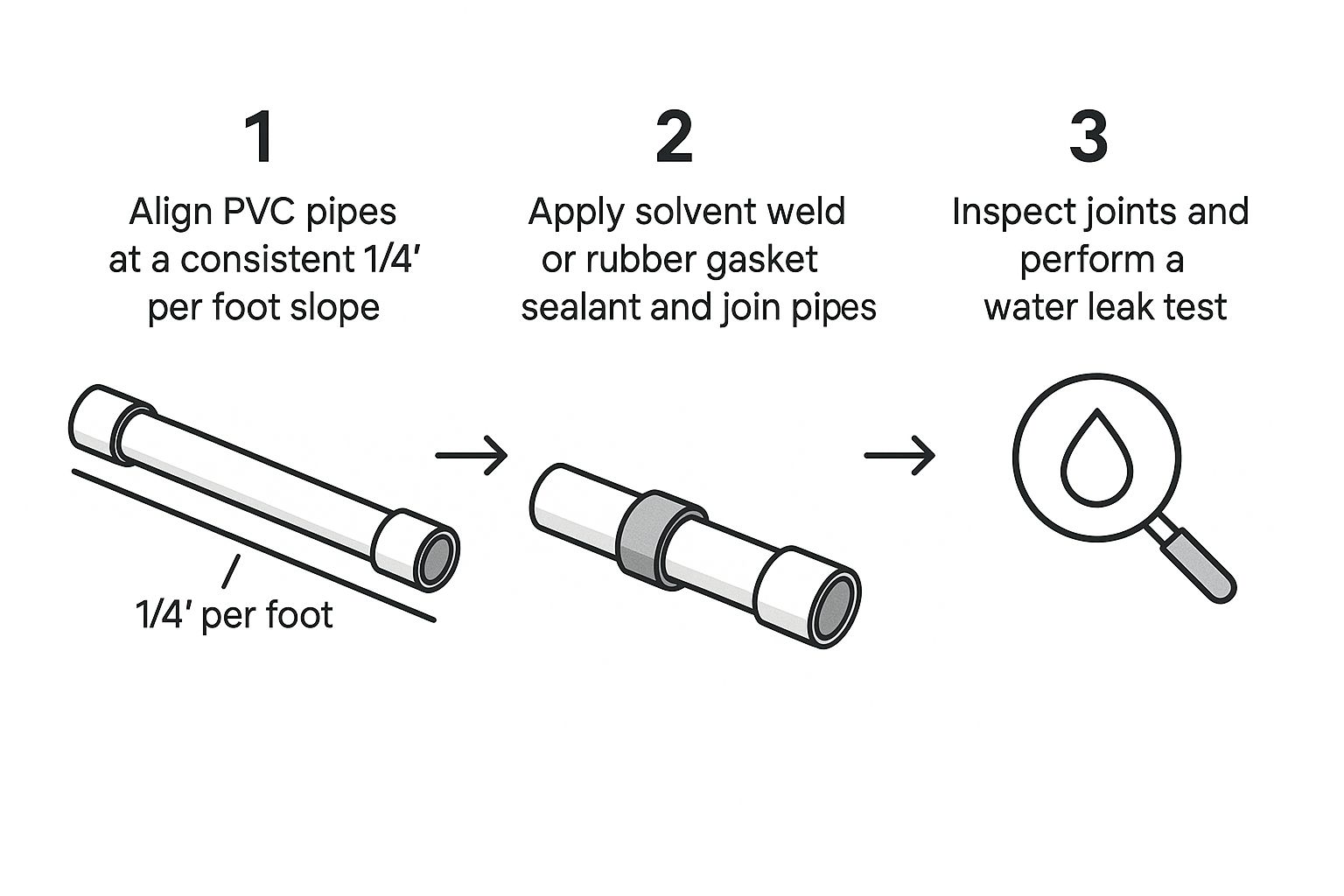
As you can see, success boils down to three fundamentals: maintaining your slope, getting a perfect seal on the joints, and then testing everything to be sure.
Installing Fittings and Maintaining Slope
While you're connecting the main pipe sections, you'll also need to install fittings. The most important ones are cleanouts. These are Y-shaped fittings with a screw-on cap that give you access to the line later on for cleaning or camera inspections. Local code will tell you exactly where they need to go, but a good rule of thumb is to have one near the house's foundation and another at any point where the pipe makes a major change in direction.
Throughout this entire process, you need to be constantly checking your slope. After you connect each 10-foot section, lay a 4-foot level on top to make sure you’re still holding that critical quarter-inch of fall per foot. Even a small deviation can throw the whole system off, so stay vigilant.
The Non-Negotiable Leak Test
Before a single scoop of dirt goes back into that trench, you absolutely must test the line for leaks. Skipping this step is easily one of the most expensive mistakes you can make. Finding and fixing a bad joint now is a simple job. Finding it after it's been buried under tons of dirt is a complete nightmare.
For most residential jobs, a water test is the standard. Here’s how it works:
- Water Test: First, securely cap the lowest end of the sewer line. Then, from the highest point (usually the cleanout by the house), fill the entire pipe system with water right up to the top.
- Mark and Wait: Mark the water level inside the pipe with a sharpie. Let it sit for the time required by your local inspector, which is typically at least 15-30 minutes.
- Inspect: Go back and check the water level. If it has dropped at all, you have a leak. You'll have to drain the system, go back, and inspect every single joint until you find the culprit. Then, cut it out and remake the connection properly.
An air pressure test is another method, more common on commercial sites. This involves pressurizing the line with air to around 5 PSI and watching a gauge to see if the pressure drops. It’s faster, but it can also be more dangerous if you don’t know what you’re doing—a joint that fails under pressure can burst apart violently. For any DIYer or smaller project, the water test is definitely the safer, more straightforward choice.
Backfilling and Finalizing the Connections
You’ve laid the pipe, confirmed the slope, and the line passed its leak test. You might think the hard part is over, but don't relax just yet. The final steps demand just as much attention to detail as the digging itself. If you get the backfill wrong, you can easily crush your brand-new pipe, ruin the grade you worked so hard to set, or create a sinkhole in your yard down the road.
Getting this right is what protects your sewer line for the next few decades.
First thing’s first: you have to secure the pipe. This process is called haunching, and it means packing bedding material—like the pea gravel or sand from your base—around the sides of the pipe. You'll want to add this in small layers, or "lifts," about 6 inches at a time. Tamp it down firmly with a 2×4 or similar tool until it's packed tightly against the pipe.
This provides the critical side support that stops the pipe from shifting under pressure. Keep adding and tamping material until you have a protective cover of at least 6 to 12 inches above the top of the pipe. This layer is its first line of defense.
Protecting the Pipe with Proper Backfill
With the pipe safely shielded, you can start backfilling the rest of the trench. Whatever you do, don't just dump all the excavated soil back in at once. This rookie mistake creates massive air pockets, which will lead to the ground settling and forming a dangerous depression in your yard.
Instead, you need to backfill in compacted lifts. Here’s how we do it on our job sites:
- Clean the Soil: Before you move any dirt, pick through the excavated pile and remove any large rocks, sharp objects, or big clumps of clay. These are pipe-killers.
- Add Soil in Lifts: Shovel about 8 to 12 inches of soil into the trench.
- Compact Every Layer: After each lift, use a hand tamper (for smaller jobs) or a mechanical plate compactor to pack the soil down tight.
You’ll keep repeating this process until the trench is full. We always mound the soil slightly on top to allow for minor, inevitable settling. This methodical work is crucial, and for bigger jobs, it often makes sense to look into professional backfilling services for pipelines to guarantee the compaction is done right for long-term stability.
Pro Tip: For sandy or dusty soils, lightly misting the dirt with a hose as you backfill helps it compact much better. Don't turn it into mud—just enough moisture to help the particles bind together for a solid, dense fill.
Making the Final Connections
Now that the trench is filled, you’re clear to make the final connections. At the house, you'll join the new sewer line to the building’s main drain stub-out. This is typically done with a flexible rubber coupling held on with steel band clamps. These fittings are fantastic because they can absorb minor ground shifts or building movement without cracking or leaking.
Connecting to the municipal sewer main or septic tank is a completely different ballgame. This "tap" is almost always handled by a licensed plumber or the city's own public works crew. They have the specialized tools and saddles needed to make a connection that’s watertight and up to code, without risking damage to the public main.
Scheduling the Final Inspection
The very last step before you can use your new line is getting the final sign-off from the inspector. Call your local building department to get on their schedule.
The inspector will come out to verify that every part of your installation meets local codes. They'll check the trench depth, the materials you used, the connections, and they may ask to see proof of your passed pressure test.
Once they give you the green light, your new sewer line is officially ready for service. While this open-trench method is a tried-and-true approach, it's worth noting how much the industry is evolving. The market for trenchless pipe rehabilitation, for example, hit roughly USD 4.64 billion in 2024, thanks to methods that can replace or repair lines with very little digging. These less disruptive techniques are quickly becoming the go-to for replacing old lines without tearing up established landscapes.
Your Top Sewer Line Installation Questions Answered
Even with the best-laid plans, a project this big is going to bring up some questions. It's totally normal. Getting clear on the common worries about costs, rules, and what can go wrong will help you tackle the job with confidence.
How Much Does a New Sewer Line Really Cost?
This is the big one, and the honest answer is: it depends. The final price tag is a mix of your location, how much pipe you need to lay, and what kind of soil you're digging into.
Hiring a pro for the whole job can run anywhere from $3,000 to over $25,000. If you're a skilled DIYer and decide to go that route, you're mainly looking at material and equipment rental costs, which might be in the $1,000 to $5,000 range. Just know that the DIY path is no joke—it's tough, physical work that demands precision.
For a deeper dive into what drives these numbers, we've put together a full guide on sewer line replacement costs that breaks it all down.
Can I Connect to the City Sewer Myself?
In nearly every jurisdiction, that's a hard no. The final connection point where your private line meets the public sewer main—what we call the "tap"—has to be handled by a licensed and bonded plumber or the city's own public works crew.
Key Takeaway: This isn't just red tape. It's a critical safety measure to protect the public sewer system. One bad connection can create backups, contamination, and a massive headache for the whole neighborhood. Always, always check with your local municipality before you even think about touching the main.
What's the Biggest DIY Mistake People Make?
Hands down, it's getting the slope wrong. I've seen it time and time again.
A sewer line that's too flat won't drain right, leading to endless clogs. On the flip side, if it's too steep, the water zips right past the solid waste, leaving it behind to form a blockage. Nailing that perfect, consistent 1/4-inch of fall for every foot of pipe is the single most important part of the job. Get that right, and you're building a system that will work flawlessly for decades.