
An ADA compliant parking lot is more than just following rules. It’s about making sure every person who visits your property can get in safely and fairly. The government created the 2010 Standards for Accessible Design to show us how to build parking lots that work for people with disabilities.
Understanding the Core of ADA Compliance
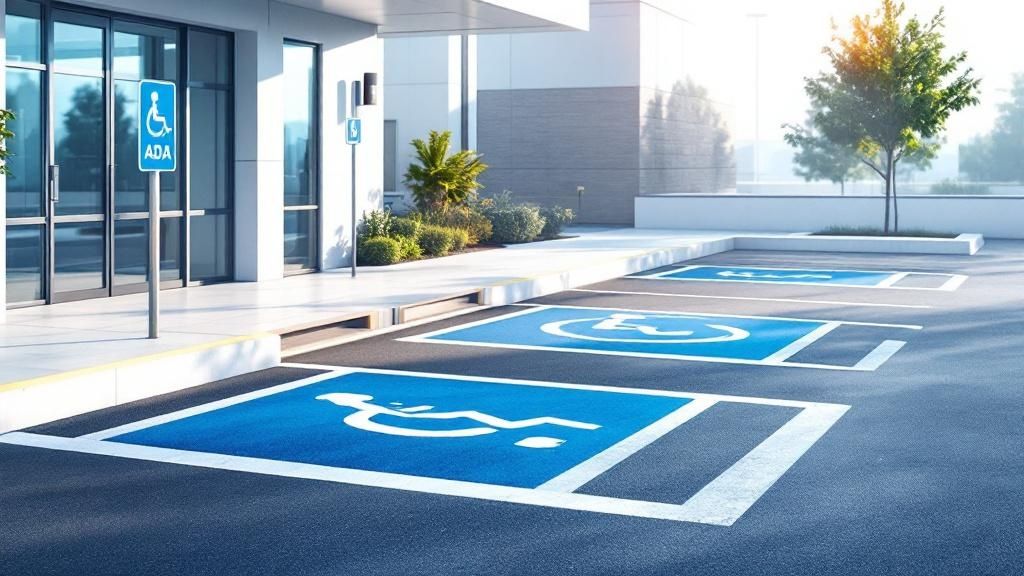
Before we talk about measurements and slopes, it’s important to know why these rules exist. The Americans with Disabilities Act (ADA) is a civil rights law. It stops businesses from treating people with disabilities unfairly. For a business owner, this means giving everyone equal access, and that starts in the parking lot.
Some people think ADA rules are just a pain to avoid getting sued. While you can get in trouble for not following the rules, the real goal is much bigger. It’s about making things safe, fair, and respectful for everyone.
More Than Just a Parking Space
Think about what it's like for someone using a wheelchair or a walker. A steep slope could make their wheelchair hard to control. A parking space without an empty aisle next to it might make it impossible for them to even get out of their car. An ADA compliant lot is designed to fix these problems.
These rules also help a lot of other people, not just those with handicap signs:
- People with mobility aids: The right slopes and smooth surfaces help prevent accidents.
- Parents with strollers: Those special routes and ramps are a big help for families, too.
- Older visitors: Clear, flat paths make it much less likely for them to trip and fall.
- Delivery drivers: Anyone pushing a heavy cart is thankful for a smooth, ramped path.
When you follow the rules, you aren't just helping one group. You're making your whole property safer and easier to use for everyone. To learn more, you can read the detailed rules for handicap parking spaces in our other guide.
The Foundation of a Welcoming Environment
A good parking lot sends a clear message: your business cares about every single customer. It shows you’ve thought about the 61 million adults in the United States who live with a disability.
A well-designed parking lot is the first step to a good customer experience. It removes problems before a person even gets to your front door. This makes them feel welcome right from the start.
This isn’t just about being nice—it’s good for business. People who feel safe and welcome are more likely to come back and tell their friends about you. It's an investment in both your community and your business.
Calculating Your Required Accessible Parking Spaces
Before you paint any lines, the first step is simple math. You need to figure out how many accessible parking spaces your lot must have. This isn't a suggestion. The Americans with Disabilities Act (ADA) has very clear rules based on the total number of parking spaces in your lot.
The rules, updated in the 2010 Standards for Accessible Design, use a sliding scale. The bigger the lot, the more accessible spaces you need. For example, a small lot with only 1 to 25 total spots needs just one accessible space. But a large lot with 501 to 1000 spaces needs at least 2% of the total to be accessible.
Getting this number right is very important.
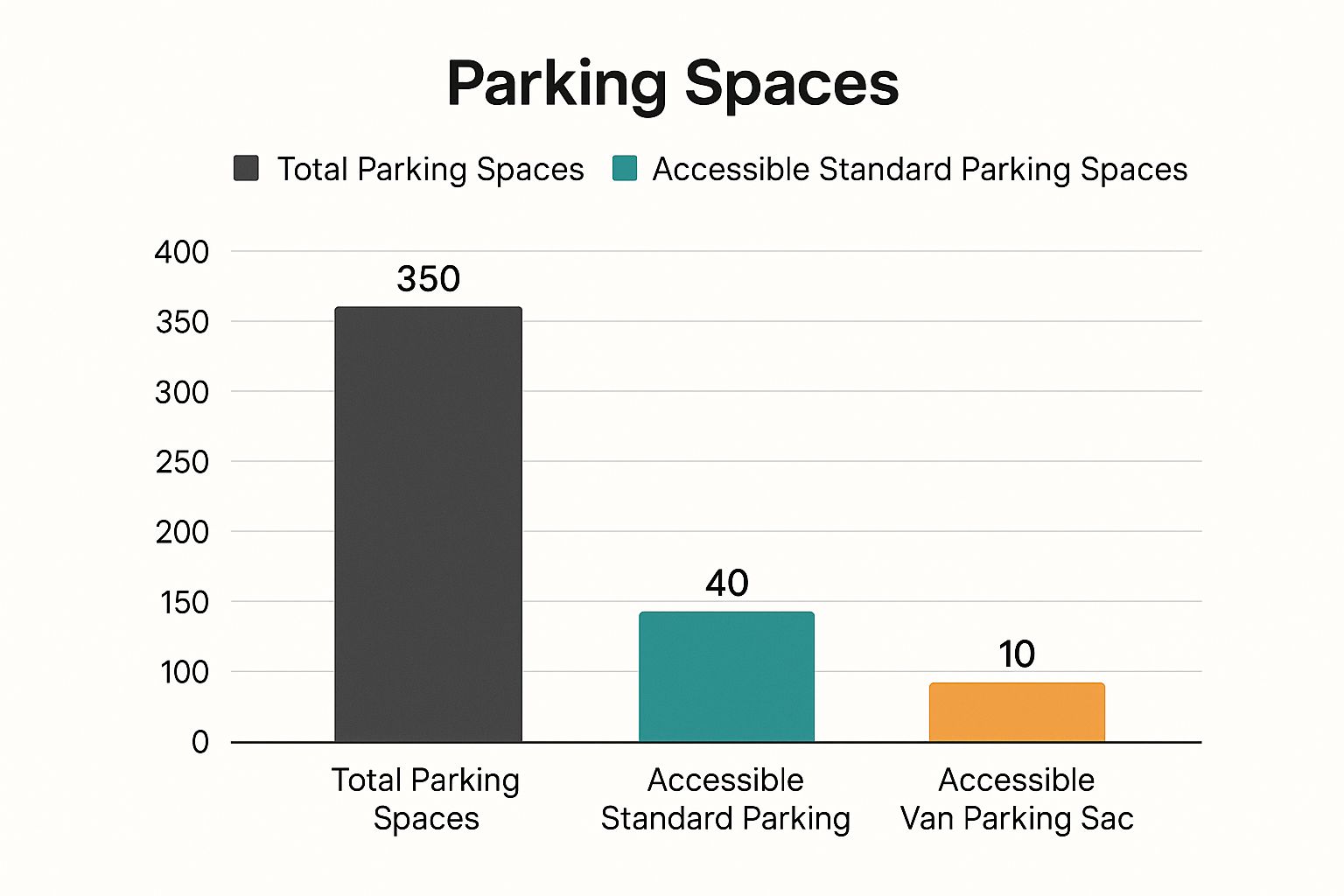
As you can see, accessible spaces are a small but key part of any parking lot. Some spots are made extra wide for vans to make sure everyone has proper access.
Breaking Down the Numbers
The ADA provides a clear chart so there’s no guesswork. You just find your total number of parking spaces, and the chart tells you how many accessible spots you need. It's that simple.
Here’s how it works in real life:
- A small store with 45 total parking spaces would need two accessible spots.
- A medium-sized office with a 250-space lot must have five accessible spots.
The system scales up as your lot gets bigger. Of course, having the right number of spaces is only the first step. The project must be built with proper paving and grading techniques to make sure the spots are not only there but also built correctly.
To make it easier, here’s a quick table based on the ADA rules.
Required ADA Accessible Parking Spaces by Lot Size
This table shows the minimum number of accessible spaces you need based on the total number of spots in your parking lot, as required by the ADA.
| Total Parking Spaces in Lot | Minimum Required Accessible Spaces | Minimum Required Van-Accessible Spaces |
|---|---|---|
| 1 to 25 | 1 | 1 |
| 26 to 50 | 2 | 1 |
| 51 to 75 | 3 | 1 |
| 76 to 100 | 4 | 1 |
| 101 to 150 | 5 | 1 |
| 151 to 200 | 6 | 1 |
| 201 to 300 | 7 | 2 |
| 301 to 400 | 8 | 2 |
| 401 to 500 | 9 | 2 |
| 501 to 1,000 | 2% of total | 1 for every 6 accessible spaces |
| 1,001 and over | 20, plus 1 for each 100 over 1,000 | 1 for every 6 accessible spaces |
Remember, this is the minimum number. You can always add more accessible parking if you think you'll need it.
The Critical "One-in-Six" Rule for Van Accessibility
This is where a lot of people make a mistake. It's not just about the total number of accessible spots. You also have to include spaces for vans. These spots are wider and have larger empty aisles next to them to make room for vehicles with lifts or ramps.
The rule is simple but you must follow it: For every six accessible parking spaces you need, at least one must be van-accessible.
Let's say your lot needs exactly six accessible spaces. Five can be standard accessible spots, but the sixth one must be marked as van-accessible. If your lot needs seven accessible spots, one still has to be a van spot. You'll need a second van spot once you get to twelve total accessible spaces.
Key Takeaway: The one-in-six rule is not flexible. It's a required part of the ADA rules. Always round up—if the math gives you a fraction, you have to provide a full van-accessible space.
Simply having the right total count isn't enough. Not having enough van-accessible spots is one of the most common—and easiest—mistakes to avoid.
Special Rules for Healthcare Facilities
It’s important to know that these rules don't apply everywhere. Certain types of healthcare buildings have much stricter rules. This is because their patients and visitors often have a greater need for accessible parking.
- Hospital Outpatient Facilities: These places must make 10% of their patient and visitor parking accessible.
- Rehabilitation Facilities: Centers that treat people with mobility problems have the highest standard. They must make 20% of their patient and visitor parking accessible.
Think about it this way: a physical therapy clinic with a 50-space parking lot would need 10 accessible spaces. A normal business of the same size would only need three. This makes sure patients can find a good spot without extra stress. Always check your building’s type to be sure you're following the right rules.
Designing Accessible Space Dimensions and Layout
Once you know how many accessible spots you need, it's time to design them correctly. Getting the size and layout right is a must for an ADA compliant parking lot. This is about more than just painting lines. It's about creating a space that is truly safe and easy to use for everyone.
Think of it this way: a normal parking space is designed for a car. But an accessible space is designed for a person and their mobility equipment, like a wheelchair. The specific measurements required by the ADA are there to make room for all kinds of vehicles, wheelchairs, and lifts.
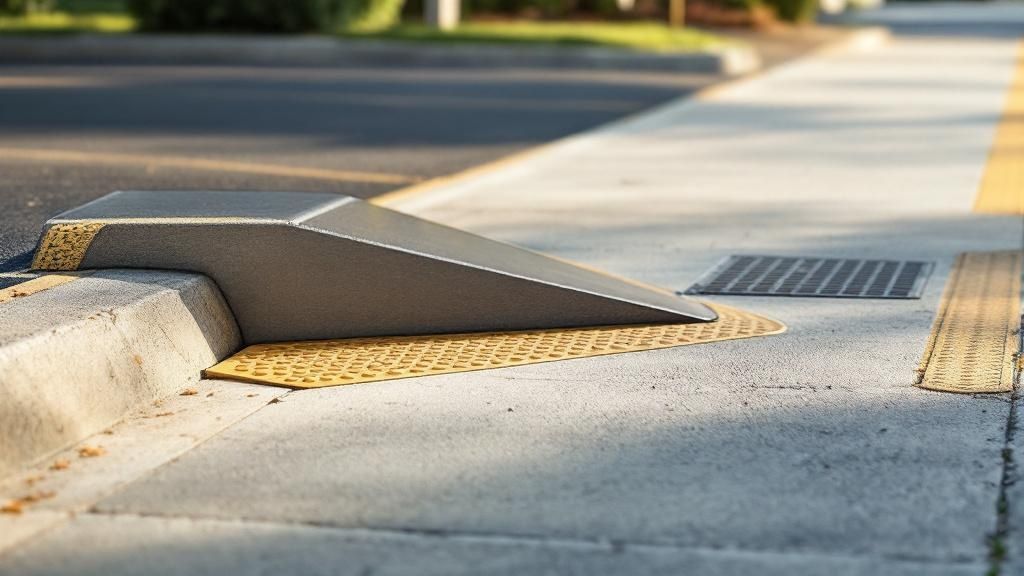
Let's look at the exact rules for both standard and van-accessible spots, focusing on the key details that make your layout correct.
The Anatomy of a Standard Accessible Space
A standard accessible car space is wider than a normal spot for a good reason. It gives people the room they need to open their door all the way and move next to their car without being squeezed by another vehicle.
Here are the key measurements you need to know:
- Parking Space Width: Must be at least 8 feet (96 inches) wide.
- Access Aisle Width: Must have an access aisle next to it that is at least 5 feet (60 inches) wide.
That striped area next to the parking space is the access aisle. It's an empty, clear zone that lets someone using a wheelchair or walker safely get in and out of their car. This aisle is just as important as the parking spot itself and must be marked to keep other cars out.
When you add them together, a standard accessible space plus its aisle will take up a total width of at least 13 feet.
Van-Accessible Spaces: A Critical Upgrade
Van-accessible spaces are a bit different. They’re made for vehicles with lifts or ramps on the side, which need much more room to come out. That standard 5-foot aisle is not big enough.
The measurements for van-accessible spaces are more flexible:
- Parking Space Width: You can use an 8-foot (96-inch) wide space, but only if you make the access aisle wider, at 8 feet (96 inches).
- Alternative Van Space Width: The other choice is to make the parking space 11 feet (132 inches) wide. This can then be next to a standard 5-foot (60-inch) access aisle.
No matter which option you choose, the total width for a van-accessible space and its aisle must be at least 16 feet. Most builders prefer the 8-foot-wide access aisle because it works well for all types of accessible vehicles.
Pro Tip: You can have two accessible spaces share a single access aisle. This is a good way to design your lot. For example, you could put a van spot and a standard car spot on either side of one 8-foot-wide access aisle, which works for both.
Location, Location, Location
Where you put your accessible spots is just as important as their size. The ADA is very clear: accessible parking spaces must be on the shortest accessible route to the building's main entrance. The goal is to make the travel distance as short as possible for anyone with a mobility issue.
Imagine a large shopping center. The accessible spots can’t be hidden in a far corner of the lot. They need to be the closest spaces to the main entrance, offering the most direct and safest path inside. And if a building has more than one accessible entrance, you should spread the accessible parking spaces among them.
This "shortest route" rule is about more than just being convenient. It's a safety rule that reduces the amount of time people are exposed to traffic and bad weather.
Avoiding Common Layout Mistakes
Designing an ADA-compliant parking lot means paying attention to the details. A few simple mistakes can make a perfectly measured space unusable and not compliant. Here are the most common mistakes people make:
- Blocking Access Aisles: Never place signs, posts, or even plants inside the access aisle. This area must stay 100% clear at all times.
- Getting the Slope Wrong: The ground of both the parking space and the access aisle has to be almost level. The slope cannot be more than 2.08% (or a 1:48 ratio) in any direction. We'll cover this more later.
- Forgetting Curb Ramps: Your accessible route must be clear of barriers. If there's a curb between the access aisle and the sidewalk, you must install a curb ramp.
- Sloppy Striping: The access aisle must be clearly marked with diagonal lines to stop people from parking there. While the government doesn't require a certain color, blue or white are the most common and safest choices.
Getting these layout details right from the start will save you a lot of trouble and expensive fixes later. It makes sure your parking lot is safe and provides the access it's supposed to.
Mastering Slopes and Surface Requirements
Even if your measurements are perfect, an ADA compliant parking lot can still fail inspection if the ground itself isn't right. The slope and surface of accessible spaces are two of the most important—and most often missed—details. If you get them wrong, you can make a space useless for the people it's meant to help.
Imagine trying to get out of a car and into a wheelchair on a steep hill. The chair could easily roll away, which is very dangerous. This is why the ADA has such strict rules about how level these spaces must be.
The Critical 2.08% Slope Rule
Both the accessible parking space and the access aisle next to it must have a slope that is no more than 2.08% in any direction. That number means a 1:48 ratio. For every 48 inches you go across, the ground can only drop by one inch.
This isn't just a random number. It’s a carefully chosen standard that ensures:
- Wheelchair Stability: It keeps wheelchairs from rolling away while someone is getting in or out of their car.
- Ramp Deployment: It makes sure that van ramps and lifts have a stable, level surface to land on so they can work correctly.
- Safe Transfers: It gives people a solid, level ground to move safely from their car to a wheelchair without losing their balance.
When the lot is being paved, your contractor needs to use a digital level to check the slope very carefully. Just looking at it is never good enough to know if it's compliant.
A common mistake is thinking the natural slope of the parking lot is fine for the accessible spaces. It’s not. These special spots must be built to be as flat as possible, even if the rest of the lot is steeper for water drainage.
If you find that the slope in an existing lot is too steep, the fix usually means working on the asphalt or concrete. This might mean grinding down high spots or adding a new patch of asphalt to make the surface level.
Why Surface Condition Matters
Besides the slope, the condition of the pavement itself is a big deal. The ground must be firm, stable, and slip-resistant. This means materials like gravel, dirt, or wood chips are not allowed for accessible spots and the paths leading to them.
Your best options are concrete or asphalt. They provide the smooth, hard surface that wheels on walkers, scooters, and wheelchairs need to roll easily without getting stuck.
Maintaining a Safe and Compliant Surface
A perfect surface today won't stay that way forever. Weather and traffic will create problems that can quickly make a space unsafe and non-compliant. Regular maintenance is a must.
Keep an eye out for these common issues:
- Potholes and Cracks: A small pothole can stop a wheelchair’s front wheel, which can be very dangerous. Any cracks wider than 1/2 inch need to be filled right away.
- Upheaval: Tree roots or frozen ground can push up the pavement, creating bumps that can cause people to trip.
- Debris and Puddles: The spots and access aisles must be kept clear of gravel, leaves, or standing water, which can cause slips and falls.
The best plan is to check your lot regularly and make repairs when needed. This will solve problems before they become serious safety risks or lead to fines. By controlling both the slope and the surface quality, you make sure your parking lot provides the safe, reliable access the ADA requires.
Installing Proper Signage and Pavement Markings
Once your parking lot is laid out with the right sizes and slopes, it’s time to make sure everyone can see and understand the rules. Clear signs and bright pavement markings are essential for a working and ADA compliant parking lot. Think of them as the directions for your lot, guiding drivers and saving accessible spaces for those who need them.
Properly marking your accessible spots is about more than just putting up a sign. It’s about following very specific rules for how things look and what they say. Without these signs and markings, even a perfect space can cause confusion and break the law.
The Importance of Correct Signage
ADA rules are very specific about the signs used for accessible parking. The most common one is the International Symbol of Accessibility—the familiar blue and white wheelchair symbol. This sign must be at every single accessible spot. There are no exceptions.
But just having the symbol isn’t enough. Where you put the sign is just as important.
- Mounting Height: The sign must be high enough so the bottom edge is at least 60 inches from the ground. This makes sure it can be seen over the hood of a parked car or truck.
- Location: The sign should be placed at the front of the parking space, so it's easy for drivers to see.
A common mistake is putting signs too low. If a big truck pulls in and blocks a low sign, other drivers might not see it. This can be frustrating for people who need that space and can lead to others parking there by mistake.
Signs for Van-Accessible Spaces
Van-accessible spaces have an extra rule. Along with the standard accessibility symbol, these spots must also have a sign that clearly says "Van-Accessible."
You cannot skip this step. This extra sign helps drivers of special vans quickly find the spots that are big enough for their side lifts or ramps. This saves them time and makes sure they can safely get out of their vehicles.
Key Takeaway: Every accessible spot needs a sign with the International Symbol of Accessibility mounted at least 60 inches high. Van-accessible spots need another sign that says "Van-Accessible."
Pavement Markings and Striping
What you paint on the ground is just as important as the signs you post. Pavement markings show the edges of the parking space and, most importantly, the access aisle.
The access aisle—that striped area next to the parking space—has to be clearly marked to keep other drivers from parking in it. While the ADA doesn’t demand a certain color, the common choice is diagonal lines in white or blue. This pattern instantly tells drivers it's a no-parking zone.
Many property owners also paint the wheelchair symbol on the ground inside the space itself. The federal ADA doesn't require this, but it’s a good idea. Also, some state or local rules, like here in California, do require it. This extra visual sign makes it even clearer what the space is for. For a perfect job, it’s always best to work with experts who focus on parking lot striping and marking in Monterey and Santa Cruz County.
By using signs that are easy to see and correctly placed, along with bold, clear pavement markings, you create a system that works. It guides drivers, protects accessible spaces, and makes your parking lot safe and legal for everyone.
Special Considerations for Healthcare Facilities
Not every property follows the same rules when it comes to designing an ADA-compliant parking lot. Healthcare buildings, in particular, have much stricter rules, and for good reason. Patients and visitors going to hospitals or clinics often have a greater need for safe, easy access.

While a normal business lot usually only needs about 2% of its spaces to be accessible, medical centers must provide a lot more to serve their communities properly.
Higher Accessibility Mandates
The specific rules change depending on the type of medical service offered.
- Hospital Outpatient Centers: These buildings must make a full 10% of patient and visitor parking accessible.
- Rehabilitation Facilities: Centers that focus on physical therapy and mobility treatment have the highest standard. They need 20% of their parking spaces to be accessible.
Let's put that in perspective. A rehab clinic with just 50 total parking spots would need 10 of them to be accessible. That's a huge jump from what a retail store of the same size would need.
These higher numbers aren't just suggestions; they are the law. They are meant to remove problems for patients who are just trying to get the medical care they need. A well-planned lot at a medical building is a key part of the patient's experience.
In the end, these tougher standards make sure that people with mobility challenges can get to their appointments without the extra stress of looking for a parking spot.
Of course, before you can even think about painting lines, the ground has to be prepared correctly. This often involves professional excavation and land clearing services to ensure the proper slope and a solid base for the new lot. This is a crucial first step in creating a truly supportive place for every patient.
Common ADA Parking Lot Questions
Learning about ADA rules can bring up some very specific questions. Property owners often face unique situations, and getting the right answers is key to following the law and keeping every visitor safe.
One of the first things people ask about is older lots. What if your parking area was built long before the current ADA standards? Many people think a "grandfather clause" means they don't have to update it, but that's a dangerous mistake. The ADA requires businesses to remove barriers in older buildings whenever it is "readily achievable."
What does "readily achievable" actually mean? In simple terms, if you can make the needed updates without too much difficulty or expense, you are required to do it. For a parking lot, things like repainting lines to meet today's rules for size and access aisles are almost always considered readily achievable.
Another common question is about maintenance. Who is responsible for clearing snow, leaves, or trash out of accessible spaces? The answer is simple: the property owner or business manager. Those spaces and their access aisles must be clear and usable at all times.
Addressing Pavement and Repair Issues
So, what happens if the ground in an accessible space gets damaged? We're talking about potholes, deep cracks, or bumpy asphalt. These aren't just ugly spots; they are serious safety problems that instantly make a space non-compliant.
Think about it—a wheelchair's small front wheels can easily get stuck in a crack or pothole, which could cause a dangerous accident. You can't just put a cone over it and ignore it. These problems need to be fixed quickly.
Fixing these issues correctly is not optional. Learning about professional asphalt patching and repair options in Monterey and Santa Cruz County will give you a clear plan for getting your lot back into safe, compliant condition. Taking action here isn't just about following the rules; it's about showing you care about every single person who visits your property.
Keeping your commercial property safe and accessible is our top priority. For expert paving and compliance services, trust Coastal Pipeline Inc. to get the job done right. Learn more about our services at https://coastalpipelineinc.com.