
Getting a $25,000 quote to replace your sewer line can be a real shock. It feels like a lot of money, but it doesn't automatically mean you're being overcharged. While that price is on the higher side, it can be fair depending on how complex the job is, the replacement method used, and the challenges of your property.
The key thing to remember is that you're not just paying for a new pipe. You're paying for a major underground construction project, which is a completely different kind of job.
So, Why Can a $25,000 Quote Be Justified?
It’s common for property owners to feel sticker shock when they get a quote for a sewer repair. Many expect a bill around $5,000 to $10,000. So, when an estimate for a full mainline replacement comes in closer to $20,000 or even $30,000, it’s a surprise. The confusion usually comes from not knowing what’s involved behind the scenes. The logistics, equipment, and safety rules are much more complex than a simple plumbing fix, much like the complexities of running professional after-hours plumbing service operations.
What the Numbers Tell Us
Industry data shows that trenchless sewer replacement methods, like pipe bursting or CIPP lining, often cost more upfront. This is due to the specialized equipment and technical crews needed. However, this method causes less damage to the surface. That means you save money on things like landscaping, repaving your driveway, or controlling traffic. CIPP installations, for example, can be up to 5 times faster than traditional digging.
The national average for a sewer line replacement is between $3,500 and $15,000. But that average doesn't tell the whole story.
The price goes up with every foot of pipe and every obstacle. A 100-foot line replacement can easily cost between $5,500 and $25,000, and sometimes more, especially if trenchless methods are needed.
To help you see how costs can grow, here’s a quick guide.
Quick Guide to Sewer Replacement Cost Ranges
| Sewer Line Length | Typical Low-End Cost | Typical High-End Cost | Potential Cost with Complications |
|---|---|---|---|
| Up to 50 feet | $3,500 | $7,500 | $12,000+ |
| 50 – 75 feet | $5,000 | $12,000 | $18,000+ |
| 75 – 100 feet | $6,500 | $18,000 | $25,000+ |
| 100+ feet | $8,000+ | $25,000+ | $30,000+ |
As you can see, a long sewer line with one or two problems—like deep pipes or difficult soil—can quickly push a project into the $25,000 range.
The most common mistake is assuming the cost only covers the pipe itself. In reality, sewer line work often includes permits, utility locates, inspections, traffic plans, and fixing up the surface afterward. People also forget that trenchless systems still need access pits and sometimes special gear, especially for long or deep pipes.
Get a Clear Breakdown of Costs
Instead of focusing on the final number, you should ask for a line-item cost breakdown. Good contractors will be happy to explain why the job costs what it does.
Here are the key things that drive up the cost:
- Pipe Length and Depth: Longer and deeper pipes require more work, materials, and safety measures.
- Soil Conditions: Digging through soft dirt is easy. Breaking through rock or dealing with unstable soil is much harder and costs more.
- City Fees: Permits and inspections are required, and they can add hundreds or even thousands of dollars to the bill.
- Accessibility: Is the line under a tree, a patio, or other utility lines? Working around these obstacles takes more time and money.
When you compare this one-time cost to the cost of repeated failures—like flooding, backups, and health hazards—trenchless replacement often proves to be the smarter long-term solution. These infrastructure challenges are becoming more common everywhere, a trend we explore in our article on how aging utility lines are driving a construction boom.
At Coastal Pipeline Inc., we provide transparent, no-surprise quotes that clearly show what’s included. We’re NASSCO-certified and offer both trenchless and traditional options. This means we recommend what’s best for your site, not just what we have the gear for. If you're in Monterey, Santa Cruz, or San Benito County, we can walk you through your project costs, permits, and restoration plan, step by step.
So, What Does a $25,000 Quote Actually Pay For?
When a $25,000 quote for a sewer line replacement shows up, it's normal to be surprised. It's easy to think, "It's just a pipe, how can it cost that much?" But thinking the price is just for the pipe is like thinking the cost of a new car is just for the engine.
A professional sewer replacement is a serious project. The price covers a lot more than just the pipe. It includes the behind-the-scenes work that makes sure the job is done safely, legally, and will last for decades. This includes things like city permits, calling to have utilities marked (so we don't hit a gas line), and camera inspections before and after the job. If the work affects a public street, you also have to add traffic control plans to the list.
More Than Just a Piece of Pipe
Most people are surprised to learn that the pipe itself is often a small part of the total cost. A large portion of that $25,000 goes toward paying for heavy equipment, skilled workers, and making sure every step meets local building codes. This is especially true for modern trenchless methods, which require special machines and certified crews.
The chart below gives you a better idea of how all these parts add up to your final quote.
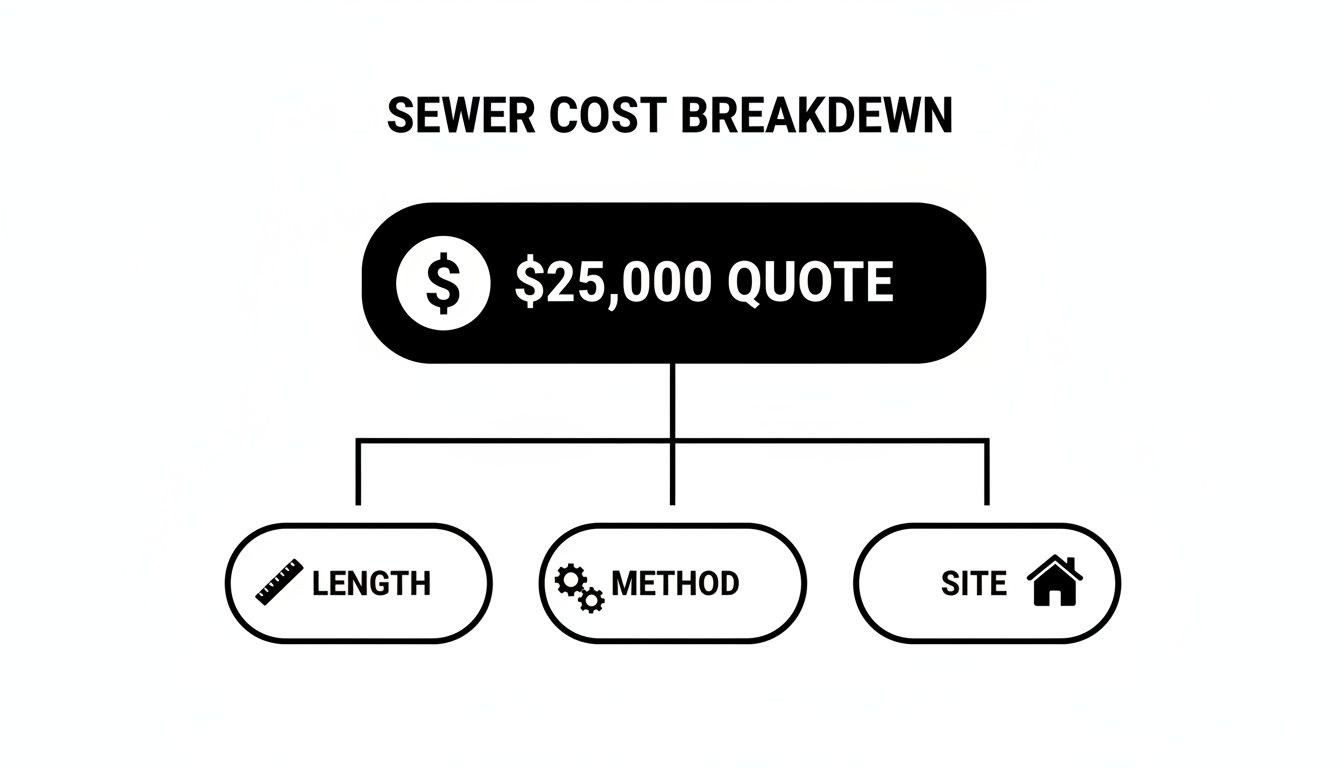
As you can see, the final price is based on the size of the project, the method we choose, and any challenges your property has. A long, deep pipe that needs a trenchless replacement under a busy street is a much bigger job than a simple installation in an open backyard.
The “Invisible” Costs That Protect Your Property
These "soft costs" are often missed, but they are very important for a successful project. They hold the whole thing together.
Your quote includes important items like:
- Permitting Fees: Paying the city or county for permission to do the work.
- Inspections: Covering the cost for officials to approve the work.
- Utility Locates: The "call before you dig" service that marks other underground lines.
- Surface Restoration: Putting your lawn, driveway, or sidewalk back the way it was.
Even with advanced trenchless systems, we still have to dig access pits. Sometimes we need special gear for very long or deep pipes. These are all necessary parts of a safe and lasting installation.
At Coastal Pipeline Inc., we lay it all out for you. Our quotes are transparent and clearly explain what every dollar covers. We’re NASSCO-certified and have the right equipment for both trenchless and traditional jobs. That means we recommend the best solution for your property, not just the one we happen to have. You can learn more about the technical side by reading our guide on how to install sewer lines.
If you're in Monterey, Santa Cruz, or San Benito County, our team can personally walk you through your project costs, the local permitting process, and the full restoration plan. Let us give you a complete breakdown before you make a decision.
How Trenchless Methods Impact Your Total Project Cost
When you get a high quote for a sewer replacement, one of the biggest reasons is the method the contractor plans to use. Think of it this way: traditional digging is like "open-heart surgery" for your yard. Modern trenchless solutions are more like minimally invasive surgery. One is messy and takes a long time for your property to recover. The other is faster and keeps your yard intact.
A quote near $25,000 often means a trenchless solution is being considered. While that number might seem high at first, this method often saves property owners money and stress in the long run. By not digging a long trench, you avoid the high cost of rebuilding driveways, patios, and landscaping.
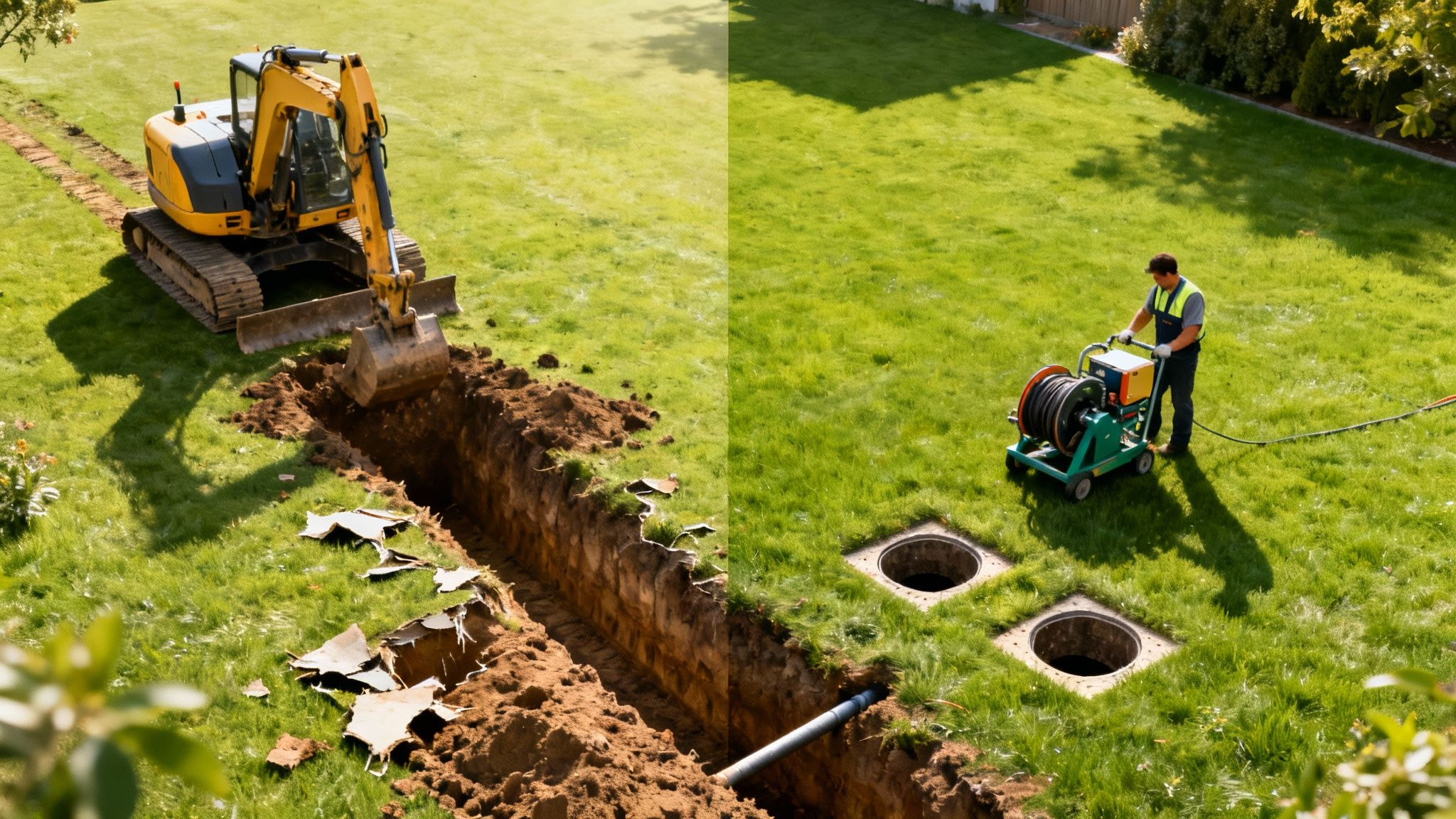
Comparing Upfront Costs To Total Project Value
To be clear, trenchless methods often have a higher direct cost per foot. A traditional dig-and-replace job might cost $50 to $250 per foot for the pipe work. In contrast, modern methods like pipe bursting or Cured-In-Place Pipe (CIPP) lining typically cost $80 to $200 per foot. The special equipment and skilled workers needed for these jobs are why they cost more.
But comparing only the per-foot costs doesn't tell the whole story. The real difference is in the hidden costs that come with traditional digging. That lower price to dig up the old pipe doesn't include the money needed to put your property back together.
The total value of a trenchless project becomes clear when you add up the restoration costs you avoid. A cheaper trenching estimate can quickly become more expensive once you factor in thousands for new concrete, asphalt, and professional landscaping.
To show this, let's break down the total project costs for a pretend 100-foot sewer replacement.
Cost Comparison: Trenchless vs. Traditional Excavation
| Cost Factor | Traditional Excavation | Trenchless Replacement (Pipe Bursting/Lining) |
|---|---|---|
| Direct Sewer Work (100 ft @ $150/ft) | $15,000 | $17,500 |
| Driveway/Walkway Removal & Repair | $5,000 | $0 (Avoided) |
| Landscaping & Sod Replacement | $3,500 | $500 (Minimal restoration at access points) |
| Permit & Inspection Fees | $1,000 | $1,000 |
| Project Duration & Disruption | 3-5 days of heavy machinery, noise, and mess | 1-2 days with minimal surface disruption |
| Total Estimated Project Cost | $24,500 | $19,000 |
As you can see, once you include the cost of fixing your property, the "more expensive" trenchless option can actually save you thousands.
Why A Higher Quote Can Be The Smarter Financial Choice
This is why a $25,000 trenchless quote can be a much better deal than a cheaper digging estimate. Imagine your sewer line runs under your custom patio and a beautiful, 50-year-old oak tree. Digging would destroy both. The cost to rebuild the patio and the loss of a mature tree could easily add up to more than $10,000.
Trenchless methods, on the other hand, only need small access points at each end of the line. Your patio, your tree, and your peace of mind are safe. To learn more about how these methods work, check out our guide on the trenchless sewer line repair cost. By protecting your property's value, the higher quote often gives you a much better return on your investment.
Five Factors That Can Push Your Sewer Replacement Cost Higher
Seeing a $25,000 quote for a sewer line replacement can be a shock. But a number that high usually means you're not dealing with a simple fix. It’s a major project with some serious challenges.
When a price is on the high side, it's almost always because one or more of these five things are involved. Let's break them down so you can see where the money is going.
1. Pipe Length and Depth
This one is simple: the longer and deeper the pipe, the bigger the bill. A longer line needs more pipe, more hours to install, and bigger machines to do the job.
Depth adds another layer of cost. When you dig deep trenches, you can't just drop a pipe in. You have to support the walls to prevent a cave-in, which is a big safety risk. That support takes time and special equipment, adding to the cost.
You can see this in industry prices. A line under 50 feet might cost between $2,750 and $12,500. But stretch that past 100 feet, and the price can easily jump into the $5,500 to $25,000 range. For more on how these costs add up, check out the analysis from This Old House.
2. Site Accessibility and Obstacles
Where your sewer line is buried has a huge impact on the final cost. A pipe running through an open yard is one thing. A pipe buried under a concrete driveway, a large tree, a custom patio, or the foundation of your house is a different story.
Each of those obstacles has to be carefully worked around. That means slower work, special equipment for cutting concrete, and sometimes digging by hand. All of that drives up the cost. It gets even harder if other utilities like gas, water, or fiber optic lines are in the way. Work has to slow down to avoid an accident. That’s why knowing how to locate underground utilities is the first step for any good contractor.
3. Severity of the Damage
The condition of the old pipe is a big part of the price. A line with a few small cracks is a much cheaper problem to solve than one that has completely collapsed or is sagging and collecting waste.
- Minor Damage: Sometimes, this can be fixed with a less invasive repair or by lining a short section of the pipe.
- Major Collapse: This is a big problem. It means a full replacement is needed and often requires more digging or complex methods just to clear out the old, broken pipe.
A fully collapsed line is the worst-case scenario. You're not just replacing a pipe; you're dealing with a complicated removal. The old line has to be taken out or crushed underground, which adds a lot of labor and equipment time to the job.
4. Choice of Materials
Not all pipes are the same. The material used for the new line will affect your quote. Standard PVC is a good, affordable choice for many jobs. But some situations need stronger, more expensive materials like High-Density Polyethylene (HDPE).
HDPE is often used for trenchless jobs because its sections are melted together, creating one long, seamless pipe. No joints means no weak spots for roots to get in. It costs more upfront, but it's very durable and a smart investment.
5. Local Regulations and Labor Rates
Finally, where you live matters. Labor rates, permit costs, and city rules can be very different from one place to another.
Here on California's Central Coast, for example, the cost of doing business is higher. We have strict local codes, higher wages for skilled workers, and specific rules for getting rid of old materials. These local factors are part of the quote, which is why a job in Monterey or Santa Cruz will cost more than the same job in another part of the country.
How to Evaluate Your Quote and Avoid Overpaying
When a big estimate shows up, it's easy to feel sticker shock. So, how do you know if $25,000 is too much for a sewer line replacement? The key is to look beyond the total price and become an informed buyer. A good contractor won't just give you a number; they'll explain how they got there and will be happy to answer your questions.
Your first step is to ask for a detailed, line-item cost breakdown. This will show you every major cost, from the length and depth of the pipe to city permit fees and whether they need to work at night or on weekends.

Your Checklist for an Informed Decision
Once you have the cost breakdown, it's time to ask some questions. Asking the right questions can save you money and make sure you get a lasting solution.
- Verify Credentials: First, are they licensed and insured? This is a basic but important question. Also, ask about special certifications, like being NASSCO certified, which is the top standard in our industry.
- Question the Method: Ask them to explain why they chose a certain replacement method for your property. Is pipe bursting the best option, or is digging a trench necessary? Their answer should be based on your home's needs, not just the equipment they own.
- Clarify Restoration: The words "surface restoration" can mean different things. Does it mean they'll plant new grass? Repave the driveway they cut? Or just push the dirt back in the hole? Get the details in writing.
- Compare Long-Term Costs: Also, ask yourself: what’s the cost of not doing this project? A one-time replacement cost might seem high, but it's often less than the ongoing costs of dealing with backups, emergency calls, and potential water damage.
The most common mistake is assuming the cost only covers the pipe. In reality, a comprehensive quote includes permits, utility locates, inspections, traffic plans, and full surface restoration—all essential for a safe and compliant job.
Finding a Partner You Can Trust
At Coastal Pipeline Inc., we believe an informed customer is our best customer. We provide transparent, no-surprise quotes that break down every part of the job so you know exactly where your money is going. As a NASSCO-certified team, we can handle both trenchless and traditional methods. This means we recommend what’s truly best for your property, not just what’s easy for us.
If you're in Monterey, Santa Cruz, or San Benito County, let us give you a clear, honest breakdown. We'll walk you through the project costs, the local permitting process, and our restoration plan, step by step. Contact us before you make a decision—we’re here to help you make the right choice.
Your Partner for Sewer Projects on the Central Coast
Let's be honest—looking at a big quote for a sewer line replacement is stressful. It's easy to feel overwhelmed, especially when the price seems high. What you really need is a contractor who does more than just give you a price. You need a partner who can explain exactly where every dollar is going. The goal is to feel sure that the price is for a permanent, high-quality solution.
At Coastal Pipeline Inc., that's how we work with property owners on California's Central Coast. We know a $25,000 price tag needs to be explained. That’s why our quotes are clear and show a complete breakdown of every cost—from permits and inspections to the materials and final restoration work.
The Right Method for the Right Job
One of the biggest worries homeowners have is being sold a solution that isn't right for them. It happens. Some contractors will push whatever method—trenchless or traditional—matches the equipment they own, not what your property actually needs. That approach doesn't put you first.
We have the skills and equipment to handle both trenchless and traditional sewer replacements. This lets us look at your site, pipe depth, and property layout, then recommend the method that is the most effective and affordable for you. Our priority is the best long-term result for your property, not just the easiest job for our crew.
As a NASSCO-certified team, we are held to the highest industry standards for pipeline work. This certification is your proof that our work is accurate, our methods are proven, and our final product is built to last. It’s peace of mind that your investment is a good one.
Transparent Quoting for Monterey and Santa Cruz Counties
If your property is in Monterey, Santa Cruz, or San Benito County, think of Coastal Pipeline Inc. as your local expert for underground utility work. We provide transparent, no-surprise quotes that clearly detail what’s included in our sewer line services and installations. Because we’re NASSCO-certified and equipped for both types of jobs, you can trust our recommendation is what's best for your site.
Get in touch with us today. Our team will personally walk you through your project costs, the local permitting process, and a detailed plan for restoring your property, step by step. Let us give you the clarity and confidence you need to move forward.
Got Questions? We Have Answers
Even with a detailed breakdown, it's normal to have a few more questions. Let's answer some of the most common ones we hear from property owners.
Does Homeowners Insurance Cover Sewer Line Replacement?
This is often the first question people ask, and the answer is… it depends. Most standard insurance policies won't cover a replacement if the problem is from normal wear and tear, old age, or tree roots. They see that as a maintenance issue.
However, if the damage is from a sudden and accidental event, you might be covered. A major pipe burst is often what leads to a replacement. Checking your policy to see Does homeowners insurance cover burst pipes? is a smart first step. It's always a good idea to talk to your insurance agent. You might even be able to add extra coverage for underground utility lines.
How Long Does a New Sewer Line Last?
The good news is that a modern sewer line is a long-term investment. How long it lasts really depends on the material. Today's common materials, like PVC or HDPE, are very durable. When installed correctly, they can easily last 50 to 100 years.
Unlike old clay or cast iron pipes that often cracked or got invaded by roots, these new plastics are very tough. They resist corrosion and roots, which have always been the main causes of sewer line failures. A professional installation makes sure your new system will work well for decades.
Why Is a Camera Inspection So Important Before a Quote?
Think of it this way: you wouldn't want a surgeon to operate without an X-ray, right? A camera inspection is like that for plumbing. It is absolutely needed to get an accurate, honest quote. Without one, any price is just a guess.
Sending a special camera down the line lets a professional see exactly what's going on—the location, the cause, and how bad the damage is. This is the only way to know for sure if you need a full replacement or if a much cheaper spot repair will work. It removes the guesswork and protects you from surprises after the work has started.
At Coastal Pipeline Inc., we believe in being open and honest so you feel confident in your decisions. We provide clear, detailed quotes with no hidden surprises. If you're in Monterey, Santa Cruz, or San Benito County and need an honest look at your sewer line, give us a call or visit us at https://coastalpipelineinc.com to get started.