
Beneath our cities and towns lies a hidden world we rarely think about but rely on every day: our drainage infrastructure. This network of pipes, culverts, and basins is silently getting older. For many communities, it’s reaching a breaking point. Taking a hard look at why aging drainage infrastructure needs urgent upgrades isn’t just a good idea—it’s essential for keeping our communities safe and financially sound.
The Hidden Crisis Beneath Our Cities
Think of your city’s storm drain system like the plumbing in an old house. For decades, it did its job, channeling water away without a fuss. But after years of use and not much upkeep, the pipes start to crack and get clogged. Then one day, a huge storm rolls in—way bigger than what the house was built for—and the old pipes just can't handle it. The basement floods, causing thousands in damage.
That’s exactly what’s happening under our feet, but on a much larger scale. Our communities are running on drainage systems designed for weather and populations from fifty years ago. Today, these old systems face new challenges they were never meant to handle.
A Problem Decades in the Making
Many of our storm drains are made from materials like reinforced concrete pipe (RCP) or undersized PVC. These were standard for their time, but nothing lasts forever. Years of putting off maintenance have turned small cracks into major breaks.
This slow decay has created a huge, unseen risk. In Monterey and Santa Cruz counties, over 58% of local municipalities have reported stormwater system backlogs exceeding five years. These delays increase the risk of a culvert collapse or basin overflow near roads and utility lines. It’s a story playing out across the country, as countless utility systems are nearing the end of their useful life. You can learn more in our guide on how aging sewer, water, and gas lines are driving a construction boom.
Extreme Weather is the New Normal
Our changing climate is making things worse. Heavier rainfall is overwhelming these old systems, and it's happening more often.
During the 2024–2025 wet season, stormwater runoff in coastal California surged 32% above historical averages. Existing storm drains—especially older RCP and undersized PVC lines—can’t manage these high-volume flows. This leads to road washouts and property flooding.
State climate forecasts predict a 27% increase in “severe precipitation events” over the next decade in coastal regions. Our drainage infrastructure was never designed to handle that much water. As these intense storms become more common, the need to upgrade our systems grows with every forecast. The time for quick fixes is over. We need to overhaul our systems to protect our communities from what’s coming.
Why Outdated Drainage Systems Are Overwhelmed
Many of our drainage systems are ticking time bombs. They were installed decades ago for a world with different weather and less development. They simply weren't designed to handle today's pressures, which is causing failures right under our feet.
The core of the problem is a one-two punch: increased rainfall and deferred maintenance. These two factors turn normal wear and tear into serious public safety risks. A pipe designed in the 1970s was never meant to handle the water from a modern superstorm.
This concept map shows the dangerous cycle we're trapped in, where neglect, extreme weather, and system failure feed off each other.
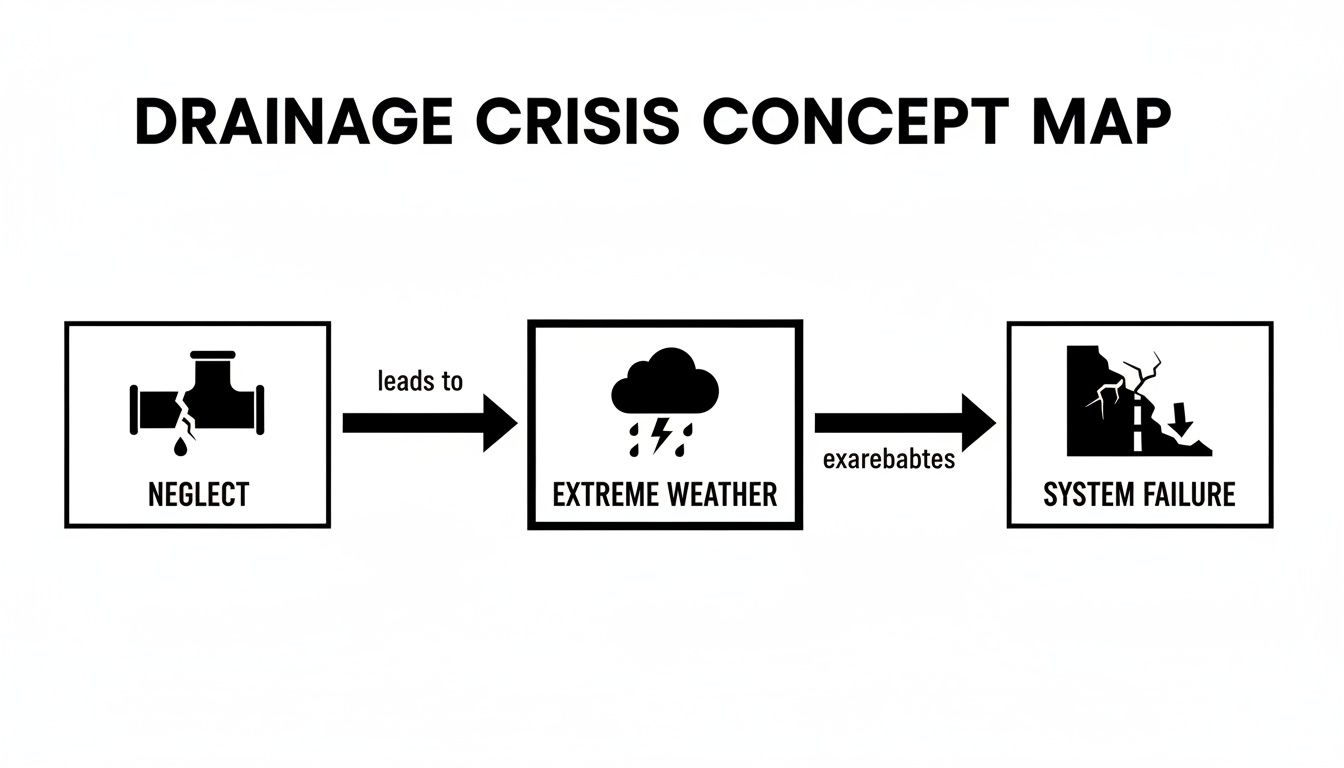
As you can see, the path from a small, ignored crack in a pipe to a major road collapse is shorter than most people realize—especially when an intense storm hits.
Increased Rainfall Overwhelms Old Designs
Today’s weather patterns are pushing old infrastructure past its breaking point. Systems that once handled seasonal rain are now being hit by sudden, heavy downpours.
For instance, stormwater runoff in coastal California surged 32% above historical averages during the 2024–2025 wet season. This massive amount of water is too much for older systems with outdated Reinforced Concrete Pipe (RCP) or small PVC lines.
When these pipes are overwhelmed, the results are immediate and severe:
- Road Washouts: Water with nowhere to go washes away the ground supporting our roads, leading to dangerous sinkholes.
- Property Flooding: Backed-up systems force stormwater into buildings and neighborhoods, causing costly damage.
- System Backups: The high volume can cause backups that affect entire business districts.
This isn't just an inconvenience; it's a direct threat to public safety and the economy. Let's compare old and new systems to see the difference.
Comparing Old vs Modern Stormwater Systems
The difference between a drainage system built 50 years ago and a modern one is night and day. Materials, design, and ability to handle climate change have all improved greatly.
| Feature | Aging Infrastructure (RCP, Undersized PVC) | Modern Upgraded Infrastructure (HDPE) |
|---|---|---|
| Capacity | Often too small for modern rainfall. | Designed for current and future weather. |
| Material Durability | Prone to cracking, rust, and joint failure. | Resists rust, damage, and chemicals. |
| Joint Integrity | Gasketed or mortared joints often leak. | Heat-fused joints create a seamless, leak-proof pipe. |
| Flow Efficiency | Rough surfaces (like concrete) slow down water. | Smooth interior allows for faster water flow. |
| Climate Resilience | Can become brittle and fail in extreme weather. | Flexible and durable, can handle ground movement. |
Modernizing with materials like High-Density Polyethylene (HDPE) isn't just a repair. It's an upgrade that prepares infrastructure for the future.
The Domino Effect of Deferred Maintenance
Putting off repairs is like ignoring a small leak in your roof. At first, it's just a drip. But over time, that drip rots the wood and leads to an expensive failure. The same thing happens with our storm drains.
In Monterey and Santa Cruz counties, more than 58% of local municipalities have stormwater system maintenance backlogs of over five years. This delay lets small problems grow into major hazards.
Deferred maintenance is creating costly public safety risks. A single cracked culvert, left unrepaired, can eventually collapse under a roadway. These delays heighten the risk of culvert collapse, basin overflow, and erosion near roadways and utility corridors.
The impact of this neglect is often hidden until it's too late. A crumbling pipe underground doesn't seem urgent until it causes the pavement above to fail. You can learn more about how subsurface utility conditions impact pavement performance in our related article.
At Coastal Pipeline, our infrastructure-first approach addresses these hidden weaknesses. Unlike others who focus only on surface restoration, we provide full-scale underground storm drain upgrades. This includes HDPE pipe replacements, erosion control riprap, and hydrology-based layout design. This approach ensures both flow efficiency and long-term durability.
The Escalating Costs of Inaction
When it comes to aging drainage infrastructure, the most expensive choice is often to do nothing. Putting off upgrades guarantees higher costs, bigger risks, and worse problems when things finally break. That "deferred maintenance" budget item becomes very real when a sinkhole swallows a road or floodwater swamps a business.
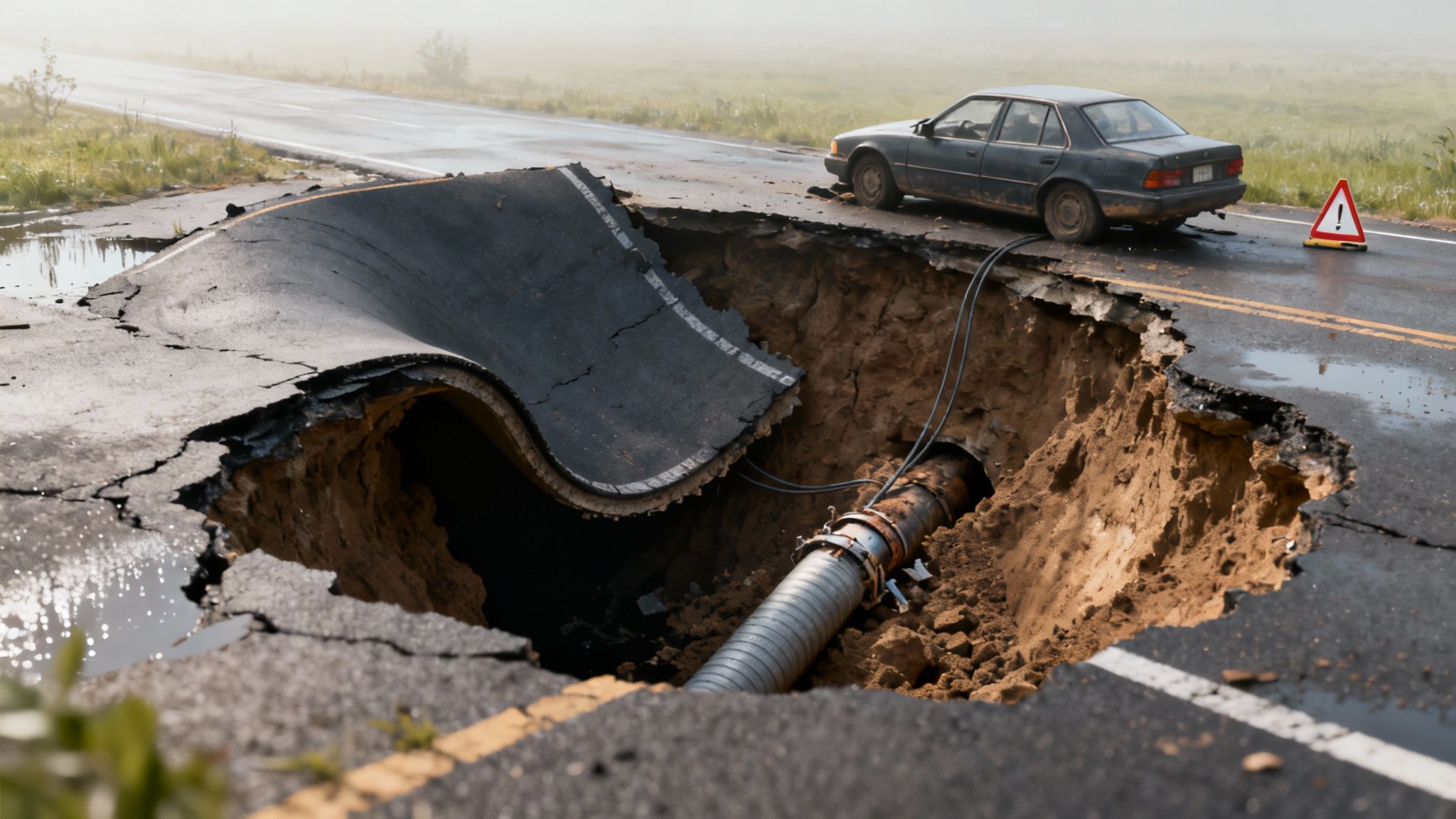
Delaying needed upgrades creates a dangerous cycle where small problems snowball into emergencies. Once you understand the true price of doing nothing—from emergency repairs to economic damage—it’s clear that planned investment is the only smart path forward.
The High Price of Emergency Repairs
A planned infrastructure upgrade is a controlled, budgeted project. An emergency failure is the opposite: chaotic, unpredictable, and very expensive. When a major culvert collapses or a storm drain fails during a heavy rain, the costs multiply instantly.
Municipalities and property owners are then forced to pay extra for:
- Emergency mobilization of crews and heavy equipment.
- Urgent sourcing of materials, often at a higher price.
- Overtime labor to restore service and make the area safe.
These emergency jobs can easily cost three to five times more than a scheduled project. The cost of an unexpected failure is much larger than the investment in a proactive upgrade.
Public Safety Risks and Hidden Liabilities
Beyond the repair bill, doing nothing creates serious public safety hazards and financial liabilities. On the Central Coast, those risks are becoming more real.
In fact, more than 58% of local municipalities in Monterey and Santa Cruz counties have reported stormwater system backlogs exceeding five years. A recent report showed how these delays increase the risk of culvert collapse, basin overflow, and erosion right next to important roads and utility lines.
A single neglected pipe can lead to a sinkhole that shuts down a key road for weeks. This hurts local business and delays emergency services. When drainage systems fail, they can also wash away soil supporting other utilities, causing water main breaks and communication outages.
Events like these expose property owners and public agencies to huge liability. Damage to other properties, claims for business interruption, and potential injuries all add to the staggering cost of doing nothing. You can learn more by reading our guide on what Central Coast property owners should know this winter.
Long-Term Economic Damage
The effects of failing infrastructure don't end when the emergency crews leave. Communities with unreliable drainage systems suffer long-term economic harm. Frequent flooding can lower property values, scare away new investment, and drive up insurance costs for everyone.
Justifying a major expense requires understanding the financial benefits. Thankfully, there are great resources to help assess the return on investment for infrastructure projects. This makes it easier to show why proactive upgrades are a smart financial move. When roads are unreliable and properties are at risk, a community's economic health suffers. Tackling why aging drainage infrastructure needs urgent upgrades isn't just about preventing floods—it's about protecting a stable and prosperous future.
How New Regulations Impact Your Property
It’s not just weather that's straining our drainage systems. Stricter government regulations are also pushing property owners and public works managers to act. State and local agencies are updating stormwater rules to face new climate realities. What was "up to code" a few years ago might now leave your property non-compliant and at risk.
This isn't just red tape. It's a response to seeing outdated systems fail again and again. When undersized pipes cause flooding, regulators tighten the standards to protect public safety and the environment. For property owners, ignoring these new rules is a financial gamble that can stop a project in its tracks.
The New Baseline for Stormwater Capacity
The days of designing drainage for a gentle rain shower are over. New regulations are built on a simple truth: our infrastructure must be ready for more intense storms.
For instance, a major update is set to take effect. As of July 2025, all new commercial or industrial development over 5,000 sq. ft. must meet revised regional stormwater capacity and discharge standards. Many property owners are unaware that their existing systems no longer meet code—creating liability and permitting delays.
This regulatory pressure means that aging drainage infrastructure needs urgent upgrades, not just to work better, but to follow the law.
The takeaway is that a property’s drainage system is no longer just a functional part of the site. It's now a regulated utility that must meet changing standards. Failing to keep up can lead to fines, stop-work orders, or rejected permits for future work.
Are Your Systems Still Compliant?
It’s a common mistake to think, "My system passed inspection when it was built, so I'm good, right?" Unfortunately, that’s not always true. New rules often aren't grandfathered in, especially when you make changes to your property.
Planning to expand your building? Repaving a large parking lot? Any big project will likely require you to bring your entire stormwater system up to the latest code. This creates a hidden risk for many commercial sites. A system that is decades old is almost certainly not equipped for today’s strict requirements. To learn more, see our guide on how to determine if your stormwater systems are up to code.
The only way to avoid a surprise is to be proactive. An expert evaluation can show where your system falls short and provide a clear plan for upgrades. This turns a potential problem into a manageable plan, ensuring your property remains a valuable, compliant asset.
A Modern Game Plan for Infrastructure Upgrades
Relying on old drainage in an age of intense weather is like using a horse and buggy in a car race. The old ways just don’t work anymore. The real solution isn't patching cracks; it’s a modern, ground-up strategy that rebuilds our systems to last. This means making our infrastructure smarter, stronger, and ready for the future.
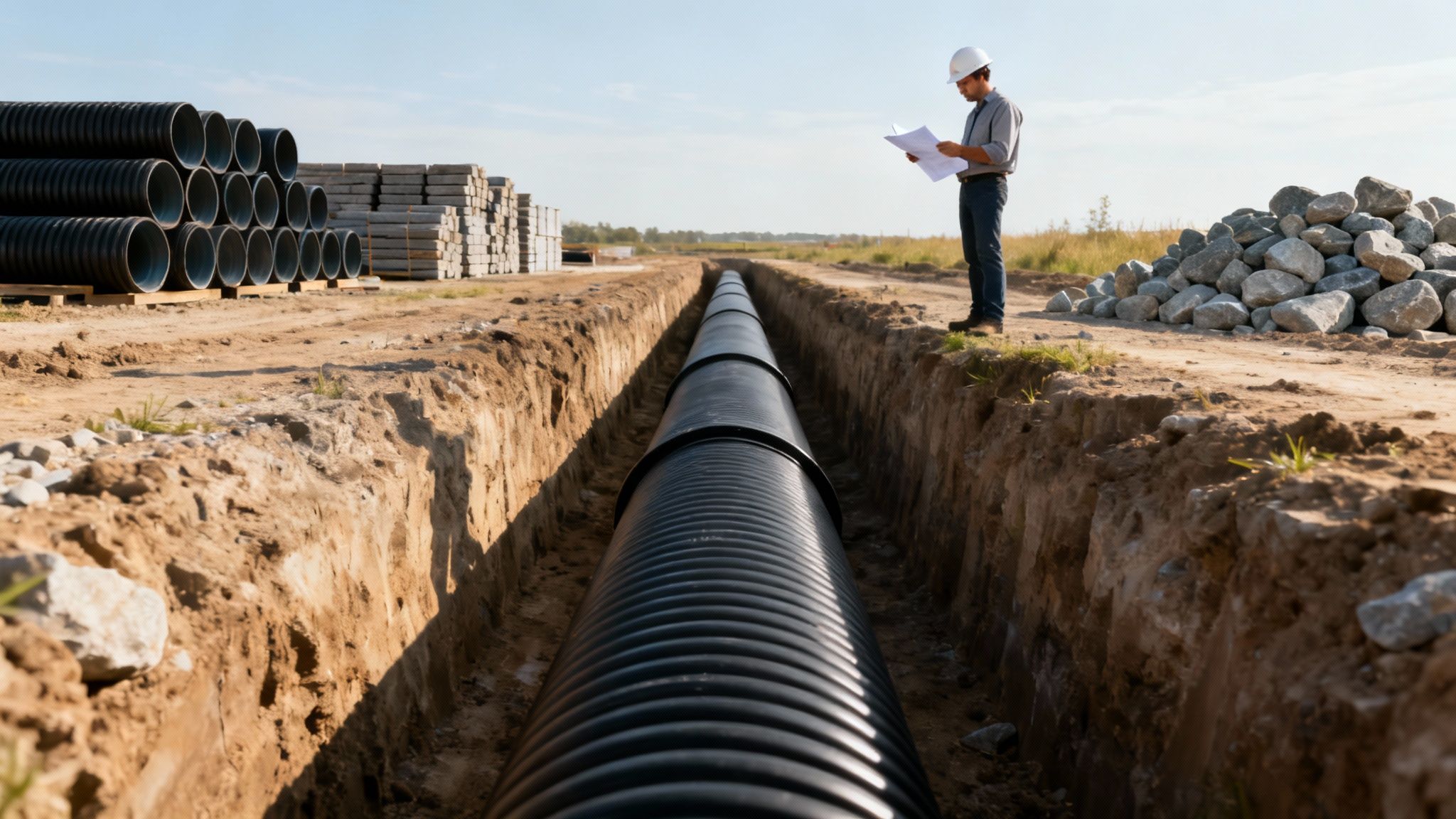
Unlike temporary fixes, this complete approach gets to the root of the problem—the hidden parts underground. It’s about engineering a system that can handle tomorrow's storms, not just yesterday's.
Built to Last: Prioritizing Strength and Durability
A modern upgrade begins with better materials. Old concrete and metal pipes are a ticking time bomb of cracks and rust. Today’s options are a huge leap forward. High-Density Polyethylene (HDPE) pipe is a game-changer, built to last 50 to 100 years.
HDPE is the new standard for good reasons:
- Leak-Proof Joints: Instead of leaky gaskets, HDPE pipes are heat-fused into one seamless line. This removes the weak points found in older systems.
- Corrosion Resistance: It's immune to rust and chemical damage, so its flow capacity stays the same for decades.
- Flexibility: This material can bend with ground movement, making it more resilient during soil shifts.
At Coastal Pipeline, we put these full-scale underground upgrades first. We replace failing systems with high-performance HDPE to ensure good water flow and a strong structure. This is a key part of effective storm water drainage system design.
Designing for the Climate of Tomorrow, Not Yesterday
A modern drainage system isn't just about replacing a pipe with a new one of the same size. It’s engineered based on hydrology—the science of how water moves. We use current and future rainfall data to design a system that can handle the intense storms that are now common.
This forward-thinking is vital because our climate is changing. In fact, state forecasts predict a 27% increase in “severe precipitation events” over the next decade in coastal regions. Upgrading systems to handle this new reality is a critical investment that saves money and protects communities. You can read the full climate impact forecast for a closer look at the data.
An infrastructure-first approach means building for the climate we will have, not the one we used to have. It uses hydrology-based layouts and strong erosion control measures to make sure the entire system remains stable and effective.
Protecting the Whole Picture: Comprehensive Site Protection
A modern upgrade is about more than just pipes. Good stormwater management also requires serious erosion control to protect the surrounding land and infrastructure. This is where measures like riprap—layers of rock and stone—become essential.
Riprap is used to protect areas that are at risk of being washed away by heavy water flows. You'll see it protecting:
- Drainage channels and ditches
- Culvert openings
- Bridge supports and steep slopes
By stopping soil erosion, these measures prevent roads, utility lines, and building foundations from being weakened during a major storm. It’s a complete view that ensures every part works together. Combining this with regular maintenance is key to making your systems last longer and avoiding expensive repairs. Check out these Top 10 Preventive Maintenance Best Practices to help protect your infrastructure. This complete approach is the only way to build a resilient future.
Partnering for a Resilient Future
Knowing your drainage infrastructure needs help is one thing; actually fixing the problem is another. A patch on a cracked pipe or a new layer of asphalt over a damaged lot is just a band-aid. It doesn’t fix the real issues underground. For a solution that lasts, you need a partner who understands the whole picture, from local water patterns and regulations to the latest construction materials.
This is where an "infrastructure-first" approach proves its value. Some contractors just focus on making the surface look good. A complete strategy gets to the root cause of the failure. A specialist will handle the full range of underground storm drain upgrades, from replacing old pipes with durable HDPE to installing heavy-duty riprap for erosion control. They design the layout based on how water actually flows, ensuring you get both efficiency now and durability for the long term. You can see this comprehensive approach by exploring the services offered by Coastal Pipeline.
Your Local Infrastructure Experts
If you manage property in Monterey, Santa Cruz, or San Benito Counties, the pressure to upgrade can feel huge. We are all dealing with a new reality: more extreme weather and stricter rules. In fact, state climate forecasts predict a 27% increase in “severe precipitation events” over the next decade. This makes proactive upgrades a necessity.
The longer you put off maintenance, the higher the risk of a major failure. This can bring massive emergency repair bills and steep fines. Investing in a modern, compliant system is the best way to protect your assets and keep people safe.
Hoping for the best is no longer a good strategy. Whether you're responsible for a commercial property, a public road, or a private development, that drainage system is a critical asset. A professional assessment is the only way to find hidden weaknesses and get a clear plan to bring your infrastructure up to today’s standards.
Working with a knowledgeable local partner ensures you can meet the tough water flow and code requirements of today. This will make your property ready for whatever comes next.
Common Questions About Drainage Upgrades
Realizing your drainage infrastructure is old is one thing. Figuring out what to do next is another. You likely have questions about the process, what to watch for, and if the investment is really needed. Let's answer some of the most common ones.
How Can I Tell If My Drainage System Is Failing?
Some warning signs are obvious. If you often see standing water, parking lots that drain slowly, or erosion around drain outlets, you have a problem. You might also see dips or small sinkholes in your asphalt.
But the real trouble is often hidden underground. Hairline cracks, rusted joints, and the risk of a pipe collapse are issues that worry property managers.
The only way to know for sure what’s happening is to get a professional video inspection. As a general rule, if your property is decades old and the drainage system has never been updated, it’s probably living on borrowed time—especially with today's intense rainfall.
Remember: stormwater runoff in coastal California jumped 32% above historical averages in just one recent wet season. Older systems were not built to handle that kind of pressure.
What Does a Modern Drainage Upgrade Actually Involve?
A real upgrade isn't just swapping out an old pipe. It starts with a smart analysis to figure out how much water your property will need to handle for the next 30 years, not just in the past.
From there, a typical project includes a few key steps:
- Replacing outdated materials: Rusted metal and crumbling concrete pipes are replaced with modern, durable HDPE pipes that last for generations.
- Increasing pipe sizes: We often use larger pipes to give the system more capacity so it won't get overwhelmed during heavy downpours.
- Installing modern erosion control: This could involve placing riprap (rock armor) to keep the surrounding soil from washing away.
A good contractor handles the whole process—from design and permits to excavation and restoring your site. The goal is to leave you with a system that's built right and fully up to code.
Is Proactively Upgrading Really Worth The Cost?
Absolutely. A planned, proactive upgrade is a big investment, but it costs far less than an emergency failure. A sudden system collapse can cause major property damage, shut down a business for weeks, and lead to huge fines for not meeting environmental rules.
When you upgrade on your own terms, you can budget for it and schedule the work to cause the least disruption. A typical commercial project might take a few weeks, but that's a small price to pay to protect your property from a disaster. And with state climate forecasts predicting a 27% increase in severe storms, waiting is no longer an option.
Whether you manage a commercial site, public road, or private development, Coastal Pipeline can assess your stormwater infrastructure and recommend upgrade options that meet today’s hydrology and code standards in Monterey, Santa Cruz, and San Benito Counties. Learn more about how we can help you protect your property.