
A fresh sealcoat or a quick patch can make a parking lot look sharp, but it's often a temporary fix. The real reason asphalt fails isn't what you see on top; it’s what’s happening underneath. Utility-ready asphalt work starts below the surface, and lasting pavement is only as good as the ground it’s built on.
The Problem with Surface-Level Pavement Fixes
Many articles focus on improving curb appeal with a quick sealcoat. They often share tips on seasonal maintenance to protect asphalt from sun and rain. This advice is helpful for homeowners, but it misses the point for commercial properties and public roads. For these, stability, safety, and meeting codes are most important.
Hiding Symptoms Instead of Curing the Cause
A sealcoat is like a fresh coat of paint on a house with a cracked foundation. It looks good for a while, but it does nothing to stop the real problem from getting worse. Cosmetic fixes can mask serious issues hiding a few feet underground.
These quick solutions are temporary bandages. They cover up what you can see, but they don't solve the root causes of failure. The problems will always come back.
What Your Asphalt Is Trying to Tell You
When you see the same cracks, potholes, or sunken spots showing up again and again, your pavement is sending a clear warning. Those surface problems are almost always a direct result of issues happening below.
Common issues like alligator cracking—that web of cracks that looks like reptile skin—or a pothole that won’t stay patched are rarely just about the asphalt. They often point to bigger failures, including:
- Poor Subgrade Compaction: The soil foundation was never packed down correctly. This creates a soft, unstable base that can't support the weight above it.
- Drainage Issues: Water gets trapped and soaks the ground under the pavement. This turns a solid base into mud and weakens everything.
- Failing Utility Trenches: The ground where pipes were installed was not filled in properly. Over time, that poorly packed soil settles, causing the pavement above it to sink, crack, and collapse. You can learn more about how winter rains expose these weak spots in our article on why pothole season demands a utility-smart response.
Surface Symptoms vs. Subsurface Causes
It's easy to get the diagnosis wrong if you're only looking at the surface. This table connects what you see with what's likely happening underground.
| Visible Surface Problem (The Symptom) | Common Subsurface Cause (The Real Problem) |
|---|---|
| Potholes that keep returning | Water gets into the subbase, often from a poorly sealed utility trench, and then freezes or washes away material. |
| Alligator Cracking (spiderweb cracks) | A weak or flexible base can't support traffic loads, causing the asphalt to bend and break. |
| Sunken Areas or Depressions | Improperly packed soil in a utility trench or poor subgrade preparation has settled over time. |
| Long, straight cracks over utility lines | The trench backfill has settled, creating a void that causes the pavement above it to crack under its own weight. |
Seeing these signs means it's time to stop thinking about the surface and start looking at the foundation.
Ignoring these warnings for another quick patch just locks you into an expensive cycle of repairs. The only real solution is to look deeper—literally. For property owners in Monterey, Santa Cruz, and San Benito Counties, Coastal Pipeline Inc. provides paving services that fix the problem from the ground up. If your pavement keeps failing, it’s time for a utility-focused assessment.
How Your Pavement Fails From the Ground Up
To understand why a road or parking lot crumbles, you have to think about how it's built. Every solid pavement system is like a layer cake. Each layer does a specific job. If even one of those layers is weak, the whole structure is at risk. It’s a simple truth we’ve learned from decades in the field: utility-ready asphalt work starts below the surface.
Think about it like building a house. You wouldn’t install nice countertops and floors on a cracked, shifting foundation. The same logic applies to asphalt. A weak foundation guarantees that whatever you build on top of it will fail. This leaves you with an expensive cycle of endless repairs.
The Layers That Make or Break Your Pavement
What you drive on isn't just "asphalt." It’s a carefully designed system that takes the weight of traffic and spreads it safely into the ground. This system has three key parts that must work together.
- The Subgrade: This is the natural soil, the very bottom of the structure. It’s the ground you start with. It must be graded and packed until it's strong and stable enough to hold everything else up.
- The Aggregate Base: On top of the prepared soil sits a layer of crushed stone and gravel. This is the structural backbone of the pavement. It provides strength, stability, and a path for water to drain away.
- The Asphalt: This is the top surface you see and drive on. It’s built to be smooth, tough, and waterproof. But its long-term survival depends completely on the two layers supporting it from below.
This visual breaks down how problems that show up as ugly cracks and potholes on the surface actually begin deep underground.
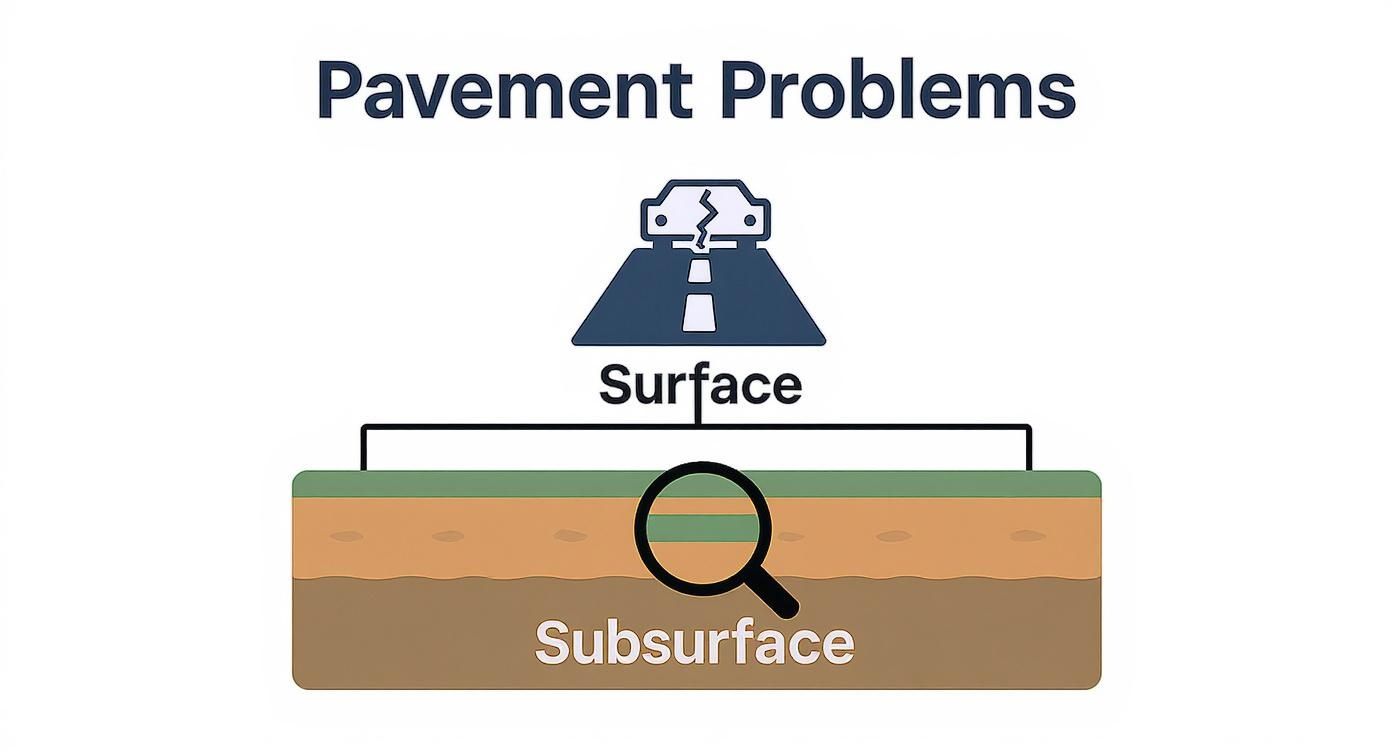
As the infographic shows, just patching the cracked surface is like trimming the dead leaves off a dying tree without checking the roots.
Where Things Really Go Wrong
So where do these underground problems usually start? The most common cause is any area where a trench was dug for underground utilities—like water mains, storm drains, or electrical lines. When a crew digs a trench and then fills it back in, the soil around the new pipe has to be put back and packed in careful, thin layers to get it back to its original strength.
If that step is rushed or done wrong, you've just created a hidden weak spot.
Over time, that poorly packed soil begins to settle under traffic and its own weight. This settling opens up a gap right under the aggregate base, leaving the asphalt with no support. Eventually, the surface sinks, cracks, and collapses into the classic pothole or trench depression we all know.
This is why a quick patch is never a real fix. You're just temporarily filling a hole in the top layer while the unstable ground underneath keeps sinking. For our commercial and municipal clients, these surface-level fixes often fail to meet safety standards or ADA accessibility codes, which can lead to regulatory issues. Truly durable work requires a complete understanding of utility systems construction. After all, another coat of sealer can't fix a failing foundation.
The Integrated Approach to Infrastructure Paving
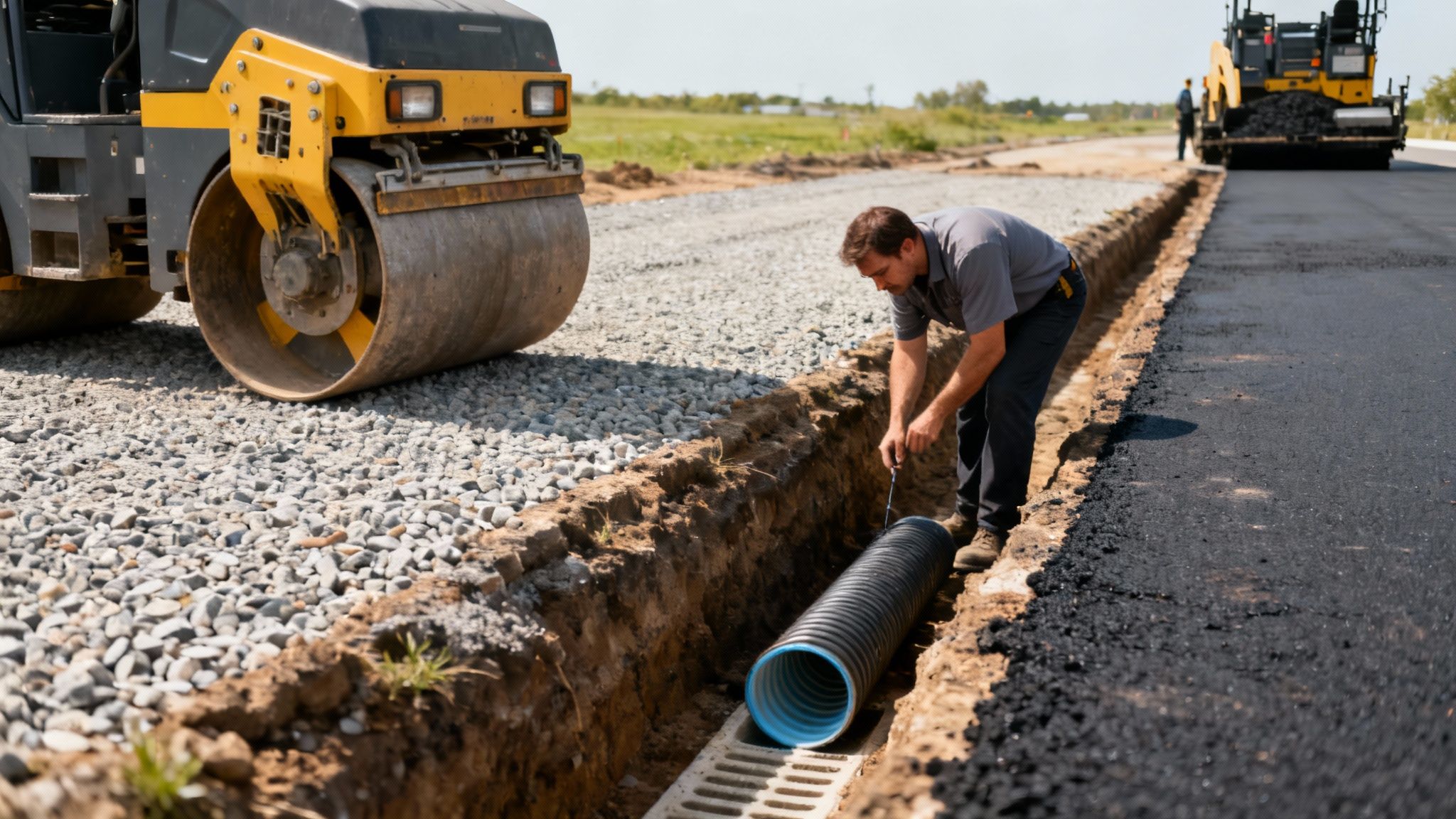
When you see a cracked or sinking patch of asphalt, your first thought might be to just put a new layer on top. But that's like putting a bandage on a broken bone. A long-lasting repair isn't about fixing the surface; it's about understanding that the pavement is the last piece of a much larger puzzle.
A truly professional approach digs deeper. Instead of just patching a problem, we ask why it happened. More often than not, the answer is buried underground. After all, utility-ready asphalt work starts below the surface. A beautiful, smooth finish is worthless if the foundation it sits on is going to fail.
Building Pavement That Lasts
Think of a strong pavement system as a pyramid. The smooth asphalt you drive on is just the very tip. The real strength is the wide, stable base hidden underneath. This means giving the unseen layers just as much attention as the final blacktop.
So, what does that look like?
- Subgrade Stabilization: We start with the natural soil. It has to be properly packed and graded to create a rock-solid platform. This foundation needs to handle heavy pressure without shifting.
- Proper Utility Trench Restoration: Anytime a trench is dug for water, sewer, or storm drain pipes, it creates a potential weak spot. The secret is to backfill that trench in thin, carefully packed layers to prevent it from sinking later.
- Engineered Drainage and Slopes: Water is the number one enemy of pavement. We design the entire system, from the deep subgrade to the final surface, with precise slopes to shed water. This stops moisture from seeping in and turning the base to mush.
This method produces pavement that’s not just durable, but also safe and fully code-compliant. A thorough job even considers factors like environmental vibration monitoring to guarantee long-term stability.
Connecting Underground Work to a Flawless Surface
This is where having the right kind of experience makes a huge difference. Many paving companies only focus on the asphalt. But a contractor who also specializes in underground utilities sees the whole picture. They know how a poorly packed sewer trench will eventually send a crack straight up to the surface.
At Coastal Pipeline Inc., we don't just see a paving project; we see a complete infrastructure system. Our approach combines trench restoration, utility connections, subgrade stabilization, and proper slope grading. Whether it’s a private driveway, city street, or commercial lot, we evaluate the full structural and functional performance of the pavement, not just the surface.
This viewpoint is essential for any property with underground utilities. When your contractor understands both the pipes below and the pavement above, they can build a single system that’s made to last. It’s the only way to break the frustrating cycle of patch jobs and protect your investment.
See our expert approach to grading and paving that builds a foundation for success.
What to Check Before You Repave or Sealcoat
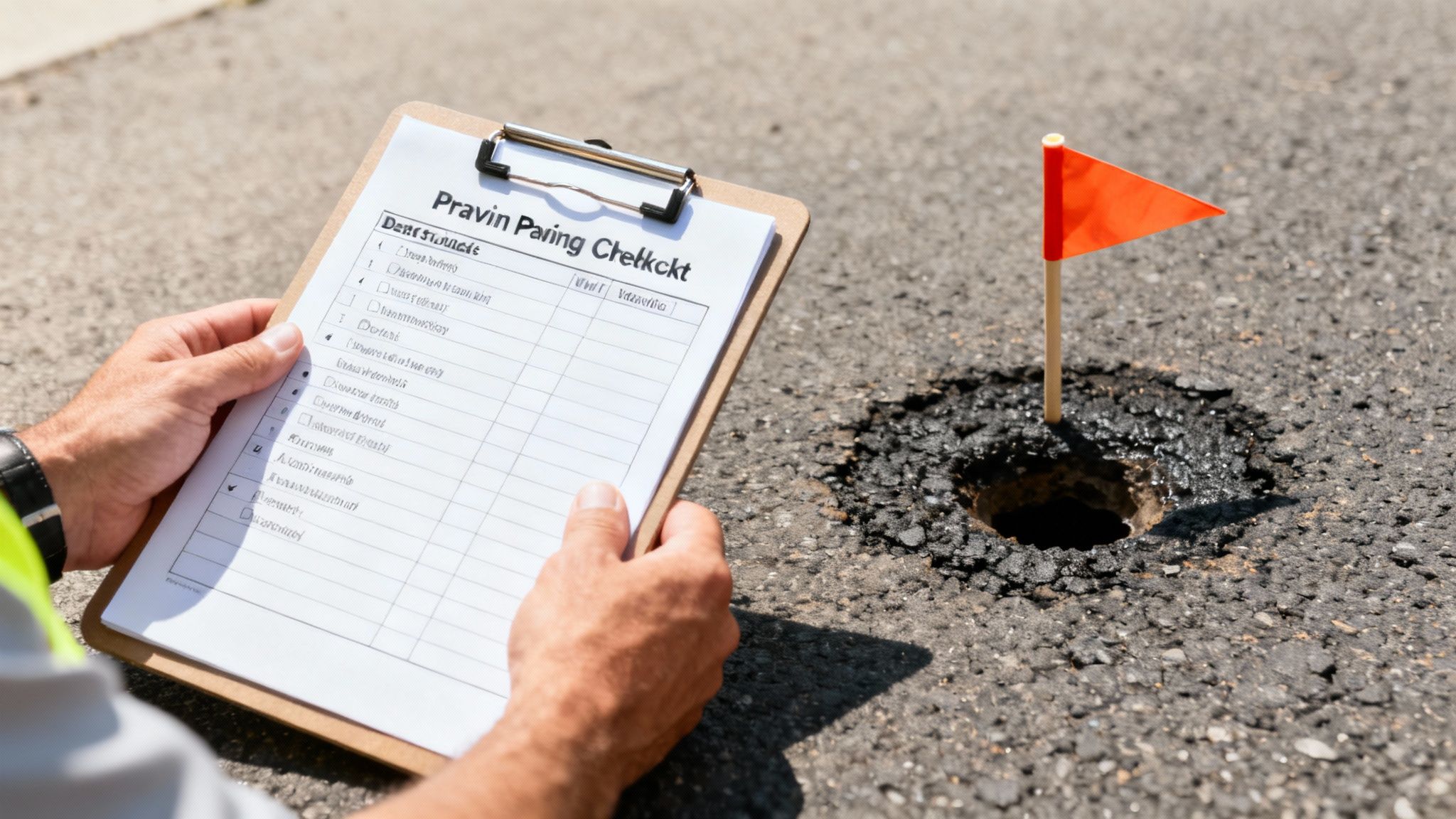
Before you spend money on a new sealcoat or an asphalt overlay, you need to be a detective. A fresh layer of blacktop always looks great for a while, but if you’re just covering up a failing foundation, you’re kicking an expensive can down the road.
Understanding what to look for helps you ask the right questions and demand a solution that actually lasts.
The key is to spot the red flags of a failing subbase. When you walk your property, don’t just look for ugly surface cracks—look for patterns. These signs almost always point to problems that a simple resurfacing job can’t fix, proving that truly utility-ready asphalt work starts below the surface.
A Pre-Paving Inspection Checklist
Use this simple checklist to find warning signs that your pavement problems are more than skin deep. If you answer "yes" to any of these questions, you need a deeper look before starting any work.
- Are there persistent puddles? Does water pool in the same spots for hours or days after it rains? This is a clear sign of low spots caused by a sinking subgrade and poor drainage.
- Do cracks reappear in the same places? If you’ve had cracks filled before only to see them return, the ground underneath is shifting. The problem isn’t the crack itself; it's the unstable base causing it.
- Is there sinking over utility lines? Look for long, straight dips or cracks that follow the path where pipes for water, sewer, or storm drains are buried. This is a classic sign of improper trench backfill.
- Do you see "alligator" cracking? This pattern of connected, blocky cracks looks just like reptile skin. It’s a direct sign that the base layer has failed and can no longer support the weight of traffic.
Questions to Ask a Paving Contractor
Once you’ve spotted potential subbase issues, your conversation with a contractor needs to go beyond the price per square foot. A true professional will be able to answer these questions with confidence.
Before scheduling a sealcoat, property managers and owners should assess whether surface damage is hiding larger problems. If the pavement covers sewer laterals, water mains, or electrical conduit, any settling or cracking may signal deeper failure.
A contractor’s answers will show whether they’re offering a real, long-term solution or just another temporary patch. For those looking for more details on how weather can impact the job, you can find valuable information in our guide to asphalt paving temperature requirements. This knowledge helps you ensure any work is done under the right conditions for success.
Understanding the True Cost of Asphalt Work
When you're looking at bids for pavement repair, it's tempting to go for the lowest number. But in this business, the lowest bid is almost never the best value. Focusing only on the upfront price of a quick surface fix often traps property owners in an expensive cycle of endless repairs.
The real cost of asphalt work isn’t what you pay the contractor today; it’s what you end up paying over the next five, ten, or even twenty years.
A complete, utility-first approach requires a higher initial investment. But it delivers a powerful return by fixing the root causes of failure. This prevents the early cracks, potholes, and sinking that happen with cheap patch jobs. This isn't just about saving money on future fixes—it's about protecting yourself from long-term problems.
The Compounding Cost of Cheap Fixes
Low-bid paving jobs that only fix the surface often start to fail within a year or two. Once that happens, the cycle begins: more patching, more sealcoating, and more money spent on a problem that just keeps getting worse. Each "cheap" fix is a lost cost, while the unstable ground underneath continues to damage your pavement’s foundation.
This approach also brings hidden financial risks:
- Safety Hazards: A crumbling parking lot with potholes and uneven surfaces can cause trip-and-fall incidents, which can lead to expensive claims.
- ADA Non-Compliance: Improper slopes and damaged walking surfaces can violate the Americans with Disabilities Act (ADA), exposing commercial properties to fines.
- Operational Disruptions: Constant repairs mean barricades, closed-off sections, and detours. For a business, that means disrupting customers or tenants.
Investing in Long-Term Pavement Performance
The most cost-effective strategy is to do the job right the first time. That means putting the health of the underground layers first. A properly prepared subgrade and a correctly packed aggregate base create a solid foundation. This allows the top asphalt layer to perform as designed for its full lifespan.
This is especially important in regions where paving demand increases seasonally. Every fall and spring, the demand for paving services goes up. Many competitors focus only on asphalt appearance. Coastal differentiates by combining its underground utility expertise with paving that’s built to last, even over active utility corridors.
An investment in subgrade preparation is an investment in longevity. It's the difference between a pavement that lasts five years and one that can last twenty. By preventing early failures, you eliminate the costs of repetitive repairs and protect your property's value.
Thinking about the full financial picture is crucial. You can learn more about the factors that influence the initial price by exploring our guide on asphalt driveway costs, which has insights that apply to commercial projects as well. In the end, a utility-focused assessment ensures your budget is spent on a permanent solution, not just a temporary illusion.
Your Partner for Pavement That Actually Performs
Are you tired of patching and sealcoating, only to watch the same old cracks and potholes reappear? It’s a common story. A fresh, black topcoat looks great for a while, but that pretty finish doesn't mean much if the ground beneath it is giving way.
This endless loop of temporary fixes doesn't just drain your budget; it misses the real problem. Most pavement failures don't start with the asphalt—they start in the subgrade, deep below the surface. To get utility-ready asphalt that lasts, you have to start the work long before the paver shows up.
Serving Monterey, Santa Cruz, and San Benito Counties, Coastal Pipeline Inc. offers paving services that go deeper—literally. If your driveway, parking lot, or private road has been sealed repeatedly but still fails, it’s time for a utility-focused assessment. The problem probably isn't your asphalt; it’s the unstable ground and poorly compacted utility trenches buried underneath. You don't just need a paving company; you need a true infrastructure partner.
At Coastal Pipeline Inc., our paving services go deeper—literally. We bring our utility-focused expertise to every project, diagnosing the root cause of the failure to deliver a long-term solution, not just another temporary patch.
Let's get it right from the ground up. Contact Coastal for a site visit and recommendations grounded in long-term performance, not just short-lived curb appeal.
Common Questions About Asphalt Pavement Failure
On the surface, new asphalt looks great. But what's happening underneath is what really determines whether it will last. Here are a few common questions we hear from property owners who are tired of watching their pavement fall apart.
How Do I Know if a Crack Is a Real Problem?
A tiny, single hairline crack might not be a major issue, but some patterns are a clear sign that something is seriously wrong. The most well-known is "alligator" cracking.
If you see a web of connected cracks that look like a gator's back, you're looking at a classic sign of base failure. It means the foundation underneath the asphalt has given up.
Pay close attention to any cracks that are wide, deep, or uneven, where one edge is lower than the other. That's a clear signal the ground beneath is shifting. And if you keep patching a crack only to have it return, the root cause is almost certainly in the subgrade, not the asphalt itself.
Why Is My Pavement Sinking Over a Buried Pipe?
This is the classic result of a poor trench backfill. When the original trench was dug for the utility line, the crew that refilled it probably didn't pack the soil correctly.
They likely just pushed the dirt back in. Over time, that loose soil settles under its own weight and the stress of traffic. A gap forms, and the asphalt on top has no choice but to sink and crack. This isn't an asphalt problem—it's a foundation problem, and it’s proof that utility-ready asphalt starts well below the surface.
Is a thicker layer of asphalt the answer?
Absolutely not. Piling more asphalt on top of a failing base is like putting a brand-new roof on a house with a crumbling foundation. It's a waste of money. The new asphalt will just crack and sink all over again as the unstable ground continues to move. For pavement that lasts, the strength of the subgrade and aggregate base is a hundred times more important than the thickness of the asphalt on top.
At Coastal Pipeline Inc., we build pavement from the ground up so it performs for the long haul. If you're done with temporary patches and want a real solution, see how our utility-focused paving services can help.